

A red card is a small, physical object. A referee lifts it out of a pocket, and for a moment the entire stadium agrees on what it means: one player, one offense, one match missed.
Then the card leaves the pitch and enters the newsroom, and something happens to it that never happens on the grass — it starts to mean different things depending on which side of which border it lands.
In Atlanta, the story that formed around Folarin Balogun’s reversed suspension was about a phone call and the man who made it — his reasoning, his defense, his account of a challenge he insisted wasn’t a foul at all.
In Doha, the story that formed around the same reversal was about a governing body that had, in the space of four days, appeared to let a head of state edit its own rulebook.
Neither newsroom invented anything. They simply stood in different places and watched the same card catch different light.
– On July 5, 2026, FIFA suspended U.S. striker Folarin Balogun’s automatic one-match ban after President Trump personally asked FIFA president Gianni Infantino to review it.
– CNN’s coverage centers on Trump’s own explanation of the call, quoting him at length on his reasoning and intent.
– Al Jazeera’s coverage centers on the institutional backlash — UEFA, Belgium’s federation, and the precedent set — with Trump’s justification given minimal space.
– The essay proposes Domestic Refraction™: an outlet’s national proximity to the powerful actor in a story bends coverage toward that actor’s interiority; distance bends it toward the institution’s exposure.
The same 48 hours, reported from inside the actor’s country and from outside it.
On July 1, 2026, USMNT striker Folarin Balogun was shown a straight red card during a Round of 32 win over Bosnia-Herzegovina, triggering an automatic one-match suspension for the Round of 16 tie against Belgium.
Four days later, FIFA reversed course: the suspension would be held in abeyance for a one-year probationary period, clearing Balogun to play.
The reversal followed a phone call from President Trump to FIFA president Gianni Infantino, a fact Trump himself confirmed from the Oval Office. UEFA called the decision a red line crossed; Belgium’s federation called it a contradiction of the tournament’s own regulations.
Every outlet had the same facts within hours: the red card, the call, the rule FIFA cited (Article 27 of its Disciplinary Code), and the backlash. What differed was not the facts but which facts got the lede, the quotes, and the interpretive frame around them.
The American desk covering its own president builds the story around his account of events.
CNN’s report is structured around Trump’s own words. He is quoted describing the challenge as “two guys running full speed that happened to crash into each other,” insisting he only asked for a review and did not direct an outcome, and casting doubt on the referee’s impartiality.
The piece also carries the White House’s account of its own restraint, through Andrew Giuliani’s description of the effort as helping U.S. Soccer build an appeal rather than pressuring FIFA’s disciplinary committee directly.
The controversy is present in this coverage as the piece opens by calling the intervention remarkable and controversial, but the analytical center of gravity sits inside Trump’s head.
The reader is invited to weigh whether his stated intent holds up, not to weigh what the intervention did to the tournament. This is intent-centered framing: the story’s organizing question is why he did it and whether that reason is credible.
The outlet with no domestic stake in the president’s standing centers the fallout instead.
Al Jazeera’s report opens not with Trump’s reasoning but with the furore it caused: accusations that FIFA bent its own rules to please a head of state.
Trump’s justification appears, but briefly, and mostly as a trigger for the reactions that follow: UEFA’s statement that FIFA “crossed a red line,” Belgium’s complaint that its own appeal rights were effectively foreclosed, and a direct comparison to FIFA’s earlier suspension of a ban for Cristiano Ronaldo, invoked here as evidence of a pattern rather than a one-off.
Where CNN asks the reader to adjudicate a man’s motive, Al Jazeera asks the reader to adjudicate an institution’s credibility.
The organizing question shifts from why he did it to what it costs the game when someone with power can get a rule suspended by making a phone call. Trump’s interiority is almost incidental to this version of the story.
Distance from power, not editorial bias, is doing most of the framing work.
It would be easy to read this gap as a partisan one: an American outlet protecting its president, a foreign outlet piling on.
That reading doesn’t survive contact with the coverage itself: CNN’s piece is not flattering to Trump, and Al Jazeera’s is not editorializing beyond quoting the parties involved.
The more useful explanation is structural.
CNN’s audience has a stake in Trump’s credibility as a domestic figure whose statements are newsworthy in their own right; his reasoning is intrinsically reportable to that audience regardless of whether it’s persuasive.
Al Jazeera’s audience has no comparable stake in Trump specifically, but a direct stake in FIFA — the body that governs a sport followed intensely across the Middle East and that just hosted a World Cup implicating its own credibility on a global stage.
Call this Domestic Refraction™: when a news event involves a powerful actor, an outlet’s national or institutional proximity to that actor bends coverage toward the actor’s interiority, i.e., intent, justification, self-account, while distance from that actor bends coverage toward the exposed institution’s structural integrity.
The actor closest to home becomes a character to be understood; the actor farthest from home becomes a system to be audited.
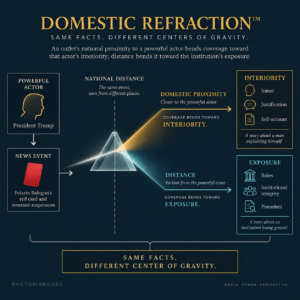
The refraction occurs in the distance between an event and the question a newsroom chooses to organize around it. The underlying facts remain available: the red card, the phone call, the FIFA decision, the regulatory basis, the institutional objections. What changes is the point toward which those facts are made to converge.
From closer to the actor, the story acquires a human center:
What did he mean?
Why did he intervene?
Was his account credible?
From farther away, the same event acquires a systemic center: What happened to the rule?
What precedent does the decision establish?
What does the intervention expose about the institution?
The difference is subtle enough to disappear beneath the label of factual accuracy. Both stories can be accurate while directing the reader’s attention toward different objects of judgment.
This is not a claim that either outlet got the facts wrong. Both are accurate. It is a claim about what “accurate” coverage still has to choose: whose voice organizes the piece, and which question the piece is actually answering.
A skeptic’s case that this is just ordinary sourcing, not a framing effect.
A fair objection: perhaps this isn’t refraction at all, just access.
CNN is a domestic outlet with direct lines to the Oval Office and can get Trump on the record; Al Jazeera has direct lines to UEFA, European federations, and the football establishment instead.
Each outlet quotes who it can reach, and the resulting frame is simply a byproduct of the rolodex, not a national lens shaping the story’s meaning.
This objection has real force, and access does explain part of the gap. But it doesn’t explain all of it.
Both outlets had equal access to the public record, i.e., Trump’s Truth Social post, FIFA’s own statement, UEFA’s statement, and still made different choices about which material to lead with, how much space to give Trump’s reasoning versus the institutional reaction, and whether to frame the story as resolved-by-explanation or open-as-precedent. Access shapes who can be quoted; it doesn’t fully determine which quote becomes the story’s spine.
What this comparison does not establish.
No — that reading doesn’t hold up against the coverage itself. CNN’s piece is not sympathetic to Trump, and Al Jazeera’s is not hostile beyond quoting real, on-record objections from UEFA and Belgium’s federation. The gap tracks proximity to the actor, not sympathy toward him.
Because the two frames lead to different follow-up questions. An intent-centered reader asks whether Trump was telling the truth about his motives. A consequence-centered reader asks whether FIFA can still enforce its own rules against anyone with enough leverage to call the president. Those are different conversations about the same event.
The pattern should generalize to any story where a powerful actor’s home outlet and a distant outlet both cover the same act like diplomatic incidents, corporate scandals, election disputes. Testing that generalization across a wider set of cases is a natural next step, not something this single comparison can claim on its own.
Find hidden frames and structures where the dots and nodes cease to be objects.
Response time. We reply within 48 hours. No automated responses — a real person reads and responds.
While you wait. Explore the nodes — Decode, Roots, Dark Matter, The Loop, and Meta are all live.
Stay in the loop. Subscribe to The Dispatch and get notified the moment the next essay goes live.
Every new essay arrives in your inbox before it reaches social media or the feed.
Long-form structural analysis that teaches you to read media — not just react to it.
One email per essay. No digests, no roundups, no promotions. Unsubscribe in one click.