

FIFA World Cup 2026…start (a whistle blows!).
On the evening of June 11, 2026, in the SoFi Stadium in Inglewood, California, approximately 1.2 billion people watched a 47-minute ceremony that was simultaneously a celebration of football, a geopolitical statement about three nations, a contractual obligation to fourteen corporate sponsors, a tourism advertisement, a diplomatic overture, and a brand activation at planetary scale. Despite being all this, nobody called it a brand activation. It was called an opening ceremony.
The distinction matters, or rather, the collapse of the distinction is the entire argument of this essay.
The FIFA World Cup 2026 opening ceremony is the most concentrated act of national branding and commercial architecture in contemporary media.
A country, in this case, three countries, communicating a constructed self-image to a global audience of a billion people in under an hour, with FIFA’s sponsor requirements embedded throughout, performed by artists whose own brands are managed assets, narrated by broadcasters whose networks have their own commercial relationships with the event, and received by audiences who have been algorithmically prepared for the emotional register the ceremony is designed to produce.
This is agora in action, profound than it apparently looks. This idea is the central piece of this essay.
This essay is an attempt to read the ceremony structurally — not to evaluate it aesthetically, not to assess whether it was a good or bad ceremony in the conventional sense, but to examine what was happening beneath its surface:
which symbolic claims were being made;
whose interests they served;
how the commercial requirements of the event colonized its ritual grammar;
…and what the result tells us about the current state of national branding, corporate sponsorship, and the rhetorical colonization of collective experience.
Durkheim and Burke on ritual as the mechanism that constitutes community and the function that thirty years of commercial integration has been progressively colonizing.
To understand what the World Cup opening ceremony has become, you need to understand what it was designed to be, and what ceremonies, as a category, are designed to do.
Emile Durkheim, writing in The Elementary Forms of the Religious Life (1912), argues that rituals do not merely celebrate existing social bonds. In fact, they constitute them. The community does not gather because it already shares values, symbols, and collective identity. The ritual gathering is how those values, symbols, and identity are periodically renewed, made vivid, and made real. The ceremony is not the expression of community, but one of the mechanisms by which community is produced.
Kenneth Burke, whose rhetorical theory provides the most analytically precise framework for the ceremony’s symbolic operations, introduces the concept of identification in A Rhetoric of Motives (1950). Identification is the rhetorical process by which a speaker establishes consubstantiality with an audience, i.e., the sense that speaker and audience share something essential: values, history, interests, identity.
Burke’s point is that identification is not a simple declaration of sameness. It is a strategic construction, produced through the selection and arrangement of symbols that invite the audience to experience itself as sharing something with the speaker. Identification, Burke argues, is compensatory to division. We identify precisely because we are divided and because the unity that the ceremony performs is not a pre-existing fact but an achievement that must be continuously renewed.
The World Cup opening ceremony, understood in Burke’s terms, is an act of identification at planetary scale. The host nation — in 2026, three host nations — is the speaker. The global audience is the audience. The ceremony’s function is to establish consubstantiality: to make the global audience feel that they and the host nations share something essential, that the tournament belongs to everyone because it belongs to the place where it is held, that the particular histories and identities of the host nations are expressions of the universal values that football represents.
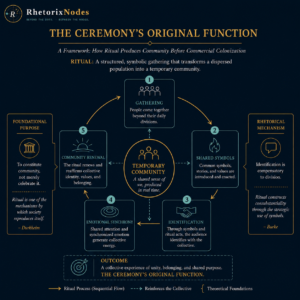
This is the ceremony’s legitimate rhetorical function. And it is also the function that commercial integration has been progressively colonizing for the past three decades.
The unprecedented symbolic arithmetic of three host nations sharing one ceremonial stage with fourteen corporate brand obligations — and what that arithmetic structurally cannot produce.
The 2026 World Cup presents a ceremonial problem that is genuinely unprecedented: three host nations, each with a distinct national brand, a distinct relationship to football’s global cultural meaning, and a distinct set of political interests in the ceremony’s symbolic output, sharing a single ceremonial stage.
The United States brings the world’s most developed national branding infrastructure — the apparatus of American cultural soft power that has been operating globally since the mid-twentieth century. The problem is that American national brand identity is, in 2026, deeply contested domestically in ways that make any single representation of it politically charged.
Canada brings a national brand whose dominant global register is defined by contrast to the United States — the polite neighbor, the multicultural middle power, the country whose identity is partly constituted by what it is not. In the context of a shared ceremony, this structural dependency becomes visible in a way that the Canadian national brand infrastructure is poorly equipped to manage.
Mexico brings a national brand with the deepest football heritage of the three — the country that has hosted the World Cup twice (1970, 1986) and whose football culture is among the most passionate and historically embedded in the world. Mexican national identity in the ceremony context carries a specific weight that the other two nations’ identities do not: it is the one host nation for which football is genuinely constitutive of national self-understanding.
These three national brand identities had to be synthesized into a single ceremonial narrative lasting 47 minutes, subject to FIFA’s symbolic requirements and the contractual requirements of fourteen official sponsors: Adidas, Coca-Cola, Wanda Group, Hyundai/Kia, Visa, Qatar Airways, Budweiser, McDonald’s, Hisense, Vivo, Byju’s, Crypto.com, Entain, and Saudi Aramco. Each purchased, at various price points, the right to associate their brand with the World Cup’s symbolic field.
The symbolic arithmetic of the ceremony is therefore: three national identities plus FIFA brand values plus fourteen sponsor brand requirements, compressed into 47 minutes, performed before a global audience.
What this arithmetic produces is not a ceremony in Durkheim’s sense. It is a brand portfolio activation in which the ceremony’s ritual grammar has been systematically colonized by commercial requirements that are structurally incompatible with genuine collective identification.
Compression is not merely a practical necessity of live broadcasting. It is the ceremony’s central communicative operation.
Diverse political interests, historical narratives, commercial obligations, and cultural identities cannot appear simultaneously in their full complexity. They must first be condensed into a symbolic vocabulary capable of being understood almost instantly by audiences across radically different cultures.
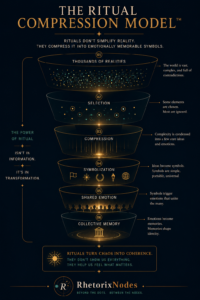
The ceremony therefore becomes an engine of symbolic reduction.
Complex realities enter the ritual as competing histories, political interests, economic relationships, and institutional constraints. They emerge as a limited repertoire of emotionally legible symbols: unity, celebration, belonging, progress, heritage, and hope.
Instead of eliminating contradiction, compression translates it into forms that can circulate globally without disrupting the ritual’s communicative coherence.
Only through this process did three national identities, FIFA’s institutional narrative, and fourteen commercial partnerships coexist within a single symbolic performance.
How Coca-Cola’s 48-year sponsorship relationship transformed commercial intrusion into ceremonial atmosphere — and what Roland Barthes called this process fifty years before it happened.
Roland Barthes, in Mythologies (1957), develops the concept of myth as a second-order semiological system in which signs that already carry meaning become the signifiers of a new, ideological meaning. The function of myth, Barthes argues, is naturalization: it transforms what is historical, contingent, and politically interested into what appears universal, timeless, and innocent.
Myth, in this sense, purifies the existence of the things it mythologizes.
The opening ceremony of the World Cup is a mythologizing apparatus in Barthes’s sense. Its function is to naturalize a specific set of propositions — about the universality of football, about the host nation’s right to represent that universality, about the sponsors’ agenda — by presenting them not as claims being advanced for political and commercial reasons but as celebrations of facts that everyone already knows.
What Barthes’s framework makes visible is that the commercial content of the ceremony undergoes exactly the same mythologizing process.
The Coca-Cola logo that appears in the broadcast is not presented as an advertisement. It is presented as a recognition: Coca-Cola is not here as a product. Coca-Cola belongs here because refreshment and passion are natural companions.
The sponsor integration is designed to make the brand’s presence feel not like an intrusion into a ritual space but like a natural feature of that space.
This transformation does not happen through logos alone. It emerges from the architecture of the ceremony itself. Every ritual functions as a communication system in which multiple actors cooperate to produce a single symbolic experience. Sponsors, performers, broadcasters, audiences, institutions, and media technologies each contribute a different layer of meaning, yet the audience encounters them as one seamless event.
The ceremony succeeds because its structure hides the complexity required to produce that feeling of unity.
Viewed structurally, the ceremony occupies the center of an interconnected network rather than existing as an isolated performance.
Symbols provide a common language. Performers embody those symbols through emotion and movement. Media extends the ritual beyond the stadium, while broadcast technologies synchronize millions of viewers into the same temporal experience.
Sponsors finance visibility, but over time they become woven into the ritual’s visual grammar instead of remaining external commercial interruptions. Algorithms continue the ceremony long after its conclusion by determining which moments circulate, repeat, and become culturally memorable.
What appears to the audience as a single uninterrupted spectacle is therefore the product of multiple systems operating simultaneously. The remarkable achievement of the ceremony lies not simply in producing emotional identification, but in making this entire architecture disappear beneath the experience itself.
It is precisely this disappearance that Roland Barthes describes as myth. Once the structure becomes invisible, its products begin to feel natural. Commercial relationships cease to register as commercial. They become part of the ceremony’s atmosphere, accepted with the same inevitability as the stadium, the anthem, or the trophy itself.
This is a profound rhetorical achievement, accomplished gradually, across thirty years of World Cup sponsor integration.
The mechanism is what Robert Cialdini calls the principle of familiarity: repeated exposure increases acceptance, and acceptance shades into naturalness. The first time a sponsor logo appeared in a World Cup broadcast, it was noticed as an intrusion. By the tenth tournament, it was part of the visual grammar of the event.
By 2026, its absence would be noticed as an anomaly. That’s how a global ceremony naturalizes signs associated with it.
Naomi Klein, whose analysis of brand culture in No Logo (1999) remains the most systematic account of corporate branding as cultural colonization, would recognize this process immediately. The World Cup is, in Klein’s terms, no longer a football tournament that has sponsors. It is a brand portfolio of which football is one element.
The ceremony traverse the brands’ identity into a tangible experience, where football also happens to exist.
Entman’s framing theory applied to the ceremony’s symbolic hierarchy: which national identity achieved dominance, which were subordinated, and what Saudi Aramco’s presence reveals about the commercial colonization of ritual.
When three national identities, a global sporting body’s brand values, and fourteen corporate sponsors compete for dominance in a 47-minute ceremony, the result never translates as a neutral synthesis. It explicitly creates a defined hierarchy: a winner, several runners-up, and several symbolic presences that the ceremony absorbed without meaningfully representing.
In this setting, one of the participants inevitably takes the cherry home. Someone clearly dominates.
Reading the ceremony’s symbolic output through Robert Entman’s framing theory, which argues that frames define problems, diagnose causes, make moral judgments, and suggest remedies, allows us to identify which of the competing symbolic claims achieved dominance and which were subordinated.
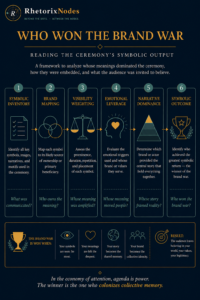
The dominant frame of the 2026 ceremony was American. America took the cherry home.
Mexico and Canada were not invisible: they were present, represented, given ceremonial time. But the aesthetic register, the emotional grammar, the narrative architecture of the ceremony was organized around American cultural production: the entertainment values of Hollywood, the scale aesthetics of American sports spectacle, the musical vocabulary of American pop. Mexico’s presence was authentic but contained within a ceremonial architecture whose grammar was not theirs. Canada was nearly invisible as a distinct symbolic presence.
The most symbolically interesting sponsor presence in the ceremony was Saudi Aramco, the state oil company of Saudi Arabia, which is the world’s largest oil producer and one of the primary drivers of the carbon emissions that produce the climate conditions under which the 2026 World Cup was held in extreme heat requiring unprecedented cooling infrastructure.
Saudi Aramco’s presence in the opening ceremony of a tournament whose host cities are in climate-stressed regions is a case study in what Michael Walzer would call the invasion of one sphere by the logic of another: the commercial sphere’s logic colonizing the symbolic sphere in which Saudi Aramco’s presence would be, to put it mildly, contested.
The ceremony did not contest it. The ceremony naturalized it, in Barthes’s sense: Saudi Aramco’s logo appeared where it was contractually entitled to appear, and its presence was neither celebrated nor acknowledged. It was simply there; as natural as the grass on the pitch, as innocent as the opening chord, and as significantly present as the football in the stadium.
This is the mechanism that criticism of the FIFA World Cup 2026 opening ceremony rarely names precisely.
The controversy is not that sponsors were present. Sponsorship in sport is expected, documented, and unremarkable. The controversy is structural: that the ceremony’s mythologizing apparatus is specifically designed to prevent the sponsor presence from registering as controversial.
The critique is not of individual brands. It traverse deeper into the structural layer, addressing the architecture that makes individual brands invisible, and the decision to build that architecture over thirty years of uninterrupted commercial integration.
Hall’s encoding/decoding framework and the polysemic presence of celebrity performers whose managed brand identities are as much a product of the ceremony as the spectacle itself.
The performers at the opening ceremony were not simply artists performing at a major event. Once they are analyzed through their symbolic presence and brand value, they become brand vehicles. The FIFA World Cup 2026 opening ceremony featured performers who were entities with their own carefully managed brand identities, activated through their association with the ceremony. Their presence simultaneously contributed to the ceremony’s symbolic content while extending their own brand marketing
The modern performer of sufficient stature is a brand in Klein’s sense: their meaning exceeds their function. More than being simply musicians or dancers, they are constellations of associations, having values, aesthetics, politics, histories, fanbases, that can be activated in specific contexts to produce specific symbolic effects.
The selection of performers for a World Cup opening ceremony is therefore a brand portfolio decision as much as an artistic one. Each performer brings their brand associations to the ceremony. A performer whose brand is associated with political controversy brings that controversy into the ceremony’s symbolic field. The casting process is simultaneously artistic and actuarial, a calculation of brand risk and brand value that operates alongside, and often in tension with, the purely artistic consideration of who would give the best performance.
Shakira’s appearance at the Mexico City ceremony is the paradigm case. Her brand carries decades of accumulated Latin American cultural capital, global pop recognition, and a personal narrative of resilience that the ceremony’s curators could encode as authentic Latin representation. What the ceremony encodes as cultural celebration, a more skeptical audience decodes as the purchase of credibility. For them, it is the hiring of a brand whose authenticity does the symbolic work that no corporate sponsor logo could perform. This is Stuart Hall’s encoding/decoding at its most precise: the preferred reading is homecoming; the oppositional reading is brand activation dressed as belonging.
Stuart Hall’s encoding/decoding framework, developed in Encoding/Decoding (1980), is illuminating here. Hall argues that media messages are encoded with a preferred meaning by producers, but decoded through their own cultural frameworks by audiences, producing preferred, negotiated, or oppositional readings. The ceremony encodes the performers’ presence as a celebration of cultural diversity and artistic excellence. But different audiences decode it differently: a performer encoded as a symbol of Latin American cultural pride may be decoded by one audience as genuine representation and by another as commercial appropriation.
McCombs and Shaw on what the ceremony makes the world think about and Debord on why thinking about it is not the same as participating in it.
Maxwell McCombs and Donald Shaw’s agenda-setting theory, developed in The Agenda-Setting Function of Mass Media (1972), argues that the media does not tell people what to think, in fact it tells them what to think about. The World Cup opening ceremony is, in this framework, the most powerful single act of agenda-setting in contemporary sports media.
In the pre-social-media era, the ceremony set a single agenda. In 2026, the ceremony sets multiple simultaneous agendas, each disaggregated by the algorithmic personalization of social media platforms.

The agenda that no major media organization and no algorithmic platform foregrounds is the commercial one: the specific contractual relationships that determined what appeared in the ceremony, whose brand was visible and whose was not, what symbolic claims were available to be made and what claims were foreclosed by sponsor obligations.
This is what Guy Debord, in The Society of the Spectacle (1967), means by the spectacle as a social relation among people mediated by images.
The opening ceremony is the spectacle in Debord’s sense, not simply an impressive visual event, but a relationship of consumption masquerading as a relationship of participation.
The audience is invited to experience itself as a participant in a global celebration of football and human unity. What it is actually doing is consuming a carefully constructed brand experience in which its emotional engagement is the commodity being produced.
Why the most valuable commercial position in the opening ceremony is the one that has become invisible — and why that invisibility costs decades to build and cannot be purchased in a single contract cycle.
The RhetorixNodes framework of the Opacity Premium™ describes the counterintuitive value generated by strategic illegibility in an attention economy of radical transparency. The most powerful brands are not the ones with the most visible presence but the ones whose presence has been so thoroughly naturalized that it is no longer perceived as presence at all.
The World Cup opening ceremony is the highest-stakes demonstration of the Opacity Premium™ currently available for analysis.
The sponsors who gained most from the ceremony are not the ones whose logos were most prominently displayed. They are the ones whose brand presence was so thoroughly embedded in the ceremony’s visual and emotional grammar that viewers experienced it not as advertising but as atmosphere. These are the sponsors who have been integrating with the World Cup long enough — across multiple tournaments, multiple decades — that their presence has achieved naturalization in Barthes’s sense: it no longer registers as commercial intrusion because it has become part of the natural order of what a World Cup looks and feels like.
Coca-Cola is the paradigm case. Continuous FIFA World Cup sponsor since 1978 with 48 years of integration across twelve tournaments. The result is that Coca-Cola’s presence at a World Cup feels not like sponsorship but like belonging. The red and white of the Coca-Cola brand doesn’t translate as an advertisement but as a feature of the tournament’s aesthetic identity, as natural as the green of the pitch and the gold of the trophy.
The ceremony’s sponsor hierarchy is a perfect mirror of the platform economy’s concentration dynamics: the incumbents accumulate advantage that makes their position self-reinforcing, while new entrants must purchase visibility precisely because they cannot yet afford invisibility.
The structural foreclosures enforced by sponsor obligations and diplomatic requirements and why Burke’s identification is compensatory to exactly the divisions the ceremony cannot acknowledge.
Every rhetorical act is defined not only by what it says but by what it cannot say… the claims that are foreclosed, the subjects that are unspeakable, the political realities that the ceremony’s commercial and diplomatic requirements make it impossible to acknowledge.
Silence, however, is rarely empty.
Every public ritual operates within a limited field of visibility. Some realities are illuminated until they become unforgettable. Others remain outside the beam, not because they cease to exist, but because the architecture of the ceremony never permits them to enter its symbolic center.
Visibility itself becomes a rhetorical resource.
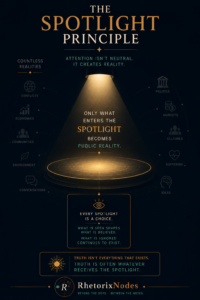
The diagram illustrates this communicative constraint. Rituals organize the visibility of reality. Their persuasive force depends less on fabrication than on selective illumination.
The ceremony therefore performs a continuous act of selection. It concentrates public attention on a carefully constructed symbolic world while allowing countless competing realities to remain structurally peripheral. The audience experiences this concentration as completeness, even though it is necessarily partial.
This helps explain why the opening ceremony could celebrate unity while remaining silent about climate stress, sponsor contradictions, human rights controversies, and FIFA’s own institutional history. These realities existed throughout the event, yet they never entered the illuminated space where collective meaning was being produced.
The 2026 opening ceremony could not say that the tournament’s host cities are in climate-stressed regions requiring unprecedented cooling infrastructure, partly as a result of emissions produced by one of its official sponsors.
It could not say that several official sponsors have significant human rights records that are in direct tension with the unity and inclusion values that the ceremony was performing and signaling.
It could not say that FIFA’s organizational structure has been subject to sustained credible allegations of corruption across the same decades during which the opening ceremony’s ritual grammar was being colonized by commercial interests.
It could not say any of these things because saying them would have been incompatible with the ceremony’s primary rhetorical function and symbolic meanings, which is precisely what identification entails.
It is the establishment of consubstantiality, at its highest form, between the global audience and the proposition that football, this tournament, and this ceremony represent something universal and good.
Kenneth Burke’s insight is precisely applicable here: identification is compensatory to division. The ceremony performs unity precisely because the reality it performs upon is divided — nationally, economically, ecologically, politically. The ceremony’s job is not to reflect reality but to temporarily suspend it by producing a 47-minute interlude in which the audience can experience something it does not otherwise have access to: the feeling of belonging to a global community that shares values, that celebrates together, that is, for this moment, one.
Roland Barthes gave us the framework for this question fifty years before the World Cup made it urgently practical: myth does not deny things. It purifies them. It makes them innocent. The ceremony is not a lie. It is a myth and like all myths, its function is to naturalize a specific set of interests as universal truths, to make what is historical and contingent appear eternal and self-evident.
The ceremony happened. A billion people watched it. Most of them felt something real. The feeling was real. The structure that produced it was also real. Both things are true simultaneously and the ability to hold them simultaneously is exactly what structural media literacy is for.
Viewed together, the concepts explored throughout this essay reveal that the opening ceremony functions less as a sequence of performances than as an integrated communication system. Each theoretical perspective illuminated one layer of that system. Combined, they describe the operating logic through which modern public rituals construct collective experience.
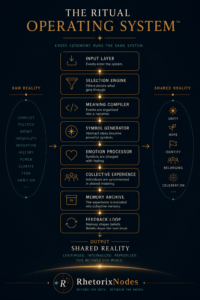
The diagram should not be read as an alternative to Burke, Barthes, Hall, Entman, McCombs, or Debord. It is an attempt to visualize how their insights converge within a single communicative structure. The World Cup opening ceremony is where these theories cease to exist as isolated ideas and begin operating simultaneously.
Only when viewed together does the ceremony reveal itself as a complete communication system rather than a televised performance.
And that’s how:
The ceremony sold itself beautifully. And no one objected!
From a media theory perspective, the FIFA World Cup 2026 opening ceremony was not simply a celebration. It was a brand portfolio activation at planetary scale: three host nations, FIFA brand values, and 14 corporate sponsors competing for symbolic dominance in 47 minutes of live global ritual. Kenneth Burke’s rhetoric of identification, Roland Barthes’s theory of myth, and Naomi Klein’s analysis of brand colonization are the most precise analytical frameworks for what the ceremony actually did.
Barthes in Mythologies (1957) defines myth as a second-order semiological system that naturalizes what is historical, contingent, and politically interested, making it appear universal, timeless, and innocent. The World Cup opening ceremony is a mythologizing apparatus in this sense. It transforms commercial sponsorship obligations into celebrations of universal human values. The Coca-Cola logo does not appear in the broadcast as an advertisement. It appears as a recognition — as natural a feature of the tournament as the grass on the pitch. This naturalization is the result of 48 years of continuous FIFA sponsorship since 1978.
Burke’s concept of identification, developed in A Rhetoric of Motives (1950), describes the rhetorical process by which a speaker establishes consubstantiality with an audience. Burke argues that identification is compensatory to division: we identify precisely because we are divided. The World Cup opening ceremony is an act of identification at planetary scale — performing unity precisely because the reality it performs upon is nationally, economically, and ecologically divided.
The Opacity Premium™ is a RhetorixNodes analytical framework describing the counterintuitive value generated by strategic illegibility in an attention economy of radical transparency. The most valuable sponsor position in the opening ceremony is not the most visible one. It is the one that has become invisible through sustained naturalization. Coca-Cola has been an official FIFA sponsor since 1978 across 12 tournaments — its presence no longer registers as commercial intrusion because it has become part of the natural order of what a World Cup looks like. New sponsors pay for visibility. Established sponsors pay for invisibility.
The 14 official FIFA World Cup 2026 sponsors were Adidas, Coca-Cola, Wanda Group, Hyundai/Kia, Visa, Qatar Airways, Budweiser, McDonald’s, Hisense, Vivo, Byju’s, Crypto.com, Entain, and Saudi Aramco. The most structurally significant presence in the ceremony was Saudi Aramco — the world’s largest oil producer — whose logo appeared in a ceremony held in climate-stressed host cities requiring unprecedented cooling infrastructure partly produced by the fossil fuel industry Saudi Aramco represents.
McCombs and Shaw’s agenda-setting theory (1972) argues that media does not tell people what to think but what to think about. The World Cup opening ceremony is the most powerful single act of agenda-setting in contemporary sports media. In 2026, this agenda is disaggregated by algorithmic personalization into multiple simultaneous national agendas. The agenda no major platform foregrounds is the commercial one: the contractual relationships that determined what appeared, whose brand was visible, and what symbolic claims were foreclosed by sponsor obligations.
The 2026 opening ceremony could not say that its host cities are in climate-stressed regions partly produced by one of its official sponsors. It could not say that several official sponsors have human rights records in direct tension with the unity and inclusion values the ceremony performed. These silences are structural, not incidental — foreclosed by the ceremony’s primary rhetorical function: identification, the establishment of consubstantiality between the global audience and the proposition that football and this ceremony represent something universal and good.
Debord in The Society of the Spectacle (1967) defines the spectacle not as an impressive visual event but as a social relation among people mediated by images — a relationship of consumption masquerading as a relationship of participation. The World Cup opening ceremony is the spectacle in Debord’s sense. The global audience is invited to experience itself as a participant in a celebration of human unity. What it is actually doing is consuming a carefully constructed brand experience in which its emotional engagement is the commodity being produced.
Find hidden frames and structures where the dots and nodes cease to be objects.
Response time. We reply within 48 hours. No automated responses — a real person reads and responds.
While you wait. Explore the nodes — Decode, Roots, Dark Matter, The Loop, and Meta are all live.
Stay in the loop. Subscribe to The Dispatch and get notified the moment the next essay goes live.
Every new essay arrives in your inbox before it reaches social media or the feed.
Long-form structural analysis that teaches you to read media — not just react to it.
One email per essay. No digests, no roundups, no promotions. Unsubscribe in one click.