

Each December, several hundred million people open an app to be told who they were that year.
Spotify Wrapped appears as a slide deck: a handful of cards naming a top artist, a top song, a personality-adjacent superlative, a minute count rendered as if it were a form of virtue.
Within days it colonizes group chats and Instagram Stories with the reliability of a holiday.
What makes Wrapped interesting is not that it is popular; ad products go viral constantly. What makes it worth pausing on is the specific shape the popularity takes: not consumption of an ad, but performance of a rite. People do not merely see Wrapped. They do Wrapped, i.e., checking it at a particular hour, screenshotting it, defending or mocking their own numbers in public.
This essay asks what kind of engineering produces that behavior, and argues that the answer is closer to liturgy than to marketing copy while taking seriously the case that calling it liturgy at all is a category mistake.
– Spotify Wrapped repackages a company’s most ordinary asset, i.e.,listening logs kept for algorithmic and advertising purposes, into an annual rite with its own calendar, vocabulary, and public confession.
– The mechanism is not disclosure but translation: raw behavioral data is recast as scripture-like verdicts on the self (“you’re in the top 0.5% of listeners”), and this essay names that translation Data Liturgy™.
– Data Liturgy™ has two working parts: Behavioral Scripture™, the re-narration of exhaust data as revealed identity, and Communion of Metrics™, the synchronized public act of comparing and sharing that data.
– The strongest objection: this is gamified marketing, not ritual — Durkheim’s collective effervescence was theorized for bodies assembled in the same room, not parallel Instagram Stories.
– The honest limit: a rite designed by a shareholder-owned company for a retention metric cannot fully escape that origin, however sincerely individual users experience it.
How a product-release date, repeated enough times, came to function like a fixed calendrical rite rather than a campaign.
Ritual theorists from Émile Durkheim onward treat calendrical fixity as load-bearing, not incidental: a rite recurs on a schedule the community holds in common, and the schedule itself becomes part of what is venerated.
Christmas is not just a story; it is a date everyone agrees to observe the story on.
Wrapped’s genius was procedural before it was creative — Spotify simply declared early December the moment the year’s data would be revealed, adjacent enough to existing year-end list culture to borrow its emotional register, but distinct enough to own its own name.
After several annual cycles, early December now functions the way Advent functions for a liturgical calendar: a known season of anticipation before a release that everyone has agreed, without ever voting on it, to treat as meaningful.
Victor Turner’s account of ritual process describes a liminal phase, i.e., a threshold state between an old status and a new one, and Wrapped sits neatly at the threshold most people already recognize: the closing of one year and the unwritten resolutions of the next.
The platform did not invent the human appetite for a year-end reckoning. It annexed a pre-existing liminal window and installed itself as the instrument of the reckoning.
Naming the rhetorical step that turns ordinary exhaust data into what reads like a verdict on the self.
Every play, skip, replay, and pause Spotify logs already exists for unglamorous reasons: recommendation models, ad targeting, churn prediction. This is ordinary behavioral exhaust, the same kind every platform collects.
Wrapped’s distinctive move is rhetorical, not technical. It takes that exhaust and re-narrates it in the declarative voice of a verdict about the self.
“Your top artist was…” is a sentence built to read less like a log entry and more like an oracle. This essay calls that translation Behavioral Scripture™: data that has been rhetorically elevated from a record of what a person did into a statement of who a person is.
The move mirrors a familiar religious mechanic — the consecration of ordinary substance into sacred substance, where bread does not change chemically but changes categorically, through ritual language and context.
Wrapped performs the secular equivalent: the same skip-and-replay data that feeds an ad auction the other 364 days of the year is, for one week, consecrated into an identity claim, complete with percentile rankings that function like a congregation’s implicit hierarchy of devotion.
The transformation can be reduced to a single movement: the record remains materially similar while its rhetorical status changes.
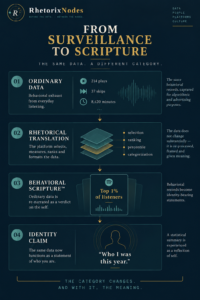
What changes, then, is less the underlying behavior than the meaning assigned to it.
This is also where the framework connects to Custodial Bias™ — the platform is not a neutral recording instrument but a custodian that decides which behaviors are legible enough to become scripture, and which are quietly left as noise.
Why the public sharing, not the private viewing, is the actual mechanism doing the work here.
Durkheim’s collective effervescence: the charge generated when a group perceives itself perceiving the same sacred object at the same moment, was theorized for physical assembly.
Wrapped produces a networked analogue: millions of people, dispersed but temporally synchronized, performing an identical act (checking, screenshotting, posting) within the same seventy-two-hour window, each aware that everyone else is doing it too.
This essay names that synchronized, public exchange the Communion of Metrics™: not a private glance at a dashboard but a shared symbolic meal made of statistics, eaten in public and compared at the table.
The comparison is the point: a top artist becomes a badge to defend, a low minute-count becomes a joke to preempt, a shared niche artist becomes the basis of an in-group nod between strangers.
The timing is not incidental to Spotify’s business either: the ritual lands during the lowest-friction, highest-attention window of the year, converting a moment when Attention Depletion Economy™ dynamics would otherwise favor competitors’ content into a week where the platform itself becomes the content everyone is discussing.
Taken together, these mechanisms form a loop. A year’s listening becomes behavioral exhaust; the platform decides what portion of that exhaust becomes legible; the selected data is re-narrated as identity; identity is made public through comparison; and the annual repetition turns the sequence itself into a cultural expectation.
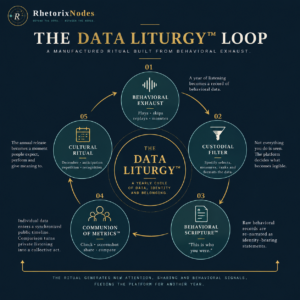
The Data Liturgy™ Loop: behavioral exhaust is converted into identity-bearing narrative, circulated as public comparison, and stabilized through annual repetition. The resulting ritual generates another round of attention, sharing, and behavioral signals.
Steelmanning the case that this essay’s entire ritual framing is, at bottom, a category error.
The most serious challenge to calling any of this ritual is not cynicism about Spotify; it is fidelity to the theorists being borrowed from.
Durkheim’s effervescence required literal co-presence:
bodies assembled, arousing one another through shared sensory experience no screen reproduces. Turner’s liminality involved genuine risk: initiates who entered a liminal phase could be transformed or could fail, with real social consequences either way.
Nothing is at stake in opening Wrapped. No community authored it, no elder mediates it, and no version of it existed before a product team decided it should exist to lift December engagement numbers.
On this view, dignifying a gamified year-in-review with the vocabulary of the sacred does exactly what Spotify’s own PR would want: it launders an engagement funnel into something that sounds like meaning, when the honest description is simpler, i.e., clever data visualization, a frictionless share template, and a well-timed marketing calendar.
Calling it liturgy, the objection goes, is a category error that flatters both the platform and the essay that takes it seriously.
The disagreement becomes clearer when the same structural features are placed beside one another.
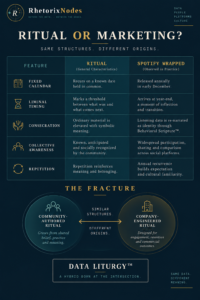
The comparison reveals the precise tension: Wrapped reproduces several recognizable structures of ritual while retaining the authorship and incentives of a commercial platform.
Conceding real ground on authorship and risk, while arguing the core claim survives the concession.
The objection is right that co-presence in Durkheim’s original sense is absent, and right that no community authored Wrapped from below.
But ritual theory has already had to answer this challenge once before, for religion practiced across dispersed diasporas and now for publics that assemble only through networks. Danah boyd’s account of networked publics argues that synchronized, mutually visible performance across a dispersed audience can generate the same self-reinforcing awareness that physical assembly does, because what effervescence actually requires is perceived simultaneity, not shared oxygen.
Wrapped supplies that: the awareness that everyone is looking at their own version of the same ritual object in the same week is precisely what turns individual curiosity into a Communion of Metrics™.
Where the objection lands hardest is on risk and authorship and the honest response is not to argue those away but to name Wrapped for what it structurally is: a manufactured ritual, engineered top-down for a business outcome, rather than an emergent one authored by the community that performs it.
Data Liturgy™ is offered as a term for exactly that hybrid, not as a claim that Wrapped is indistinguishable from a rite with centuries of communal authorship behind it.
Three places this framework declines to overreach beyond what the evidence actually supports.
Three limits deserve stating plainly.
First, obligation: genuine ritual typically carries real social cost for non-participation, and opting out of Wrapped costs a user nothing beyond a missed conversation, This is a rite people can decline without consequence, which is not true of most rites the term ritual usually describes.
Second, sincerity is unmeasured: Spotify has never published, and has no incentive to publish, data on how many participants experience Wrapped as meaningful self-reflection versus how many perform the sharing purely as social currency; this essay’s claim is about the structure of the experience, not the interior state of every participant.
Third, and most important, the rite is legible only inside a single company’s interface. Unlike community-authored ritual, it can be redesigned, discontinued, or monetized differently at any point by people who owe the participants nothing.
Data Liturgy™ is meant to hold that tension rather than resolve it: real enough in its effects on attention and identity-narration to merit the vocabulary of ritual, manufactured enough in its authorship to never be mistaken for the thing it borrows the vocabulary from.
None of this makes Wrapped sinister. It makes it a case study in a broader pattern this platform has tracked before, under other names: a system’s Cognitive Entropy Theory™ pressure, i.e., the open, unresolved messiness of a year’s actual listening, gets compressed, once a year, into a closed, shareable narrative small enough to post.
The compression is what people are actually thanking Spotify for when they say Wrapped gets them.
It is not that the platform knows them uncannily well. It is that it hands them, once a year, a story about themselves finished enough to stop revising.
Both, and the essay’s central claim is that the distinction is less stable than it sounds. Wrapped is unambiguously a marketing campaign in its origin and incentive structure. But it also reproduces the formal features ritual theorists use to define ritual: fixed calendar, liminal timing, consecration of ordinary material, and synchronized public performance. This essay calls the hybrid Data Liturgy™ rather than picking one label and discarding the other.
Data Liturgy™ is the process by which a platform converts extracted behavioral data into a ceremonial form, i.e., a fixed annual moment, a shareable script, a public performance, that borrows the structure of religious or civic ritual without inheriting its communal authorship. It has two working parts, defined below.
Ordinary data is descriptive: a log of what happened. Behavioral Scripture™ is the same data after it has been rhetorically re-narrated in a declarative, identity-conferring voice, i.e., the shift from “you played this song 214 times” to “you’re in the top 1% of fans,” which reads as a verdict on the person rather than a record of an action.
Ordinary sharing is asynchronous and open-ended. Communion of Metrics™ describes sharing that is temporally compressed into a known window, mutually visible in the sense that participants know everyone else is performing the same act at the same time, and comparative by design. The point is not the individual post but the implicit ranking created once many posts of the same format sit side by side.
Unknown, and this essay is explicit about that limit. The argument concerns the structure of the experience, not a claim about the sincerity of any individual participant. High participation is consistent with genuine reflection, pure social performance, or, most plausibly, a mixture that varies person to person and year to year.
The mechanism is portable to any platform holding a large, ownable behavioral dataset and a plausible calendrical moment to anchor it to… several have already tried variants. What is harder to replicate is the decade of habituation that makes early December feel, at this point, like a date rather than a campaign.
No — if anything the framework sharpens the critique rather than softening it. Naming the mechanism Data Liturgy™ makes explicit that the data being consecrated into scripture was collected for unrelated commercial purposes the other fifty-one weeks of the year. Recognizing the ritual’s power is a precondition for asking who authored it and for what end, not a reason to stop asking.
Find hidden frames and structures where the dots and nodes cease to be objects.
Response time. We reply within 48 hours. No automated responses — a real person reads and responds.
While you wait. Explore the nodes — Decode, Roots, Dark Matter, The Loop, and Meta are all live.
Stay in the loop. Subscribe to The Dispatch and get notified the moment the next essay goes live.
Every new essay arrives in your inbox before it reaches social media or the feed.
Long-form structural analysis that teaches you to read media — not just react to it.
One email per essay. No digests, no roundups, no promotions. Unsubscribe in one click.