

There is a standard critical reflex when the subject of Taylor Swift arises in intellectual discourse: a kind of pre-emptive defensiveness, as if to engage seriously with her work is to confess an embarrassing lapse in taste.
This essay refuses that posture.
The interesting question about Swift is not whether she is good or whether she deserves her audience, those are reviewer’s questions, but rather: what rhetorical and structural architecture has she constructed, at the level of text, paratext, and community formation, that makes her cultural product not merely popular but genuinely habitable?
The distinction matters. Popular art is consumed. Habitable art is lived in. One passes through you; the other becomes part of the environment in which you interpret your experience. Swift has built the latter, and she has done so through a set of interlocking rhetorical mechanisms that operate simultaneously across the lyrical, symbolic, parasocial, and communal registers. This essay decodes those mechanisms with the rigor they deserve.
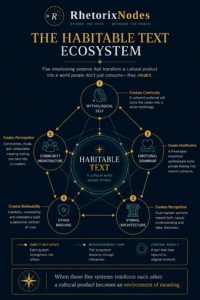
The argument proceeds in five movements:
The conclusion proposes a theoretical frame — drawn from Bourdieu, Aristotle, and media ecology — that places this ecosystem within a longer intellectual tradition.
The conclusion proposes a theoretical frame — drawn from Bourdieu, Aristotle, and media ecology — that places this ecosystem within a longer intellectual tradition.
How Swift turns a career into serial mythology, making every new album retroactively reframe everything that came before it.
Swift’s primary structural move is not songwriting — it is autobiography as mythology. Every album functions as a chapter in a single, continuous narrative about a coherent self-moving through the world.
This is architecturally distinct from the standard pop operating model, which tends toward reinvention: the artist of each era is notionally a new person, and the previous version is treated as a husk. Swift inverts this logic. She accumulates. The 2006 debut is not erased by Reputation; it is absorbed into it, its naivety now legible as a prior stage of the same developing consciousness.
The consequence is structural compulsion: you cannot fully understand the new thing without the old thing. This is not accidental. It is an ecosystem architecture that rewards long-term engagement and penalizes casual listening. The album is not the unit; the career is. And a career-length narrative is, by definition, never complete—there is always another chapter, another recontextualization, another retrospective discovery. Instead of buying a product, the listener buys into a serial.

Each ‘era’ — a term that originated in fan discourse but has been institutionalized by Swift herself through the Eras Tour — functions as a distinct emotional and aesthetic chapter: its own color palette, its own sonic register, its own emotional landscape.
The era framework means that fans do not merely remember when they discovered a song; they remember which era they were in when it found them. Time itself becomes organized by Swift’s narrative. This is not metaphorical, but a genuine restructuring of autobiographical memory around an external cultural text, which is precisely what mythology does.
How specificity, universalization, and retrospective reframing work together to produce safe catharsis at scale.
Swift’s songs operate on a three-beat emotional structure that is, in its deep logic, classically Aristotelian.
The First Beat
The first beat is granular specificity: a detail so precise, so oddly particular, that it signals authenticity. “You’ve got your mother’s necklace.” “She wore short skirts, I wore T-shirts.” “You keep his picture in your drawer.”
The hyper-particular activates personal memory through what cognitive linguists call schema-priming: the listener’s brain interprets this level of specificity as truth rather than performance, and begins searching its own archive for the associated feeling. The song doesn’t just describe her experience, but also unlocks yours.
The second beat is sudden universalization. The bridge or chorus abstracts the particular into something immense: “We are never getting back together.” “It was rare, I was there.” “I had the time of my life fighting dragons with you.” The zoom-out performs a transfer of ownership.
The song ceases to be hers and becomes collective property. The “I” dissolves into a “we” that includes everyone in the room, or everyone listening alone in their car. This is the moment of communion that distinguishes pop music from other narrative art forms — the lyric becomes a shared utterance.
The third beat is retrospective reframing. Swift consistently writes from a position of having survived something. The narrator is never purely in the middle of the crisis without a vantage point. Even in her most devastated songs, there is a grammatical structure of retrospection — a past tense that implies a present from which the past can be surveyed.
This produces an experience of what we might call safe catharsis: the listener can undergo the emotion without being destabilized by it, because the implied frame of the narrating voice is I made it through this. The grief is real, but the griefer is intact.

This three-beat structure, i.e., particular incident, felt recognition, shared judgment, is Aristotle’s account of how pathos works in rhetoric. Effective emotional appeal in the Rhetoric is not sentiment dumped on an audience; it is the systematic construction of conditions in which the audience moves through recognition to judgment on their own.
Swift’s best lyrics do not tell you how to feel. They engineer a set of conditions — lyrical, melodic, rhythmic — in which you arrive at the feeling yourself. The distinction is the difference between manipulation and genuine persuasion, and it is what separates her work from sentimentality.
How Swift layers a private mythology for devoted fans over universally legible symbols—simultaneously, in the same lyric.
Swift operates two parallel symbolic registers simultaneously, and the relationship between them is the heart of her communal architecture. The first register is the personal symbol system: images and objects that recur across her catalog and accumulate meaning through repetition.
The cardigan. Red lips. Golden hour. Driving at night. Staircases. Windows. Scars. These symbols begin as concrete, imagistic details, but they develop intratextual weight as they reappear across albums. By the time the cardigan appears in Folklore as a central motif, it carries the freight of every prior domestic symbol in her work—the worn thing, the intimate thing, the thing that survived.
This intratextual accumulation creates what we might call a private mythology accessible only to those who have followed the full arc. The devoted listener can decode the cardigan in a way the casual listener cannot. This is not exclusion, but layering. The casual listener still gets the image. The devoted listener gets the resonance. The same lyric operates at two depths simultaneously.
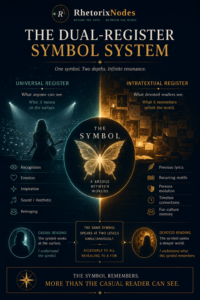
The second register is the universal symbol system: seasons, colors, physical thresholds. Fall as loss. Spring as hope. Red as intensity and danger. Blue as melancholy and distance. Gold as nostalgia and value. Doorways, bridges, airports as liminal spaces of decision and transition. Instead of innovation, these symbols are among the oldest symbolic associations in the Western tradition, traceable through Romanticism, through the Psalms, through Greek lyric poetry. Their age is precisely their power. They do not require any prior knowledge of Swift to register as emotionally significant.
The genius of the dual-register system is that it produces a tiered community without creating a hierarchy of value. The casual listener and the devoted fan are not getting different amounts of the same thing; they are getting genuinely different things from the same text. This is the deep structure of what we might call a cathedral text, i.e., a cultural object that is meaningfully different at every level of engagement, none of which is the ‘real’ one.
How Swift constructs legible interiority through selective disclosure and why this produces a different kind of authority than expertise.
Swift is unusual in constructing what we might call a legible interiority: through lyrics, interviews, social media, Easter eggs, and selective biographical disclosure, she maintains the appearance of radical transparency while controlling the narrative with extraordinary precision. This is a sophisticated rhetorical operation.
The openness is real — she does disclose more than most pop artists — but the openness is curated. What is visible has been chosen. What is concealed has been chosen. The effect is a sense of unmediated access to a private person, which is, of course, a highly mediated construction.
The parasocial dynamic this produces is specific and powerful. Fans do not merely admire Swift from a distance; they believe they know her. And belief in knowledge creates stake. When something happens to Taylor like a breakup, a feud, a legal battle, a health moment, it does not merely generate interest; it generates anxiety, protectiveness, relief. The community has an investment in her outcomes because they understand her, or believe they do, as they understand a friend.
In classical rhetoric, ethos, the credibility of the speaker, is built through the demonstration of practical wisdom, moral virtue, and goodwill toward the audience. Swift’s ethos operates differently — through a different but equally classical channel: the perceived authenticity of the confessing subject. She does not just claim expertise, but experience as well. And experience, when rendered with the hyper-specific detail that makes her lyrics work, produces a credibility that is harder to falsify than any credential.
This is the ethos of the diarist, not the expert. And the diarist who writes with sufficient precision and self-awareness becomes, paradoxically, a figure of authority. It’s not because they know more than you, but because they have noticed more, articulated more, survived more and written it down. The literary tradition of the confessional lyric (Plath, Sexton, Lowell) understood this dynamic. Swift has operationalized it at a scale those poets could not have imagined.
How fan interpretive labor, Easter egg architecture, and the Taylor’s Versions project create a cultural object that never fully closes.
The fan community does not merely consume Swift’s work. It produces interpretive labor that extends and amplifies the cultural object.
Fans decode Easter eggs embedded in album artwork, music videos, merchandise, and social media posts. They build lyric analysis threads. They argue about the identities of unnamed figures in songs. They construct elaborate timelines linking biographical events to musical choices. This interpretive labor is not peripheral to the cultural object; it is, in a real sense, part of it.
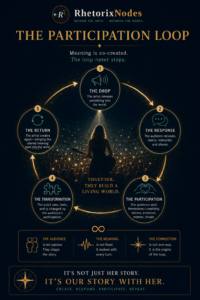
Swift facilitates this by maintaining strategic opacity on certain interpretive axes while offering excessive clarity on others. She will confirm the emotional truth of a song while leaving its biographical referents ambiguous. She will hide precise future announcements in plain sight while making them invisible without the right frame of reference.
This calibrated opacity creates the conditions for what we might call generative hermeneutics: an interpretive practice that is productive rather than merely receptive, that creates new meaning rather than only receiving it.
Pierre Bourdieu’s concept of the cultural field is useful here. A field, in Bourdieu’s account, is a structured space of positions defined by the distribution of relevant capital, where capital can be economic, social, cultural, or symbolic. What Swift has produced is precisely a field: a structured community in which participants occupy positions determined by their command of Swift-specific cultural capital (knowledge of the catalog, ability to decode Easter eggs, depth of investment in the biographical narrative), and in which those positions carry social stakes within the community.
The community polices its own boundaries through the distribution of this capital. The casual fan who misremembers a lyric is marked as a lower-capital participant. The devotee who decoded a hidden track announcement hours before its official reveal accumulates social capital within the field.
Swift benefits from this structure without engineering it directly. And the community self-organizes around the cultural object she has provided, generating its own hierarchies and its own symbolic rewards.
What sustains the field over time is a deliberate re-entry architecture: a set of structural features that ensure the cultural object never fully closes, that there is always something to find, reexamine, or return to. The mechanisms are multiple.
Easter eggs discovered over weeks after a release extend the album’s active interpretive period. Vault tracks (bonus songs unavailable on the standard album) create supplementary content that rewards early adopters and archivists. The Taylor’s Versions re-recording project is perhaps the most elegant example: it retroactively recontextualizes an entire prior catalog, investing old material with new meaning (ownership, legal biography, emotional reclamation), and in doing so creates a second complete run of engagement with every song she has made.
This is not fan service in the pejorative sense of the term — gratuitous sycophantic bonus content. It is a structural feature of an ecosystem designed for perpetual engagement. The horizon is always moving. There is never a moment at which the devoted participant can conclude that they have finished with the object.
The theoretical vocabulary for this convergence exists in scattered form across disciplines. Aristotle’s Rhetoric gives us the emotional grammar. Bourdieu’s field theory gives us the community architecture. McLuhan’s media ecology gives us the insight that the medium is not neutral, that the structure of engagement shapes what kind of cultural object can emerge. What is unusual about Swift is that she has synthesized these dynamics intuitively, through practice rather than theory, and at a scale that has no clear historical precedent.
The critical reflex that dismisses her work as mere pop phenomenon, as commercial confection dressed in the clothes of sincerity, misses what is actually interesting about it. The interesting thing is not whether it is good. The interesting thing is that it works as a total social and rhetorical system — one that produces genuine community, genuine interpretive engagement, and a genuinely habitable cultural world.
Mostly art invites you to watch, but this one invites you to move in. And you move…
What the convergence of five interlocking mechanisms produces and why it belongs in a longer theoretical tradition about how cultural objects become world-building systems.
The ecosystem that Taylor Swift has constructed is not reducible to any single mechanism. It is the emergent property of several interlocking structures:

Taylor Swift’s popularity is the product of a deliberate rhetorical system, not demographic luck. She constructs autobiography as ongoing mythology, uses hyper-specific lyrics to trigger personal memory in listeners, maintains a parasocial contract built on perceived authenticity, and has built a community infrastructure that turns fans into active co-producers of meaning. The result is a cultural object that is habitable rather than merely consumable — one you can live inside, not just experience.
Swift operates two parallel symbol registers simultaneously. Her personal symbols like the cardigan, red lips, golden hour, driving at night, scarves, windows, recur across albums and accumulate intratextual meaning that devoted fans can decode. Her universal symbols like seasons as emotional states, colors as psychological registers, physical thresholds (bridges, airports, doorways), draw on mythologically ancient associations accessible to any listener without prior Swift knowledge. The dual-register system rewards both casual and devoted engagement at the same time.
The psychology operates through parasocial relationships — one-sided emotional bonds that feel reciprocal. Swift engineers this through legible interiority: autobiographical lyrics, selective personal disclosure, direct fan interactions, and Easter eggs that reward attentive engagement. Psychologists Horton and Wohl identified the underlying mechanism as the “illusion of intimacy.” Swift’s case extends this: the community itself becomes the site of belonging, not just the individual relationship with the artist.
Taylor Swift’s Easter egg strategy involves deliberately hiding clues in lyrics, music videos, album artwork, wardrobe, and social media posts pointing to upcoming releases or collaborations. A 2025 study comparing TikTok posts during the Midnights era found that posts featuring Easter eggs generated 57.69% more views and 75.79% more shares than posts without them. The strategy gamifies fan engagement, extends the interpretive life of each release, and transforms promotional periods into participatory puzzles the community solves together.
Swift’s lyrics operate on a three-beat rhetorical structure: granular specificity that triggers personal memory through schema-priming; sudden universalization in the chorus or bridge that transfers emotional ownership from artist to listener; and retrospective reframing from a position of having survived the experience, producing safe catharsis. In classical terms, this is Aristotle’s account of pathos at scale. Metaphor is the most prevalent literary device in her catalog (~22% of figurative language), followed by imagery and symbolism.
Most pop artists build loyalty through consistency of product and brand. Swift builds it through a participatory field, in Bourdieu’s sense, where fans generate their own symbolic capital (knowledge of the catalog, ability to decode Easter eggs, depth of biographical investment) and the community polices its own boundaries. The cultural object is designed with perpetual re-entry architecture: vault tracks, Taylor’s Versions re-recordings, and Easter eggs ensure there is always something to find. There is never a moment at which a devoted participant can conclude they have finished with the object.
Each Taylor Swift era functions as a discrete emotional and aesthetic chapter with its own color palette, sonic register, and narrative arc, from Lover’s pastel romanticism to Reputation’s paranoid grandiosity. The era framework restructures fans’ autobiographical memory around her narrative: fans remember which era they were in when a song found them. The Eras Tour formalized this by presenting the entire career as a single accumulative text, making the career, not the album, the primary unit of meaning. This is the structure of mythology, not standard pop release strategy.
Find hidden frames and structures where the dots and nodes cease to be objects.
Response time. We reply within 48 hours. No automated responses — a real person reads and responds.
While you wait. Explore the nodes — Decode, Roots, Dark Matter, The Loop, and Meta are all live.
Stay in the loop. Subscribe to The Dispatch and get notified the moment the next essay goes live.
Every new essay arrives in your inbox before it reaches social media or the feed.
Long-form structural analysis that teaches you to read media — not just react to it.
One email per essay. No digests, no roundups, no promotions. Unsubscribe in one click.