

For most of digital marketing and AI’s history, the larger question was how to use AI in marketing.
The work of AI in marketing and branding sat on one side of the transaction: it helped humans make things faster. Copy generation, image generation, ad variant testing etc., all of it assumed a person would eventually look at the output and decide whether it worked.
That assumption is no longer safe.
Across 2026, using AI in marketing is defined in two separate but entangled shifts.
On the demand side, AI agents have started evaluating, comparing, and in some cases purchasing on behalf of the humans they serve, which means brands are now writing for an audience that doesn’t experience persuasion the way people do.
On the supply side, the AI tools used to produce branding and marketing assets have matured from single-purpose generators into layered production stacks, each stage optimized for a different job.
These two fronts are usually discussed separately: one as a marketing-strategy story, the other as a tooling story.
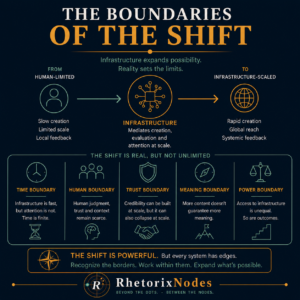
Treated together, they describe something closer to an infrastructural transition: rhetoric is being built into systems in advance, rather than delivered fresh in each encounter.
– AI in branding and marketing is now a two-front shift: agentic AI systems are becoming a second marketing audience, while AI marketing tools are splitting into specialized, staged production stacks.
– On the demand side, evaluating agents respond to structured credibility signals — consistency, verifiability, schema — rather than the emotional and scarcity cues that have historically worked on humans, making brand equity newly machine-legible.
– On the supply side, the bottleneck has shifted from generation volume to brand-consistency drift, and production has moved from single assets to connected campaign bundles tested against modeled audiences before real spend.
– The two fronts increasingly run on the same structured brand data, which is this essay’s central and least externally verified claim.
– The thesis holds most clearly in high-volume, structured-catalog categories like retail and advertising, and is weaker evidence for relationship-driven or high-consideration purchases.
Marketing used to address one audience. It’s building for two now, and they don’t reward the same signals.
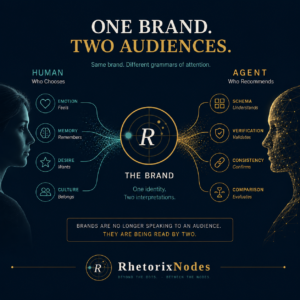
The clearest change in AI marketing this year is the emergence of the AI agent as a legitimate second audience. These systems browse catalogs, compare options, and in some cases initiate purchases, acting as a filtering layer between a brand and the person it’s trying to reach.
That leaves a brand to deal with two audience now.
That filtering layer doesn’t respond to the things that have historically worked on humans like scarcity framing, aesthetic novelty, emotional pacing.
It responds to structured signals: consistency across sources, verifiable claims, machine-readable credibility markers.
Brand strategists have started calling this shift a move from ranking to being recommended, distinct from traditional search-engine optimization because there’s frequently no click involved at all, only inclusion or exclusion from an agent’s answer.
This is a genuine reversal of a decades-old marketing hierarchy.
Performance marketing treated brand equity as a soft, hard-to-measure asset next to the hard numbers of click-through and conversion. An evaluating agent can’t read emotional resonance, but it can read citation patterns, schema consistency, and claim verifiability — which means brand equity, for the first time, becomes something a machine can score.
The consequence is a new filtering point between the brand and the person.
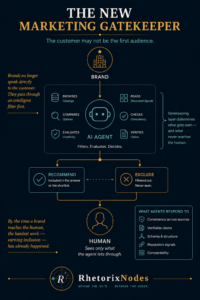
That is close to what RhetorixNodes has previously described through Gate Architecture™: a gatekeeping structure that determine which content passes through to visibility. The gatekeepers have simply moved from ranking algorithms to conversational agents making purchase decisions on a person’s behalf.
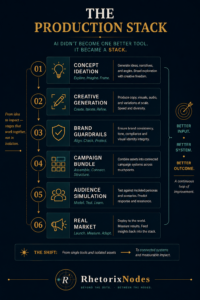
The tools that make branding assets have stopped being generalists; they now specialize by stage, and the specialization is the strategy.
On the production side, the defining change isn’t that AI marketing tools got better at generating images or copy — they did, but that’s the smaller story. The bigger one is that AI creative production stopped being a single tool and became a workflow of specialized stages.
Teams now use one system for concept-stage ideation, prized for aesthetic distinctiveness and moodboarding, and a separate, licensing-safe system for commercial production, where outputs need indemnification and brand-consistent guardrails.
The tool a team reaches for depends on which stage of the pipeline they’re in, not which tool happens to be trendiest.
This specialization has produced a new operational bottleneck.
Early generative tools were valued for speed and volume, i.e., how many variants could be produced in an afternoon. That bottleneck has largely dissolved.
What has replaced it is a coherence problem: bulk-generated creative tends to drift from brand identity as batch size grows, which is why brand guardrail systems (uploaded palettes, type rules, and messaging constraints enforced across every generated variant) have become a meaningful product category rather than a nice-to-have feature.
The scarce resource in AI-assisted branding is not output, but drift control. At scale, generation creates a new problem: keeping every expression recognizably the same brand.
A related change is the shift from atomic assets to campaign bundles. Instead of generating a single image or post, current tools increasingly produce a connected set like positioning language, landing copy, ad variants, email sequences, and video scripts, built from one shared brief so the whole set carries the same message architecture.
Testing has moved earlier in the process too: some systems now simulate creative variants against modeled audience personas before any real spend occurs, which is a genuinely new epistemic move. Now brands don’t test against the market; they test against a model of the market, then validate the winners with real budget.
The market is increasingly being previewed before it is entered.
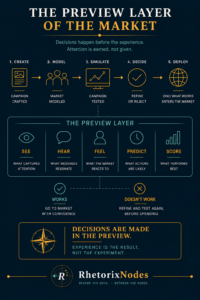
This changes where marketing decisions happen. The campaign reaches the real market only after passing through a layer of modeling, simulation, and prediction. The experience remains real; increasingly, the decision to create that experience has already been rehearsed upstream.
The agent that recommends and the system that generates increasingly speak the same structured language, and that convergence is the real story.
The reason these two fronts belong in the same essay is that they’re starting to run on the same underlying material: structured brand data.
The credibility signals an evaluating agent looks for, i.e., consistent claims, machine-readable schema, and verifiable provenance are the same brand kit inputs that production tools use to enforce guardrails and prevent creative drift.
A brand’s structured data layer, in other words, is becoming simultaneously the thing that makes it legible to a recommending agent and the thing that keeps its generated assets on-brand at scale.
That convergence changes what a brand-identity system actually is. It stops being primarily a style guide for human designers and becomes an operational asset consumed directly by machines on both ends of the transaction — the generating system on one side, the evaluating system on the other.
Rhetoric, under this arrangement, is less something a brand performs in the moment and more something a brand configures in advance, then lets run. This is a specific instance of a broader pattern named elsewhere in this project as Ambient Mediation™: communicative power relocating upstream, into the standing infrastructural conditions that determine which messages, or, here, which brands, get to exist in a receiver’s field of options before any individual signal is ever sent.
What Ambient Mediation™ describes for feeds and platform defaults, this section describes for brand data: the same claim, applied to a different infrastructure.
This is where the analysis moves past tooling commentary into a genuine claim: the same infrastructure now mediates both production and judgment, which collapses a distinction between making a brand and being evaluated as one that used to be handled by entirely separate functions.
Skeptics have a real case: hype cycles have overpromised before, and this one shares their symptoms.
Before extending the thesis, it is worth turning the argument against itself. What we can observe today, what we infer from those observations, and what we are merely forecasting about the future are three different levels of certainty.
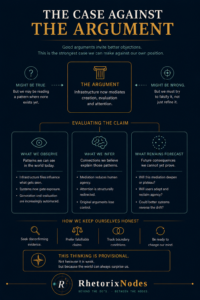
This argument deserves to be taken at full strength rather than waved off.
Marketing has a long history of technology narratives that outran adoption like programmatic advertising, big data personalization, and conversational chatbots all promised to remake the discipline and instead settled into narrower, useful niches.
Much of the current agentic-commerce narrative rests on vendor-reported figures, trend-report projections, and adoption forecasts rather than audited, independent transaction data. ‘AI agents will be the customer’ is still substantially a prediction, not an observed baseline, and the definition of agentic AI varies enough across sources that some of the apparent consensus is definitional inflation rather than a shared empirical finding.
There’s a parallel critique on the production side. Faster, cheaper asset generation solves a volume problem, not necessarily a meaning problem: a brand that produces more on-brand variants faster hasn’t necessarily produced anything more resonant, and the risk of visual and rhetorical homogenization across brands using the same handful of underlying models is a real cost that tooling vendors have little incentive to discuss.
Human creative judgment for emotional nuance, cultural specificity, narrative risk-taking remains the thing that AI-assisted workflows consistently defer to human oversight rather than automate, which suggests the ceiling on what generation alone can achieve is lower than the more enthusiastic tooling coverage implies.
Where this analysis is thin, and what would have to be true for the two-front thesis to hold.
Beyond the idea of benefits of AI in marketing, this essay draws heavily on 2026 trend reporting and vendor-adjacent industry coverage, which has a structural incentive to describe change as larger and more settled than it may be.
The claim that AI agents are becoming primary marketing audiences is strongest in advertising and retail media categories with high-volume, structured product catalogs; it’s considerably weaker evidence for categories where purchase decisions are relationship-driven, high-consideration, or resistant to structured comparison like in enterprise services, luxury goods, and most B2B sales motions, for instance, don’t obviously fit the pattern yet.
The convergence argument in the third section that brand data infrastructure now serves both generation and evaluation is this essay’s most original claim and also its least externally verified one; it’s an inference from parallel trends in separate source categories rather than a documented industry consensus, and it would benefit from direct evidence of brands actually building unified structured-data layers for both purposes rather than maintaining them separately. Readers should weight it accordingly.
Agentic AI in marketing refers to AI systems that act on a person’s behalf during discovery and purchasing, i.e., comparing options, evaluating credibility signals, and in some cases completing transactions, rather than simply assisting a human who makes every decision directly.
AI marketing tools have moved from single-purpose generators to staged production stacks: concept-generation tools for ideation, commercially licensed tools for production, and guardrail systems that enforce brand consistency across large batches of generated creative, with campaign assets increasingly produced as connected bundles rather than single pieces.
Answer engine optimization is the practice of structuring content and data so that AI systems can surface it directly in generated answers or recommendations, shifting the goal from ranking in a list of links to being included in, or excluded from, an AI agent’s response.
The usage of AI in sales and marketing is known and widely analyzed. Current evidence points toward AI absorbing execution-heavy production work while human judgment remains central to emotional nuance, cultural sensitivity, and narrative strategy. These are the tasks that AI-assisted workflows consistently route back to human oversight rather than automate.
Find hidden frames and structures where the dots and nodes cease to be objects.
Response time. We reply within 48 hours. No automated responses — a real person reads and responds.
While you wait. Explore the nodes — Decode, Roots, Dark Matter, The Loop, and Meta are all live.
Stay in the loop. Subscribe to The Dispatch and get notified the moment the next essay goes live.
Every new essay arrives in your inbox before it reaches social media or the feed.
Long-form structural analysis that teaches you to read media — not just react to it.
One email per essay. No digests, no roundups, no promotions. Unsubscribe in one click.