

Search “social media outrage business model” and you will mostly find two answers: a moral one, which says platforms are addicted to anger and should be ashamed of themselves, and a technical one, which says engagement-ranking algorithms optimize for time-on-platform and outrage happens to perform well.
Both are true and neither explains the arithmetic.
What follows is the arithmetic: a model of exactly what outrage does, mechanically, inside a ranked feed, that no other kind of post does nearly as well, and what platforms are actually buying when they let it win.
– Outrage is not favored by social platforms because platforms are cynical. It is favored because it is the highest-yield input available to an engagement-ranked system, full stop.
– This essay names that mechanism the Moral Arbitrage Engine™: the gap between the low cost of expressing outrage and the high value it generates in reach, replies, and time-on-platform.
– Four instruments make the Engine run: Indignation Yield™, Righteous Velocity™, Consensus Fracture™, and the Absolution Loop™.
– The steelman matters: outrage is also how accountability moves through a networked public that has no other mechanism to move it. This essay does not argue outrage is illegitimate. It argues the business model does not care whether it is.
Not a conspiracy, but a pricing signal that engagement-ranked systems cannot help but read correctly.
No platform’s terms of service say “maximize anger.” What they optimize for is engagement: replies, shares, dwell time, return visits — proxies for the only thing that is actually sold, which is attention held long enough to serve an ad against it.
Outrage is not selected because it is outrage. It is selected because, across nearly every content category tested by nearly every platform that has published research on the question, morally and emotionally charged content out-performs neutral content on almost all of those proxies at once.
A system that ranks by engagement will therefore rank outrage highly whether or not anyone building it intended to reward anger specifically.
That is the difference between a business model built on outrage and a business model that simply cannot help finding it — and it is the difference this essay is interested in, because the second is harder to fix than the first.
The framework: outrage is underpriced to the person posting it and overpriced to the platform monetizing it. And this gap is the business model.
Call it the Moral Arbitrage Engine™: the mechanism by which platforms extract surplus value from the gap between what it costs a person to express outrage and what that expression is worth once it is ranked, distributed, and sold against.
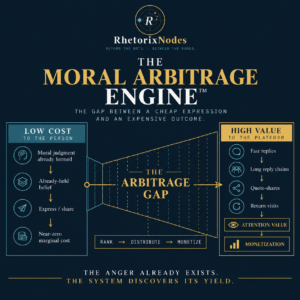
The cost side is close to zero — a moral judgment already formed, a reply already typed in the person’s head before they opened the app, no reporting, no verification, no risk beyond social ones the poster has already priced in.
The value side is high, because outrage content reliably produces exactly the signals a ranking system reads as quality: fast replies, long reply chains, quote-shares that re-inject the post into new networks, and — critically — return visits, because unresolved moral tension is a stronger hook back into a feed than almost anything else on offer.
The Engine does not need to manufacture the anger. It only needs to notice that anger is cheap to produce and expensive to ignore, and rank accordingly.
Arbitrage, in the financial sense, is profiting from a price gap that already exists rather than creating value; that is the precise and deliberately unflattering comparison this framework is making.
The mechanism can be reduced to a single asymmetry: what costs the individual almost nothing can become highly valuable once a platform distributes it at scale. The person supplies the moral charge. The ranking system converts that charge into measurable engagement. The platform then converts engagement into attention.
The Moral Arbitrage Engine™ is not one mechanism but four, operating at different points in the content’s life cycle.
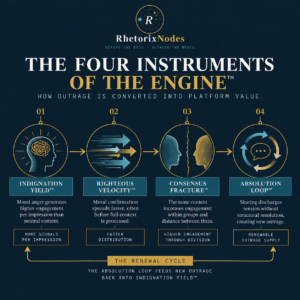
Indignation Yield™ is the engagement a piece of content generates per impression when its primary emotional register is moral anger, benchmarked against the same reach for neutral or purely informational content.
It is the closest thing this framework has to a single number, and it is the reason outrage content requires no special promotion to outperform — the ranking system’s own math does the spromoting.
Righteous Velocity™ describes how fast morally coded content moves through a network relative to other content, because sharing it costs the sharer nothing and buys them something: a public, low-effort signal of which side they are on.
Ordinary informational content has to be evaluated before it is shared. Content that confirms an already-held moral position does not… the decision to share is made before the reading is finished, which is why outrage cascades outrun corrections.
Consensus Fracture™ is what Righteous Velocity™ optimizes for without saying so: content that plays well within a tribe is, almost definitionally, content that plays badly across tribes.
A ranking system rewarding in-group validation is structurally indifferent to whether that validation also widens the gap between groups and has no line item that would tell it to care.
The Absolution Loop™ is the coping mechanism that keeps the other three running: sharing outrage discharges the moral tension a grievance produces without requiring the grievance itself to be resolved, which means the underlying issue can recur indefinitely while still generating fresh, full-price outrage each time.
The Loop is what makes this a business model rather than a single bad afternoon on the internet — it is renewable.
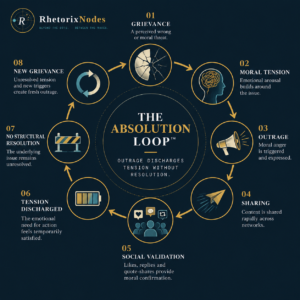
The important distinction is between releasing the feeling that something must be done and resolving the condition that produced it.
A framework that only indicts is not a framework worth citing. Outrage has done real work that no calmer mechanism has replaced.
The strongest case against this essay is not that the Moral Arbitrage Engine™ is wrong, but that it is incomplete in a way that matters: outrage is also close to the only mechanism a networked public without formal power has for moving a story past the institutions that would otherwise bury it.
Viral anger has preceded resignations, recalls, policy reversals, and prosecutions that press releases and open letters did not.
Treating all morally charged virality as an extraction scheme risks the same mistake as treating all of it as pure civic virtue.
It erases the cases where the anger was correctly calibrated to the offense and the platform’s ranking system was, this once, an accountability tool rather than a pricing mechanism.
The honest position is not that outrage is illegitimate. It is that the business model is indifferent to legitimacy. It will monetize a justified reckoning and a manufactured pile-on with exactly the same enthusiasm, because Indignation Yield™ does not carry a truth column.
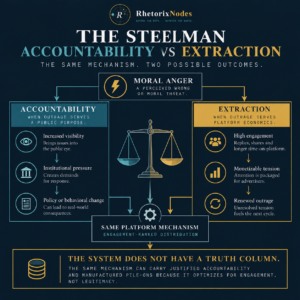
What the Moral Arbitrage Engine™ does not explain, and should not be stretched to cover.
This framework describes a ranking incentive, not a conspiracy, and it should not be read as a claim that platforms hand-tune feeds toward specific outrages or that every viral moral moment is engineered.
It also does not explain outrage that spreads through channels with little or no algorithmic ranking like group chats, in-person conversation, broadcast news, where Indignation Yield™ has no ranking system to be read by, which suggests the underlying human appetite for moral clarity predates the Engine and would exist without it.
What the Moral Arbitrage Engine™ claims, specifically, is narrower and more defensible: that wherever content is sorted by an engagement proxy, that sort will systematically and measurably favor moral anger over other content of comparable quality, and that this favoring will look identical whether or not anyone intended it.
The Moral Arbitrage Engine™ is a specific instrument of a broader economy, not a standalone claim.
The Moral Arbitrage Engine™ sits inside the Attention Depletion Economy™, RhetorixNodes’ broader account of how platforms extract and exhaust finite attentional capacity — outrage is simply the highest-yield asset class within that economy, not a separate phenomenon.
It also connects to Reality Compression Theory™, since moral outrage offers one of the fastest routes to narrative closure available: a villain, a verdict, and an ending, compressed into a single post. And it depends on Custodial Bias™, which is the platform’s own curatorial choices about what counts as reportable, rankable, and safe to amplify, because the Engine only runs on content the platform’s other systems have already decided is allowed to circulate.
Neither framing is quite right. The Moral Arbitrage Engine™ does not require intent. A system that ranks by engagement will favor outrage even if no one building it set out to reward anger specifically, because outrage reliably produces the underlying signals engagement-ranking treats as quality. The effect is systemic, not a matter of a single decision anyone made.
No. The essay’s steelman section argues the opposite: some of the most important accountability moments of the last decade moved through exactly this mechanism. The claim is that the business model is indifferent to legitimacy, not that legitimacy is absent — it monetizes justified outrage and manufactured outrage with the same enthusiasm.
It is not a new metric so much as a lens on an existing one: Indignation Yield™ names the specific, measurable gap between how morally-coded content performs on standard engagement proxies and how comparable neutral content performs on the same proxies at the same reach.
Partially. Recognizing that sharing outrage discharges moral tension without resolving its cause is a first step, but the Loop is sustained by platform-level ranking incentives, not only individual habit, which is why this framework treats it as a structural feature of the system rather than a personal failing to be corrected by willpower alone.
Custodial Bias™ describes a platform’s upstream curatorial choices: what is allowed to exist in the pool of rankable content in the first place. The Moral Arbitrage Engine™ operates downstream of that decision: once content is eligible for ranking, the Engine explains why the morally charged portion of it rises to the top.
Structurally, it would need to rank by something other than engagement proxies that outrage happens to satisfy, i.e., reverse-chronological feeds, algorithmically undifferentiated distribution, or ranking signals weighted toward accuracy and resolution rather than reply volume are the closest existing approximations, and each has been tried at some scale with real trade-offs in reach and revenue.
Find hidden frames and structures where the dots and nodes cease to be objects.
Response time. We reply within 48 hours. No automated responses — a real person reads and responds.
While you wait. Explore the nodes — Decode, Roots, Dark Matter, The Loop, and Meta are all live.
Stay in the loop. Subscribe to The Dispatch and get notified the moment the next essay goes live.
Every new essay arrives in your inbox before it reaches social media or the feed.
Long-form structural analysis that teaches you to read media — not just react to it.
One email per essay. No digests, no roundups, no promotions. Unsubscribe in one click.