

Communication theory has always reached for a physical model to explain what it cannot see directly: the pipe, the wire, the signal, the transmission.
Those mechanical metaphors made sense when the dominant technology was the telegraph.
They make progressively less sense for systems that adapt in real time, compete with each other for survival, exhaust the people who use them, and then recover.
What follows is not a decorative analogy but a working framework: five biological subsystems, observable in ordinary platform behavior, unified into a single model, i.e., Media Metabolism Theory™, along with the point at which that model stops being useful and starts being a convenient excuse.
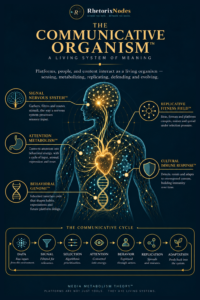
How platforms gather, filter, and route stimuli the way a nervous system routes sensory input.
A nervous system does three things before an organism ever acts: it gathers signals, filters them for relevance, and routes the surviving fraction toward a response.
Platforms do the identical work at civilizational scale.
Data collection is the sensory layer and everything is potential stimulus. The recommendation algorithm is the thalamic gate, discarding almost everything and passing forward only what clears a relevance threshold.
The feed is the motor response: what actually reaches behavior.
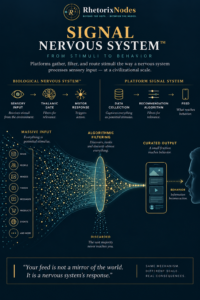
Niklas Luhmann’s systems theory anticipated this structure decades before the infrastructure existed, arguing that communication, not individual minds, is the unit that reproduces a social system. The society thinks via its communications the way a body thinks via its neurons, and no single neuron needs to understand the thought.
The useful diagnostic here is that automatic, pre-conscious response like reaching for the phone, refreshing a feed, is not a failure of willpower. It is what happens when a nervous system has been trained on a stimulus long enough that filtering becomes reflexive rather than deliberate.
Why platforms, formats, and ideas all compete under the same replication logic — copy, mutate, or die.
Three things that look like separate phenomena: platforms copying each other’s features, ideas going viral, and content getting endlessly reposted, are one mechanism observed at three scales — replication with variation, filtered by selection pressure.
When Instagram, YouTube, and TikTok all converge on a near-identical vertical-video format, that is not theft; it is convergent evolution, the same environmental pressure producing the same adaptation in unrelated lineages, exactly as it does with wings in birds, bats, and insects.
At the content level, Richard Dawkins’ concept of the meme as a self-replicating cultural unit describes exactly what a format template does as it spreads and mutates across millions of accounts where each repost a slightly imperfect copy, natural selection operating on shareability rather than survival.
TikTok simply runs this cycle faster than any medium before it, functioning less like a broadcast channel and more like a high-temperature incubator for mutation.
The mechanism becomes clearer when replication, variation and selection are viewed as one continuous field rather than as separate phenomena.
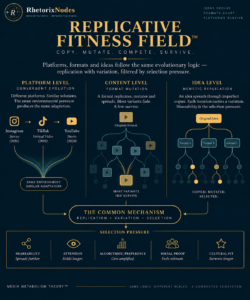
This framework extends two existing RhetorixNodes concepts rather than replacing them: Cascading Permeability™ describes how a mutation moves between platform tiers, and Format Legibility™ describes which mutations survive contact with an algorithm’s structural preferences.
Attention behaves like a scarce, ration-limited energy source your feed is metabolizing on your behalf.
Every organism runs on an energy budget it cannot exceed without consequence. Attention is the communicative equivalent: finite, must be rationed, and allocated to whatever clears the priority threshold first.
The cycle that governs it, including input, arousal, expression, reset, mirrors respiration as much as digestion: stimulus is inhaled as novelty, processed into emotional arousal, exhaled as a comment, a share, a reaction, and the system is meant to reset before the next inhale.
Feeds are built to shorten that reset window as far as it will go.
The predictable result, when the oversupply of stimulus outruns the recovery cycle, is not laziness but something closer to sensory hypoxia; it’s dopamine fatigue, doomscroll exhaustion, the specific numbness of having metabolized far more input than the system was built to process in a day.
The cycle becomes visible when attention is treated as a metabolic process rather than a static resource.
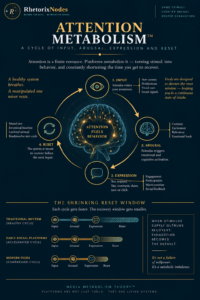
This is not a new claim so much as a sharper instrument for an existing one: Attention Depletion Economy™ already named the scarcity; Attention Metabolism™ supplies the cycle (input, arousal, expression, and reset) that explains why the scarcity produces exhaustion on a predictable schedule rather than a random one.
How audiences develop antibodies, i.e., irony, fatigue, detachment, against overexposed formats and narratives.
An immune system exists to recognize a repeated threat and neutralize it faster each time it reappears. Audiences do this to formats and narratives with striking precision: the first wave of a meme format is read sincerely, the second wave is read ironically, and the third wave is barely read at all — the culture has produced antibodies.
Skepticism, fatigue, detachment, and outright backlash are not audience failure or platform failure; they are the expected, healthy response of a system defending its own bandwidth.
This is the mechanism most often missing from growth-hacking playbooks, which tend to assume virality compounds indefinitely. It doesn’t, for the same reason a pathogen’s first outbreak is always its worst one.

Cultural Immune Response™ functions as the resistance term inside Cognitive Entropy Theory™: immunity is, structurally, a form of entropy resistance — the culture re-imposing a stable model against a stimulus that once destabilized it.
The inherited, mostly invisible code — UX rituals, interface patterns, social scripts — that shapes behavior before anyone chooses it.
An organism’s DNA is not chosen; it is inherited, and it constrains behavior before the organism is aware it has any.
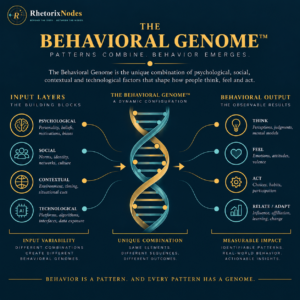
The swipe, the pull-to-refresh, the double-tap, the read receipt, the story ring, these interface patterns function as a behavioral genome for anyone who joins a platform after they’ve been standardized.
Nobody deliberates over whether to swipe; the gesture arrives pre-installed, inherited from every app that came before it, and it encodes an entire relationship to time, attention, and disposability before a single piece of content has been seen. This is cultural genomics in the literal sense: a code passed down, expressed automatically, and only rarely available for conscious edit.
This pillar sits directly downstream of Custodial Bias™: the custodian doesn’t only decide what content is shown, it also decides, earlier, and more durably, what physical gestures are available to respond with.
These inherited interface patterns form a behavioral code: they are passed forward, expressed automatically, and rarely examined as choices.
The unifying claim: these are not five metaphors, but five subsystems of one organism.
Taken separately, each pillar above is a useful local analogy. Taken together, they describe a single entity:
Marshall McLuhan called media an extension of the human nervous system; the claim here is stronger than McLuhan’s, because the infrastructure that made his phrase figurative in 1964 is, in 2026, literal.
Data pipelines, feedback loops, and behavioral prediction systems are wired together at a scale where it is more accurate to describe a shared organism made of connected minds than a collection of individuals each holding a device. The five pillars are not five metaphors for that organism; they are its organ systems.
The model becomes clearer when the five systems are viewed as parts of a single communicative architecture.
Where the organism model breaks down, and why the breakdown matters more than the model.
The strongest objection to this entire framework is also the correct one: biological language naturalizes what is, in fact, engineered.
Natural selection has no author. Platform selection pressure does: a product team optimizing a specific metric, on a specific quarterly timeline, answerable to specific shareholders.
Calling a dark-pattern feature an ‘immune response’ or calling algorithmic manipulation ‘metabolism’ launders a deliberate business decision as an inevitable natural process, and in doing so quietly removes the humans who made that decision from the sentence.
An organism does not have a growth team. A virus does not have a board meeting about retention metrics. Wherever this essay’s language starts to sound like it is describing weather rather than a decision, that is the model failing, not the phenomenon disappearing.
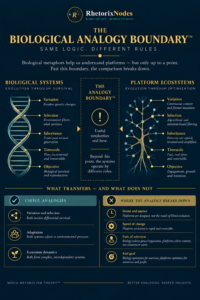
The correct use of Media Metabolism Theory™, then, is diagnostic rather than exculpatory: it explains why certain effects occur with the reliability of a biological cycle, without ever implying that the cycle was set in motion by nature rather than by a named team with a quarterly target.
It is closer to systems theory than to metaphor: the claim is that communication infrastructure exhibits the functional properties of biological systems like signal filtering, replication under selection, energy scarcity, immune response, not merely that it resembles them for rhetorical effect. The Honest Limits section above marks exactly where that claim stops holding.
‘Going viral’ describes an outcome. Replicative Fitness Field™ describes the mechanism producing that outcome, i.e., replication with variation, filtered by a specific selection pressure, which is what allows the framework to explain platform feature convergence and content mutation as the same process rather than two unrelated trends.
No — they describe sequential phases of one cycle. Attention Metabolism™ governs the short cycle of a single scroll session; Cultural Immune Response™ governs the long cycle of repeated exposure to the same format across weeks or months. A body can metabolize a meal and still develop immunity to a recurring pathogen.
No — the Honest Limits section exists specifically to foreclose that reading. The framework explains why certain effects are reliable and repeatable; it does not relocate authorship of those effects away from the teams who designed them.
McLuhan’s phrase was figurative for the media environment of 1964. The Communicative Organism™ argues that the current infrastructure, i.e., data pipelines, feedback loops, prediction systems, makes the extension literal rather than figurative, which is the specific update this essay is making to his claim.
Its clearest predictive use is in Cultural Immune Response™: a format’s engagement decay curve should be steeper on its second and third major wave than its first, the way a pathogen’s later outbreaks are blunted by existing antibodies — a claim that is directly checkable against engagement data.
Find hidden frames and structures where the dots and nodes cease to be objects.
Response time. We reply within 48 hours. No automated responses — a real person reads and responds.
While you wait. Explore the nodes — Decode, Roots, Dark Matter, The Loop, and Meta are all live.
Stay in the loop. Subscribe to The Dispatch and get notified the moment the next essay goes live.
Every new essay arrives in your inbox before it reaches social media or the feed.
Long-form structural analysis that teaches you to read media — not just react to it.
One email per essay. No digests, no roundups, no promotions. Unsubscribe in one click.