

Called the GOAT, rightfully, he was a spectacle on the court. Gliding across it, Roger Federer wrote the legacy of tennis in strokes that even his competitors admired. Besides being a maestro of the liquid-whip forehand and the one-handed backhand, Roger Federer was equally iconic as an epitome of personal branding.
He popularized SABR (Sneak Attack By Roger) on the court and embodied CALIBRE (Composure, Aesthetics, Longevity, Integrity By Roger) off it, with the same grace that built one of the most durable personal brands in sports history, without ever appearing to build a personal brand at all. A brand worth studying!
Roger Federer retired from professional tennis in September 2022 carrying twenty Grand Slam titles, an estimated billion dollars in career endorsements, and a cultural authority that outlasted his competitive peak by nearly a decade.
The standard explanation, i.e., grace, dominance, longevity, is not wrong. It is simply not the level at which the interesting questions live.
This essay moves through seven analytical frames to locate those questions precisely: semiotic, phenomenological, critical-political, media-structural, narrative, counterargument, and finally a unifying frame drawn from Cognitive Entropy Theory™ — a framework developed at RhetorixNodes to explain how cultural authority, prestige, and brand power operate as systems of entropy management.
Federer is not the subject of what follows. He is the specimen through which the mechanism becomes visible.
Why the standard account is seductive, shallow, and insufficient and what a more exacting analysis requires.
The standard account of Roger Federer’s personal brand is seductive in its simplicity: grace plus dominance plus longevity equals universal appeal.
He won twenty Grand Slams. He moved beautifully. He never seemed to sweat. Brands paid him a billion dollars over his career. Therefore: he became a personal branding masterclass.
This account is not wrong. It is merely shallow. The more interesting question is not what made Federer’s brand powerful, but how that power was structured, which ideological, semiotic, and media-systemic forces gave his image its particular charge, and what the limits of that image reveal.
To answer that question seriously requires moving through several theoretical registers that do not usually appear in the same room as ATP statistics. Those statistics, however, help reveal why Roger Federer, as a brand, remains relevant and classic even after retirement.
What follows is not a hagiography. It is an attempt to understand a cultural phenomenon with the precision it deserves.
How effortlessness became a commercial signal and why luxury brands could not have commissioned a more precise encoder.
Roland Barthes argued in Mythologies that the function of myth is to transform history into nature, i.e., to make the contingent appear inevitable.
Federer’s brand achieved something structurally identical: it transformed an athletic style that was historically produced (through specific coaching lineages, racket technology, surface preferences, and era-specific opponents) into what appeared to be pure, natural gift.
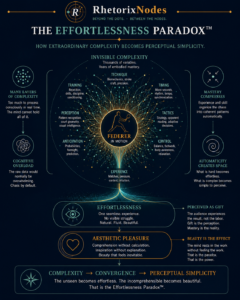
The central semiotic operation was the encoding of effortlessness. Every component of Federer’s public image, from the balletic footwork, the single-handed backhand, the post-match composure, to the designer RF monogram, signified the same message: this is not any labor, but nature expressing itself.
Where Nadal’s brand was built on visible effort (the sleeveless shirts, the tics, the obvious physical sacrifice), Federer’s was built on its absence. He appeared to play tennis the way water flows downhill: just by following the path of least resistance, not by trying.
This semiotic choice was enormously significant commercially.
Brands do not want to associate with effort. Effort implies failure is possible. Effort implies the product might not work. What luxury brands, financial services companies, and watch manufacturers want is a signifier of natural superiority: the visual argument that excellence simply is, without the ugly machinery of its production.
Federer gave them that signifier more completely than almost any athlete in the modern era. His endorsement of Rolex, Credit Suisse, Mercedes-Benz, and Moët & Chandon was not incidental to his playing style. It was a direct consequence of the semiotic register his tennis occupied effortlessly.
The RF monogram deserves particular attention. It appeared on his Wimbledon jacket, his racket bag, his shoes as a typographic assertion of self-authorship that was unusual in an era when athletes were typically subsumed into Nike or Adidas branding.
The monogram said: this person is not a vessel for a brand. This person is a brand. The logic anticipated what we now call the creator economy — the athlete as autonomous media entity — by nearly a decade
What watching Federer did to the body that watched, and why that experience was structurally different from admiration.
Merleau-Ponty’s account of embodied perception offers a different entry point.
For Merleau-Ponty, skilled movement is not the execution of a mental plan by a physical body, it is the lived body expressing its own intelligence. What observers recognized in Federer was not simply technical accuracy but something closer to what Merleau-Ponty called motor intentionality: the body knowing where it needs to be before consciousness has caught up.
David Foster Wallace’s 2006 New York Times essay “Federer as Religious Experience”, which is probably the most intellectually serious piece of sports journalism written in the 21st century, approached this phenomenologically before naming it as such.
Wallace described watching Federer as accessing something like aesthetic transcendence: the sense that one was seeing a human body operating at the outer limit of what human bodies can do, and that this limit was somehow beautiful rather than merely impressive.
This phenomenological dimension is what separated Federer’s brand from mere celebrity. Celebrity is recognizability. What Federer generated was closer to what Kant called the sublime: the experience of encountering something that exceeds the categories you bring to it.
His baseline rallies produced in spectators a kind of pleasant cognitive overload: you could not quite process how the ball arrived where it arrived. This perceptual excess was aesthetically pleasurable, and it bonded audiences to him with an intensity that statistics alone cannot explain.
Byung-Chul Han’s The Transparency Society is useful here as a counterpoint. Han argues that contemporary culture pathologically demands transparency: the visible, the legible, and the immediately consumable.
Federer was, paradoxically, both opaque and legible: his tennis was genuinely difficult to understand technically, but that opacity was aestheticized so successfully that it became readable as elegance. His brand was the transformation of incomprehensibility into beauty — which is precisely the operation luxury performs on expense.
The class and racial coordinates hidden inside the language of “timeless elegance” and what a Bourdieusian reading exposes.
Any serious analysis must engage the ideological dimensions of Federer’s appeal, and these are less flattering than the phenomenological account.
Federer’s brand was structured around a set of cultural signifiers with explicit class and racial coordinates.
The single-handed backhand is a stroke associated with amateur club tennis in Western Europe with grass courts, private clubs, coaches who insist on “classical” technique. It is historically a stroke of privilege: the two-handed backhand emerged partly because it is more accessible to players who learned without intensive early coaching.
When commentators called Federer’s style “classical” or “aristocratic,” they were using aesthetic language to encode a social position.
His association with Wimbledon, an institution with one of the most elaborate class-performance apparatuses in global sport, reinforced this. Federer won Wimbledon eight times, and the tournament’s mythology (the strawberries, the white dress code, the Royal Box) became part of his brand mythology, which was not neutral.
It situated him within a specific conception of sporting excellence that was European, historically white, and associated with old-money aesthetics rather than working-class athleticism.
Pierre Bourdieu’s framework of cultural capital is clarifying here. Bourdieu argued that aesthetic preferences are not natural but are products of class habitus — that the capacity to appreciate “refined” or “classical” forms is itself a form of capital, unequally distributed.
Federer’s brand operated as a delivery mechanism for upper-middle-class cultural capital: watching him, appreciating him, wearing a watch he endorsed were all ways of performing membership in a class that values elegance over rawness, craft over force, restraint over exuberance.
This does not mean Federer was consciously class-signaling, or that his appeal was limited to the wealthy. Mass affect does not respect class boundaries, and the phenomenological response to watching him was available to anyone with eyes.
But the commercial structure of his brand was unambiguously upscale. He was the most expensive endorser in tennis history precisely because he signified something that luxury goods needed, and luxury goods serve specific class functions.
The counterfactual sharpens this: it is difficult to imagine a Federer brand built around Rolex and Credit Suisse if his style had been Nadalian, i.e., if he had grunted, if his physicality had been more visibly laboring, if he had come from a different socioeconomic background. The aesthetic and the economic are not separate registers. They encode each other in this landscape of personal branding.
How a playing style accidentally optimized for the ten-second clip produced algorithmic amplification that outlasted the player’s competitive career.
Walter Benjamin’s concept of the aura, i.e., the quality of presence, of being-here, that mechanical reproduction destroys, requires updating for the digital media environment. What Federer’s career demonstrates is that the right kind of athletic performance can generate aura through media rather than losing it.
The key mechanism was the GIF and the highlight clip.
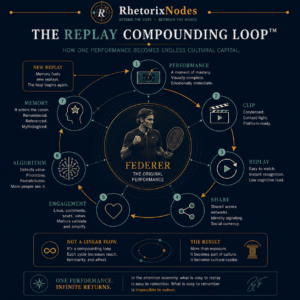
Federer’s tennis was optimized, accidentally or otherwise, for the ten-second visual extract. His best shots like the tweener at the 2009 US Open, the between-the-legs passing shot, the inside-out forehand at full stretch, were visually complete in themselves. They did not require context to produce their effect. This made them highly shareable on the early internet and then on social media platforms with short attention spans and algorithmic rewards for emotional intensity.
This structural compatibility with emergent media formats was not something Federer or his management team designed. But it meant that his image compound-interested in the digital environment in ways that less visually legible players could not.
Every new platform (YouTube, Twitter, Instagram) rediscovered Federer because his highlight clips performed well. The algorithm kept returning to him because his content kept working the same way without any effort.
Shoshana Zuboff’s The Age of Surveillance Capitalism offers a frame for what this means structurally.
The engagement data generated by his clips trained recommendation systems to show more Federer, which generated more engagement, which trained the systems further. His aesthetic properties like the visual completeness of his shots and the emotional charge they carried, made him recursively amplifiable in ways that produced cultural ubiquity exceeding what his competitive record alone would have generated.
McLuhan’s “the medium is the message” is useful here too.
Television made Federer’s tennis legible to mass audiences. But YouTube and social media made it mythological — by enabling the infinite replayability of his best moments, they allowed each clip to function like what McLuhan would have called a hot medium: high definition, low participation required, emotionally totalizing.
You did not need to understand tennis to feel the force of the between-the-legs shot. The medium delivered the message unmediated by knowledge.
The monomyth beneath the match statistics and why Federer’s story was the rarest kind: one that actually delivered on its structural promise.
Every durable personal brand is also a narrative, and Federer’s narrative had classical structural properties that warrant examination through a Campbellian and narratological lens.
The arc: child prodigy marked by extraordinary natural talent, early failures to control his temperament, the death of his coach Peter Carter (who died in a car accident in 2002, just as Federer was emerging), a period of grief and transformation, the emergence of a more disciplined and emotionally integrated player, followed by an unprecedented run of dominance. The Rivalry with Nadal, which provided the antagonist function every hero narrative requires. The defeats that humanized. The comebacks. The final retirement at the Laver Cup in 2022, weeping alongside Nadal.
This is structurally identical to the monomyth: departure, initiation, return. Campbell would have recognized it immediately. But what is interesting is not that the structure exists (hero narratives are extremely common in sports!) but that Federer’s actually delivered on the structural promise. He became, at the end, the thing the beginning had promised: a figure who had integrated excellence and emotion, domination and humility, competitor and artist.
Most personal brands promise a narrative they cannot sustain. The product fails to deliver what the marketing implied. Federer was the rare case where the person was adequate to their own myth, which is structurally extraordinary. His brand did not require the suppression of an unflattering reality. The narrative and the substance pointed in the same direction. That made the whole story extraordinary.
The final retirement scene deserves particular attention.
Weeping openly beside Nadal — his greatest rival, his genuine friend — while the crowd at the O2 stood in ovation, Federer produced one of the most emotionally legible images in the history of sport. It was not calculated. It was not managed.
And paradoxically, that made it the most powerful brand moment of his career: proof that the person had always been what the brand had claimed.
The strongest objection to the branding frame, stated at full force, without concession.
“The brand did not produce the appeal. The appeal produced the brand. Federer’s cultural authority was the accumulated output of genuine substance, including a playing style, a public character, twenty years of signal coherence, compressing until it became the standard others are measured against.”
An analysis that builds only in one direction is not serious analysis. The counterargument must be stated at full force.
The strongest objection to the “Federer as personal branding masterclass” frame is this: most of what we are describing was not branding at all. It was being. Federer did not construct his aesthetic: he played the way he played because of his specific biomechanics, his specific early coaching, and the specific era of tennis he grew up in. He did not choose effortlessness as a brand strategy. He was, by most accounts, genuinely composed and genuinely graceful as a person. The brand followed the substance rather than producing it.
This matters because the lesson most marketing discourse draws from Federer — “be authentic,” “develop a distinctive aesthetic,” “tell a coherent narrative” — misses the causal structure. You cannot decide to have Federer’s brand. You can only, if you are lucky, have the substance that makes such a brand possible, and then not ruin it with bad management. The brand was not the cause of the appeal. It was the effect.
The second objection: the Federer brand has not been without failures. His association with Credit Suisse, which collapsed in 2023, retroactively complicated the wealth-and-stability associations his brand had cultivated. His reluctance to engage publicly with political issues drew criticism from those who felt his silence was itself a political position. The pristine image had costs: it required a depoliticization that looked, in certain lights, like complicity.
And his brand was more culturally specific than its universal-appeal narrative admits. Federer was the avatar of a particular kind of educated, cosmopolitan, European aesthetic sensibility. In parts of the world where that aesthetic sensibility is experienced as colonial or alien, his appeal was significantly weaker.
The “timeless elegance” read as belonging to someone — and that someone was not universal.
The single mechanism that explains what all six preceding lenses were each, from their different vantage points, reaching toward.
The six frames above are not merely different perspectives on the same phenomenon. They are, beneath their terminological differences, different languages for the same underlying mechanism. Naming that mechanism is what allows the Federer case to become theoretically generative rather than just analytically rich.
This theory proposes that human social cognition operates under a continuous overhead cost: the uncertainty cost of maintaining a workable model of a complex, changing reality.
Every figure that enters an audience’s attention requires cognitive resources to model: to hold, update, reconcile, and manage. The sum of these resource demands is cognitive entropy.
And the central empirical claim of the framework is this: figures, brands, and institutions that reduce the cognitive entropy cost of being modeled accumulate what we call authority, trust, and prestige.
These are not separate cultural phenomena. They are outputs of the same underlying process — successful entropy reduction generating cognitive relief that audiences experience as confidence, admiration, and the desire for continued engagement.
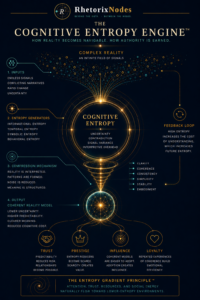
What the semiotic frame called effortlessness encoding was a compression operation. Every signal in Federer’s image pointed in the same direction — what Reality Compression Theory™ calls semiotic consolidation. The balletic movement, the single-handed backhand, the RF monogram, the Rolex association, the Wimbledon mythology: none of them broke against the others.
Each new encounter with Federer confirmed the existing model rather than forcing it to be rebuilt. In cognitive entropy terms, this is maximum compression in which the audience’s modeling overhead reduced to near zero, each signal a confirmation event rather than a reconstruction demand.
What the media-structural frame identified as algorithmic recursion was compound compression.
Federer’s highlight clips were structurally low-variance relative to audience expectation. They reliably delivered what people anticipated from him, which made them algorithmically robust. Each viral clip was a model-confirmation event that deepened the compression.
Signal Variance Theory™ names the mechanism directly: low signal variance maintains the compressed model; high variance forces reconstruction and spikes entropy. Federer’s twenty-year public record was, among other things, an extraordinary achievement in sustained low variance.
What the narrative frame identified as the hero arc was narrative closure, i.e., the third compression mechanism, and among the most powerful available. Narrative compresses entropy by providing audiences with a container stable enough that new events can be slotted into the existing arc rather than processed as raw information.
The monomyth structure reduces the cognitive overhead of following a complex life to near zero. Federer’s story, from the prodigy to the loss of Carter to the rivalry with Nadal to the Laver Cup tears, was not just emotionally resonant. It was cognitively efficient: a fully compressed narrative that required almost no interpretive overhead to maintain.
The phenomenological frame requires the framework’s most precise new term. What Wallace described as aesthetic transcendence, and what the essay called Kant’s sublime, is what Cognitive Entropy Theory™ names the Ecstatic Entropy Spike™: a brief, controlled model-breaking event in which cognitive overload is experienced as aesthetic pleasure rather than anxiety.
The ball arrives somewhere the model cannot predict. The body moves beyond what trained expectations allow. The model breaks open not into destabilizing uncertainty, but into the specific kind of pleasurable incomprehension that great art and great athletic performance share. Without the stable compressed model as background, there is no norm to beautifully violate.
The critical-political frame like Bourdieu’s cultural capital, the class coordinates of “timeless elegance,” maps onto a dimension the framework names but does not always foreground: entropy does not operate uniformly across audiences. The Compression Audience, i.e., the mass majority — wants the model closed, the signals stable, and the figure fully legible. The Depth Audience, i.e., the minority with the aesthetic training to sustain an open model without anxiety, derives ongoing value from figures who maintain productive interpretive resistance
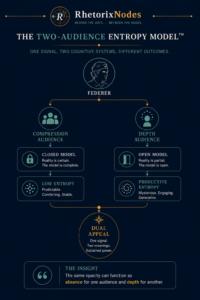
Federer’s brand operated across both simultaneously: fully consolidated for the mass audience, while maintaining the political silences, the withheld interiority, and the phenomenological opacity that sustained the Opacity Premium™ for the depth audience. The class dimension of his appeal was partly a depth-audience selection effect — appreciating his specific register of elegance was itself a form of entropy tolerance, which is itself a form of cultural capital.
Finally, the counterargument that the brand was not designed but emergent becomes, within the Cognitive Entropy framework, the most important theoretical distinction the Federer case generates.
Emergent compression is what happens when the substance is genuinely what the model claims: when the gap between the compressed image and the underlying reality is so small that it cannot be opened by revelation.
Engineered compression is what most brand strategy produces: a model that may diverge from substance, perpetually vulnerable to the spike that comes when the gap is exposed.
Federer’s brand was emergent and the compression was a description rather than a construction. This is why it was so durable, why the Credit Suisse collapse damaged but did not destroy it, why the weeping beside Nadal read as proof rather than performance. You cannot engineer emergent compression. The most you can do is have the substance, and not ruin the description of it.
What the preceding six frames were collectively doing, then, was mapping the same architecture from six different vantage points.
The counterargument named the difference between emergence and engineering. Cognitive Entropy Theory™ is what happens when you pull those six accounts into a single explanatory structure — not to replace them, but to reveal what they were all pointing toward.

Six structural principles more interesting than any marketing lesson that are drawn from the architecture of a twenty-year compression achievement.
Pulling the threads together, the Federer case demonstrates several structural principles that are more interesting than the usual branding lessons:
What Federer achieved was not a set of brand attributes but a total aesthetic: an internally consistent sensibility that expressed itself identically across his playing style, his comportment, his endorsement choices, and his public persona. This coherence was not manufactured from the outside in. It emerged from genuine alignment between the person and the presentation. The lesson is not “be coherent” but “coherence is only possible when the brand does not diverge from the substance.”
Federer’s brand was amplified by Nadal’s existence. Without the contrast, i.e., classical versus baroque, effortless versus laboring, finesse versus power, many of Federer’s defining qualities would have been less legible. Personal brands do not exist in isolation. They exist in a field of differences, and the right rival structures the brand better than any marketing can.
In an era of radical transparency, Federer’s refusal to fully explain himself like his near-absence from political discourse, his management of his private life, his emotional restraint in most public contexts, read as dignity. He retained a zone of opacity that made him appear to have depth, even when the depth could not be verified.
Federer’s greatness happened to be expressed in a form that was visually legible, emotionally immediate, and digitally distributable. This is partly luck, partly structural, and partly the accident of historical timing. But it produced a media amplification that long outlasted his competitive relevance and will likely continue long after his death.
The rarest and most important lesson: Federer’s brand worked because he was, in the end, sufficient to the story told about him. The grace was real. The competitive hunger was real. The friendship with Nadal was real. The weeping at the end was real. Personal branding fails when it outpaces the person. Federer’s brand did not outpace him.
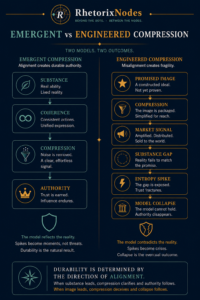
The unified mechanism beneath the lenses. What the semiotic, phenomenological, critical-political, media-structural, and narrative frames were each describing, from their different vantage points, in their different terminologies, was a single underlying process: the reduction of cognitive entropy through emergent compression.
Federer’s authority, his prestige, his commercial power, and his aesthetic hold on audiences were all outputs of the same engine. The brand was not a set of attributes. It was a sustained compression event spanning twenty years of public life, culminating in a retirement scene so low-variance relative to his established model that it read not as performance but as proof. Cognitive Entropy Theory™ does not replace the previous frames. It names what they were all reaching toward.
Why the personal branding frame, even deployed with maximum theoretical rigor, remains too small for this particular phenomenon.
The deepest problem with analyzing Federer through the personal branding frame is that the frame is too small for the phenomenon.
Branding is a commercial operation: it converts qualities into signals that drive purchasing behavior. And Federer’s image did that, spectacularly.
But what made those qualities so powerful was not their commercial utility. It was their relationship to something more fundamental: to an idea of human excellence, of what the body can do when trained with obsessive precision across decades, of what it looks like when someone builds something beautiful in the medium of sport and then, at the end, cries about having to stop.
The brand is the residue of that. Treating the residue as the substance is the error most branding discourse makes when it approaches figures like Federer.
He wasn’t a case study in personal branding. He was a person, of unusual gifts and ordinary limitations, who happened to express himself in a way that multiple theoretical lenses can illuminate and none can fully exhaust.
And what made him extraordinary in the most sophisticated way — beyond his craft, within his self.
A subject is what an analysis is about. A specimen is what an analysis is through. The distinction is not rhetorical, it changes the direction of the argument.
When Federer is treated as subject, the analysis ends at Federer: here is why this particular person was this particular kind of culturally powerful. When he is treated as specimen, the analysis travels through him toward the mechanism he reveals: here is how cultural authority, prestige, and brand power operate as systems, and Federer is the case in which that system becomes visible in high resolution.
The theoretical frameworks the case generates, including Cognitive Entropy Theory™, Reality Compression Theory™, the Ecstatic Entropy Spike™, are applicable across branding, media, political communication, and institutional authority. Federer made them visible. He does not exhaust them.
Ordinary athletic admiration is model-confirming: the athlete does what we expected, with high quality, and we experience satisfaction.
The Ecstatic Entropy Spike is model-breaking: the athlete does something the model could not predict. The ball arrives somewhere it should not be able to arrive, the body moves beyond what trained expectations allow, and the model opens completely.
The critical difference is that the spike is experienced as pleasure rather than anxiety. This is only possible because the background compression is so thorough. The stable model is the condition of the spike’s beauty: without a norm to violate, there is no violation to be beautiful. Federer’s career was structured so that the spikes like the tweener, the between-the-legs shot, the full-stretch forehand winner, were delivered against a background of such sustained compression that they became aesthetically transcendent rather than merely surprising.
The Compression Audience is the majority audience segment with low entropy tolerance: it wants the model fully closed, signals stable, the figure completely legible.
Full legibility is not a cost for this audience — it is the goal. The Depth Audience is the minority with high entropy tolerance: the aesthetic training to sustain an open model without anxiety, and to derive ongoing value from productive interpretive resistance.
A fully closed model signals exhaustion for this audience, leaving nothing to extract. Federer’s brand was structurally unusual because it operated successfully across both segments simultaneously: maximum compression for the mass audience, while maintaining the Opacity Premium™, i.e., political silence, withheld interiority, phenomenological excess, for the depth audience.
Most brands serve one segment or the other. Serving both requires a precision that is very difficult to engineer and very natural to those who are genuinely adequate to their own myth.
The primary lesson is counterintuitive and mostly negative: do not let brand-building diverge from what is genuinely true of the person or institution.
The causal structure in the Federer case runs substance → coherence → compression → authority. Most brand strategy reverses this: it tries to build the model and then fill in the substance. That reversal is what the emergent/engineered compression distinction names.
Engineered compression is real and can be effective, dominating the industry, but it is permanently vulnerable to the entropy spike that comes when the gap between model and substance is revealed. The Federer case does not offer a blueprint. It offers a diagnostic: if the brand is outpacing the substance, the model is fragile. If the substance exceeds what the brand claims, there is unrealized compression potential. The ratio between the two is the relevant variable.
Because the collapse was a Signal Variance event rather than a Substance Revelation event.
Signal Variance, i.e., the degree to which a new signal deviates from the established compressed model, spikes cognitive entropy and forces model reconstruction. But the Credit Suisse association was peripheral to the core Federer model, not central to it.
The compressed model was built on movement, aesthetics, competitive character, and interpersonal comportment, not financial stability signaling. The collapse produced a high-variance signal, but the credibility bank accumulated over twenty years was large enough that audiences worked to assimilate rather than rebuild.
A figure with a smaller credibility bank. i.e., less prior compression history, would not have survived the same signal. This is what the framework calls Error Tolerance: the capacity of established authority to absorb high-variance signals without model collapse.
Substantially. The Countertype Field™ which is an unpublished framework in development at RhetorixNodes, proposes that certain brand qualities only become visible when a countertype occupies the adjacent position in the cultural field.
Effortlessness requires visible effort nearby to be fully legible as effortlessness.
Classicism requires baroque to be readable as classical. Grace requires labor to be distinguishable from mere competence.
Without Nadal, many of Federer’s most distinctive semiotic properties would have had no contrast field to register against. The audience’s entropy overhead would have been higher, making the Federer model harder to hold because the defining contrasts would not have existed.
This does not mean Federer’s tennis was less beautiful without Nadal. It means his brand would have been less compressed. The rivalry was not a marketing device. It was an entropy architecture.
That much of what human cultures call authority, trust, prestige, and power may be understood as a battle over cognitive entropy, prevailing as who or what can offer the most effective compression of a reality that, uncompressed, would be cognitively unmanageable.
Religion reduces cosmic entropy. Political institutions reduce social entropy. Luxury brands reduce status entropy. Media reduces epistemic entropy. Art, at its most powerful, compresses the entropy of the inner life, providing a model of emotional reality that audiences can hold without the cost of working through the experience unaided.
The theory predicts that wherever sustained cultural authority exists, a compression achievement underlies it. And wherever authority collapses (revolutions, brand failures, institutional crises, artistic reputations that evaporate) an entropy spike exceeded the audience’s tolerance threshold.
If the theory holds at that scope, the Federer essay is not an analysis of a tennis player. It is the first detailed specimen of a general account of how cultural power works.
Find hidden frames and structures where the dots and nodes cease to be objects.
Response time. We reply within 48 hours. No automated responses — a real person reads and responds.
While you wait. Explore the nodes — Decode, Roots, Dark Matter, The Loop, and Meta are all live.
Stay in the loop. Subscribe to The Dispatch and get notified the moment the next essay goes live.
Every new essay arrives in your inbox before it reaches social media or the feed.
Long-form structural analysis that teaches you to read media — not just react to it.
One email per essay. No digests, no roundups, no promotions. Unsubscribe in one click.