

Every September, for the better part of two decades, technology journalists have performed the same ritual: they publish detailed, largely accurate renderings of a product Apple has not announced, based on nothing Apple has confirmed.
Component suppliers leak specifications.
Case manufacturers leak dimensions.
Analysts leak shipping forecasts.
Apple, asked to comment on any of it, says what it always says: it does not comment on rumours or speculation. By the time the keynote begins, the internet has already drawn the phone. Apple’s job that day is simply to be right.
It is tempting to read this as evidence of a company that has mastered the art of silence, the one that has learned, better than any competitor, how to make an absence of speech into a form of speech.
The claim shows up often enough, in marketing case studies and rhetoric classrooms alike, that it has calcified into something like common knowledge: Apple controls its narrative by refusing to participate in it.
The claim is not wrong, exactly. But it is much narrower than it sounds, and examining where it holds and where it collapses says more about how institutional power actually operates through language than the tidy version does.
Product secrecy and crisis silence look identical from the outside, but they differ sharply in cost, reliability, and what each one actually accomplishes.
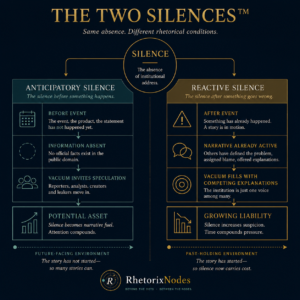
The first move worth making is definitional, because “Apple is silent” collapses two entirely different rhetorical operations into one gesture.
The first is anticipatory silence, i.e., the studied non-confirmation of what has not yet happened. This is the silence of product secrecy: internal codenames, opaque supply-chain contracts, and a standing policy, formalised enough that press offices across the industry have copied it, of declining to comment on unreleased products under any circumstance.
Anticipatory silence is cheap to maintain, because nothing has gone wrong yet; it costs Apple nothing to withhold a fact that would otherwise cost it the element of surprise, and it produces a side effect the company has never had to pay for: an entire trade press whose business model depends on generating attention for Apple products months before Apple has spent a cent on their marketing.
When a leaked chassis or a rumoured feature list circulates, Apple’s silence has been converted, without any transaction taking place, into unpaid promotional labour.
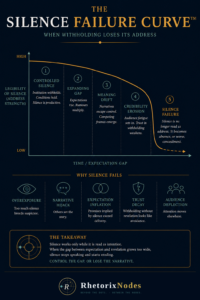
The second is reactive silence, which means the withholding of comment in response to something that has already gone wrong. This is a costlier and far less reliable instrument, because by the time reactive silence is deployed, a competing narrative is already circulating and has a head start.
Reactive silence is what a company falls back on when it has decided that a slow, muted response will do less damage than an immediate, defensive one, i.e., a calculation that is frequently mistaken, and Apple’s own history offers a clean demonstration of the miscalculation.
How the 2010 Antennagate scandal forced Steve Jobs to abandon reactive silence and stage one of the loudest public rebuttals in Apple’s history.
In the summer of 2010, weeks after the iPhone 4 launched with a steel band doubling as its antenna, users discovered that gripping the phone a certain way could drop the signal. For nearly three weeks Apple tried the reactive-silence playbook: a dismissive customer-service reply from Steve Jobs suggesting people simply hold the phone differently, an official statement attributing the problem to how signal bars were calculated rather than to the hardware itself.
Neither closed the story.
Consumer Reports declined to recommend the phone. The pressure built past the point silence could absorb it, and on July 16th Jobs cut short a family holiday and stood in front of the press to deliver a rebuttal, insisting there was “no Antennagate,” reframing the flaw as an industry-wide condition common to competing phones, and offering free cases to affected customers.
Months later, Apple quietly revised the antenna’s hardware design without ever publicly acknowledging that the original had been flawed. It floated a second, quieter kind of silence, this one embedded in the supply chain rather than the press release.
The episode is instructive precisely because it does not fit the “genius of silence” narrative cleanly.
Apple’s silence did not control the story here; it delayed a reckoning by roughly three weeks and then gave way to one of the most aggressive, high-volume communicative performances Steve Jobs ever gave. It was a lengthy, data-heavy press event built specifically to talk the controversy out of existence.
Reactive silence bought time. It was assertive, voluble speech that closed the loop.
Apple’s public letter opposing the FBI’s 2016 encryption request shows that silence was never a fixed principle for the company. It was only a calculation, applied whenever it served the brand.
The clearer counterexample sits six years later.
In February 2016, a federal magistrate ordered Apple to help the FBI unlock an iPhone recovered from one of the San Bernardino shooters.
The company that had spent a decade cultivating “no comment” as a reflex responded instead with roughly eleven hundred words, published on its own website under the header “A Message to Our Customers,” arguing that building a tool to bypass its own encryption would set a dangerous precedent and that the request threatened every iPhone owner, not only the one in question.
Tim Cook did not decline to comment. He published, argued in public, and turned a subpoena dispute into a referendum on the moral character of the company.
Read against the silence thesis, the FBI letter is the exception that breaks the rule rather than proving it. If Apple’s rhetorical identity really rested on strategic non-speech, this was the moment to apply it: say nothing, comply quietly or contest the order quietly through the courts, let the case resolve on the docket rather than the front page.
Apple did the opposite because, on this particular question, speaking loudly served the brand better than staying silent — privacy as a value proposition needed a visible, quotable defender, not an absence.
The lesson is not that Apple abandoned silence as a strategy. It is that silence was never a principle for Apple; it was a tool, deployed only where withholding information served the company’s interests better than disclosing it, and dropped the instant that calculation flipped.
Introducing the framework that explains when withholding actually functions as narrative control, and the three conditions that have to hold before silence can do that work.
What Apple is actually doing, in the cases where withholding does function as effective narrative control like pre-launch secrecy, above all, is better described as Negative Address™: a mode of communication that produces meaning and secures audience attention not through assertion but through a conspicuous, temporary refusal to assert, one that delegates the labour of narrative construction to external parties while reserving the right to reclaim final authorship at a moment of the withholding party’s own choosing.
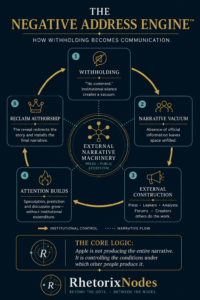
Negative Address is not mere silence, in the sense of an absence of output.
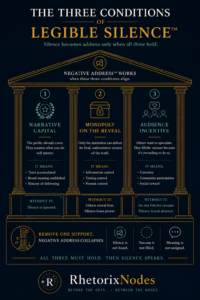
It is a highly structured performance of absence, staged in front of an audience already trained to notice it. Three conditions make it work, and their absence is exactly why the concept does not transfer to just any company that declines to comment.
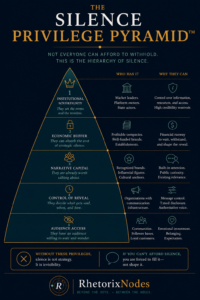
Negative Address requires pre-existing narrative capital, i.e., an audience already primed to treat an institution’s silence as meaningful rather than merely uninformative.
A hardware store that declines to discuss its next shipment generates no speculation, because nobody is listening for it. Apple’s silence is legible as a signal only because decades of keynote spectacle, product mythology, and design rhetoric already established the company as a subject worth speculating about.
The silence does not create the mystique; it spends mystique that was built elsewhere, through the loudest, most controlled forms of address the company has ever produced.
It requires a monopoly on the reveal: a guaranteed channel, a keynote stage or a press release, through which the withholding party can reabsorb the narrative it delegated.
This is the part that separates Negative Address from ordinary secrecy.
An agency that stonewalls a records request is also withholding, but it has no scheduled event at which it will triumphantly resolve the withholding into a satisfying disclosure.
Apple’s non-comment is only ever a temporary loan against a future keynote; the withholding has an expiration date built into it from the start, and that expiration date is the entire point.
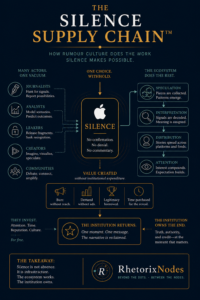
It requires an audience like trade press, forums, analysts, video channels, with its own commercial incentive to fill the vacuum on the withholding party’s behalf, for free.
Rumour culture is not incidental to Apple’s silence; it is the unpaid labour force that makes the silence productive rather than simply blank.
Every leaked render and every supply-chain rumour does market research and pre-launch hype generation that Apple never has to budget for, and never has to be right about, since responsibility for any inaccuracy sits entirely with the leaker.
Where any of the three conditions is missing, withholding stops functioning as address and reverts to what it actually is: an absence of information, with no guarantee that the meaning assigned to it will be the one the withholding party wants.
Why withholding only reads as confidence for brands that already have narrative capital to spend — and what happens to the strategy when that capital runs short, as it did around Apple’s 2018 sales disclosures.
This is the least flattering part of the analysis, and the part most often left out of the “Apple is a genius of silence” genre of business writing: Negative Address is not a technique any brand can adopt by declining to answer its email.
It is available only to institutions that have already accumulated enough narrative capital, enough channel control, and enough audience appetite that withholding reads as confidence rather than as evasion or simple absence.
Scarcity signals value only within a field that has already agreed to treat that particular scarcity as meaningful, and the agreement itself is the product of a long, prior history of assertive, expensive, highly art-directed communication.
Apple’s 2018 decision to stop reporting how many iPhones it sold each quarter is a useful test case.
Framed by the company as a shift toward more meaningful metrics — its finance chief argued that “a unit of sale is less relevant” given the spread of prices across the product line — the change was widely read instead as camouflage for slowing unit growth, and it produced not confident silence but an immediate, sharp drop in the share price.
The withholding functioned as a hedge against a bad number becoming a recurring headline; it did not function as narrative control in any strong sense, because the market filled the vacuum with the least charitable available story, and Apple has spent every earnings call since fielding variations on the same question anyway.
The honest version of the thesis, then, is not that Apple controls narrative through silence.
It is that Apple, having already secured an unusually large and unusually motivated audience through decades of loud, expensive, meticulously art-directed communication, can occasionally convert a specific, well-timed refusal to speak into free promotional labour and a controlled reveal — and that the same refusal, applied to a controversy or a bad quarter rather than an unreleased product, tends to buy a few weeks of quiet at best before the company has to do what every other company eventually has to do, which is talk.
Returning to the September keynote ritual to show what is actually being managed, and by whom, when a company appears to say nothing at all.
Return, then, to the September ritual: the leaked renders, the confident predictions, and the keynote that confirms what the internet had already assembled.
It is easy to mistake the calm at the centre of that ritual for a company that has transcended the need to speak. What it actually is, is a company that has arranged to have everyone else speak for it, on schedule, for free, right up until the moment it decides to speak for itself.
That is not silence controlling the narrative. In fact, it is narrative control, achieved, as it usually is, through the careful management of who gets to talk, and when, with silence serving, for exactly as long as it is useful, one instrument among many.
Only partially. Apple deploys two distinct kinds of silence: anticipatory silence around unreleased products, which functions as free promotional labor, and reactive silence around controversies, which is far less reliable and often gives way to loud, assertive rhetoric, as in the 2010 Antennagate press conference and the 2016 FBI encryption letter.
A RhetorixNodes framework describing a mode of communication that produces meaning through a conspicuous, temporary refusal to assert — delegating narrative authorship to external audiences while reserving the right to reclaim it at a chosen reveal moment. It depends on three conditions: pre-existing narrative capital, a monopoly on the reveal channel, and an audience incentivized to fill the vacuum for free.
No. Negative Address is only available to institutions that already have significant narrative capital, channel control, and audience appetite. Without those, withholding information reads as evasion or simple absence rather than confidence.
Find hidden frames and structures where the dots and nodes cease to be objects.
Response time. We reply within 48 hours. No automated responses — a real person reads and responds.
While you wait. Explore the nodes — Decode, Roots, Dark Matter, The Loop, and Meta are all live.
Stay in the loop. Subscribe to The Dispatch and get notified the moment the next essay goes live.
Every new essay arrives in your inbox before it reaches social media or the feed.
Long-form structural analysis that teaches you to read media — not just react to it.
One email per essay. No digests, no roundups, no promotions. Unsubscribe in one click.