

Open TikTok and scroll for ten seconds, and you are already living inside a decision no one signed. Somewhere upstream, in a testing loop no user ever sees, a video has already survived a cut, or been quietly retired, long before it reached your feed.
Every explainer on how this happens arrives at the same destination: a list of ranking signals, a shrug about the black box, and a tactical checklist for creators chasing the next upload.
That treatment answers what the algorithm rewards while skipping the more interesting question: what kind of gate this is, structurally, and whether the vocabulary built for editorial gatekeeping still describes it. Gate Architecture™ and Differential Permeability™ were built to name platforms as systems of thresholds: technical, economic, and algorithmic barriers determining which content and which actors pass through to reach an audience.
TikTok’s recommendation system does not just pass through that vocabulary. It stress-tests it. There is no single gate here, no one moment where a video is let in or turned away. There is a gate that reopens itself, at a different width, every time something manages to survive the version that came before it.
Lewin and White modeled gatekeeping as one editor rendering one verdict on a bounded pool; TikTok replaces that single decision with a graduated sequence of exposure tests, each one determining access to the next.
The gatekeeping tradition in media theory — Kurt Lewin’s channel theory, David Manning White’s study of a wire editor — modeled a single gatekeeper reviewing a bounded pool of submissions and rendering one verdict per item: in or out.
Once through, content was broadcast to an undifferentiated mass audience with no further filtering. The decision point was singular, human, and final.

TikTok’s system has no equivalent moment.
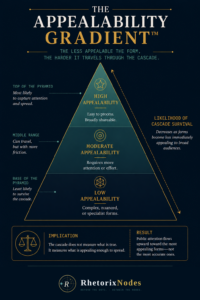
A video is not accepted or rejected once; it enters a graduated sequence of exposure. It is shown first to a small sample of users the system judges likely to be receptive, and its survival to the next round depends on whether it clears an engagement bar set relative to other content in its category — not against a fixed standard, and not by a person.
Passing the first test does not confer standing. It only earns entry into a harder one.
From a first batch of a few hundred viewers to audiences in the tens of thousands, each stage of the cascade re-tests a video against completion rate, replay rate, shares, and comment quality, with no single human review at any point.
The pattern reported consistently by creators and platform researchers runs roughly as follows: an upload is shown to a first batch in the low hundreds, drawn from users with a demonstrated interest in similar content. If completion rate, replay rate, shares, and comment quality clear the bar for that category, the video advances to a batch in the low thousands.
Continued above-average performance pushes it further, into the tens of thousands and beyond, until engagement normalizes relative to the widening audience and distribution plateaus.
Two features of this cascade matter more than the specific numbers.

Account tenure, follower count, and prior virality do not carry forward as standing; each new video is a fresh entrant into its own cascade. It is worth flagging the epistemic limit here: TikTok has not published the exact weighting of these signals, and the specific thresholds described by creators and marketing researchers are inferred from outside the system rather than confirmed by its architecture.
What can be stated with confidence is the shape of the mechanism — staged, comparative, non-cumulative — not its precise coefficients.
Differential Permeability™ described a gate that resolves in one decision; Cascading Permeability™ names the version that reapplies at increasing scale, where each round’s survival changes the odds and the cohort for the next.
Differential Permeability™, as originally formulated, describes how a gate admits some content or actors and excludes others based on structural criteria like institutional standing, format compliance, and resource access, applied at a single decision point.
Cascading Permeability™ names a related but distinct mechanism: a gate that applies its criteria repeatedly, at increasing scale, such that passage through one round changes the population being tested in the next, and the odds of passing tighten or loosen relative to a shifting cohort rather than a fixed rule.
Three features distinguish it from a single-threshold gate.
There is no singular moment of admission or rejection, only a sequence of provisional survivals. The criteria are relative to a cohort that itself changes shape between rounds, rather than fixed in advance.
And survival compounds without accumulating: passing round one is not credit banked toward round two, it is simply the price of entry into a harder test with no memory of the last one passed.

Before any critique, the platform’s own claim earns a full hearing: a zero-follower account can out-reach an established one purely on engagement, a genuine structural break from the accreditation legacy media required
The platform’s own framing, echoed widely in creator-economy commentary, deserves to be stated in its strongest form before it is examined: this system replaced institutional accreditation with a meritocracy of engagement.
A new account with no followers can reach an audience of millions on the strength of a single video, because the cascade does not ask who posted it, only whether the first few hundred viewers kept watching.
That is a real structural break from legacy distribution, where reach required prior accumulation, i.e., a broadcast license, a publishing contract, a subscriber base built over years on an earlier platform.
Removing that precondition is a genuine gain in who can, in principle, reach an audience, and it should be credited as such rather than dismissed as a marketing line.
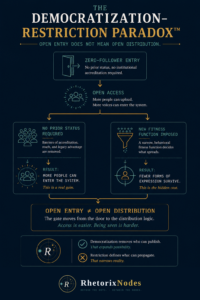
Open entry conceals a narrow and unappealable fitness function — hooks, loopability, keyword-legible captions — where rejection has no editor to petition and no single decision to contest.
Though the entry point is open, the fitness function is not.
It rewards a narrow and non-negotiable set of formal properties, i.e., a fast hook, a loopable structure, a duration and pacing legible to the categorization system, captions and on-screen text that match spoken keywords.
Content that does not fit these formal constraints is filtered out in the first round regardless of its merit by any other standard, and it receives no appeal, because there is no single decision-maker to petition. The filter is distributed across a few hundred anonymous viewers rather than lodged in an accountable editor.
This is the asymmetry the democratization claim tends to elide. Editorial rejection, whatever its faults, is at least contestable in principle like a different editor, a different outlet, a changed masthead.
Cascading permeability offers no equivalent recourse, because its criteria are read from aggregate behavior rather than issued by an identifiable party.
The claim that no institutional accreditation is required is accurate. The inference that filtering is therefore less restrictive does not follow from it, and may run the other way: a continuous, re-applied, unappealable test can be more totalizing than a single veto, precisely because there is no gate to point to and no gatekeeper to hold to account.
Most platforms mix single-threshold and cascading gates at different layers; situating Cascading Permeability™ within Gate Architecture™ shows where each logic applies, and what that means for who can appeal a rejection.
Cascading Permeability™ extends Gate Architecture™’s vocabulary rather than supplanting it.
Most platform systems are hybrids: single-threshold at some layers — account suspension, content-policy strikes, monetization eligibility — and cascading at others, chiefly the recommendation layer that decides ordinary reach.
The analytic payoff of separating the two is narrower than a claim to have explained TikTok. It is a template for asking, of any recommendation system, whether distribution is gated once or gated repeatedly and what that difference means for who gets to appeal a rejection, and who never learns a decision was made at all.
Cascading Permeability™ names a gate that applies its admission criteria repeatedly, at increasing scale, rather than once. Each round of survival changes the population being tested in the next round, and the odds of passing tighten or loosen relative to a shifting cohort instead of a fixed rule, unlike a single-threshold gate, which resolves in one pass/fail decision.
TikTok’s algorithm replaces a single editorial verdict with a staged sequence of tests. Classical gatekeeping involved one gatekeeper reviewing a bounded pool and rendering one decision per item. TikTok instead runs every upload through progressively larger test batches, with survival at each stage judged against the current performance of similar content rather than a fixed editorial standard.
Does TikTok’s algorithm democratize distribution? In one real sense, yes: a zero-follower account can reach a large audience purely on a video’s early engagement, which removes the accreditation barrier, including a broadcast license, a publisher, an accumulated subscriber base, that legacy distribution required.
The honest limits sit at the fitness function, not the entry point. Entry is open to anyone, but survival rewards a narrow, non-negotiable set of formal properties like fast hooks, loopable structure, keyword-legible captions, and content that doesn’t fit is filtered out with no appeal, since the criteria are read from crowd behavior rather than issued by an accountable editor.
Find hidden frames and structures where the dots and nodes cease to be objects.
Response time. We reply within 48 hours. No automated responses — a real person reads and responds.
While you wait. Explore the nodes — Decode, Roots, Dark Matter, The Loop, and Meta are all live.
Stay in the loop. Subscribe to The Dispatch and get notified the moment the next essay goes live.
Every new essay arrives in your inbox before it reaches social media or the feed.
Long-form structural analysis that teaches you to read media — not just react to it.
One email per essay. No digests, no roundups, no promotions. Unsubscribe in one click.