

Picture the old newsroom gate as a physical thing: a wooden desk, a wire machine clattering out more copy than any page could hold, and a man with a blue pencil making the same kind of decision a hundred times a day — this goes, this doesn’t.
There is a gatekeeper in this image.
That image is durable enough that it still shapes how we talk about platforms, as though somewhere inside the app there is an equivalent desk, an equivalent pencil, an equivalent moment of this goes, this doesn’t.
There isn’t. The gatekeeping meaning has changed. The gatekeeper meaning is also not the same as before.
What replaced the desk doesn’t make a hundred decisions a day. It makes billions, continuously, differently, for every person looking at the same piece of content at the same moment… and calls none of them a decision at all. Before asking what platforms let through, it’s worth asking whether “letting through” is still the right way to describe what they do.
Now is the time to see gatekeeping differently: beyond the gates, between the platforms.
Gatekeeping theory was built around a person, a desk, and a decision — a model this essay argues no longer fits.
Kurt Lewin gave communication studies its founding metaphor in 1947: information moves through a society along channels, punctuated by gates where an individual or group decides what passes and what doesn’t.
David Manning White took that abstraction and put a name and a face on it three years later — “Mr. Gates,” the wire editor who White shadowed as he decided, story by story, what made it onto the newspaper page. The gate, in this founding study, was a desk. The decision was discrete: in, or out. The decider could be interviewed, and was.
Pamela Shoemaker and Timothy Vos later systematized this into a five-level model: individual, routine, organizational, institutional, and social-system gatekeeping. But even at its most structural, the theory kept the shape White gave it: a finite set of items competing for passage through a finite set of gates, each gate operated by an identifiable actor applying identifiable criteria.
Axel Bruns’s concept of “gatewatching” pushed against this in the 2000s, arguing that in networked news environments the public increasingly watches and redistributes around the gate rather than waiting for it to open. That was an important correction. It was still, however, a theory of gates: plural, contested, sometimes bypassed, but still countable, still locatable.
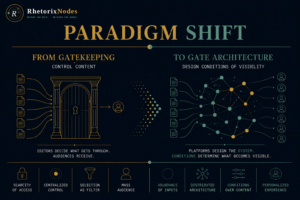
Three assumptions carried the whole model, and none of them survive contact with a ranking algorithm.
Strip the theory to its load-bearing assumptions and three remain.
First, sequentiality: content approaches a gate, a decision is made, content proceeds or doesn’t i.e., a single event with a before and an after.
Second, uniformity: once a gate opens, what passes through is roughly the same for everyone downstream of it. A story that made the evening broadcast played on every set tuned to that channel.
Third, locatability: the gate is somewhere, and someone is at it. Even in the most institutional version of gatekeeping theory, the institution has address.
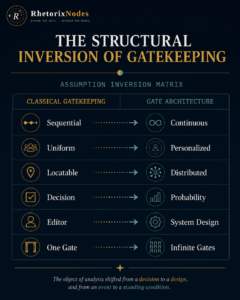
None of these three assumptions is simply weakened by algorithmic distribution. They are replaced by their opposites.
Ranking is not a decision made once; it is a probability recalculated per user, per session, per scroll.
A ranking algorithm does not decide whether a post passes through a gate. It computes, continuously and per-viewer, a probability that this particular account will engage with this particular item at this particular moment, and orders a feed accordingly.
There is no single moment of in or out — there is a constantly re-scored position in a queue that different people never see in the same order, or sometimes at all.
Tarleton Gillespie’s account of platforms as “custodians” captures the discretion involved, but even custodianship implies a keeper making a bounded set of choices about a bounded set of things. Ranking is not custodianship of a collection. It is generation of a collection, freshly, for every viewer.
Taina Bucher’s “if… then” framework for algorithmic power is closer to what’s actually happening: platforms don’t gate content so much as they encode conditional rules — if this signal, then this visibility — that produce different outcomes for the same piece of content depending on who is asking and when.
This is where uniformity breaks. A post is not published to an audience; it is distributed into thousands of slightly different audiences, each receiving a differently weighted version of its visibility. The same status update can be a rocket for one follower’s feed and a rumor for another’s, and both of those results are correct outputs of the system, not glitches in it.
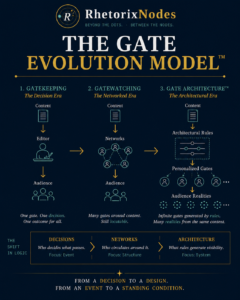
The proprietary distinction this essay proposes: a gatekeeper decides what passes through one gate; a gate architect designs the conditions under which countless gates open differently for everyone at once.
Call this Gate Architecture™: the platform’s role is not to operate a gate but to design the rule-set that generates an unbounded number of situational, personalized gates simultaneously, none of which is fully visible even to the architect at the moment any single one of them opens.
The architect sets the parameters, which signals matter, how much recency counts against relevance, what counts as engagement, what gets down-ranked by default, and then the system produces gates as an emergent property of those parameters interacting with billions of individual behavioral signals in real time.
The useful sub-concept here is Differential Permeability™: the same piece of content is simultaneously more permeable and less permeable depending on the specific viewer, and both states are true at once, produced by the same architecture.

Classical gatekeeping could only ever describe one gate’s decision about one item. Gate architecture describes a system generating a distribution of decisions about that same item, no two identical, none of them final.
This is a stronger claim than the familiar observation that “platforms have more power now than editors did.” The claim is structural, not just a difference of degree: the object of analysis has changed from a decision to a design, and from an event to a standing condition.
Gatekeeping theory has tools for describing decisions. It was never built to describe a condition that regenerates itself differently for every user, every time.
The honest counterargument: platforms still ban, demonetize, and remove — discrete acts that look exactly like classical gatekeeping. This is where the framework has to hold its ground or fold.
This distinction would collapse if discrete gatekeeping had simply disappeared, and it hasn’t.
Content moderation removals, demonetization decisions, and account suspensions are discrete, binary, sequential, and crucially, attributable in exactly the way White’s wire editor was.
A platform’s trust and safety team deciding to remove a video is a gatekeeper decision in the fullest classical sense: an identifiable actor, applying stated criteria, to a specific item, with a before and an after. Anyone arguing that gatekeeping has been superseded needs an answer for this, and “it still happens sometimes” is not a defense of the framework, it’s a concession that undercuts it.
The defensible version of the claim is narrower and, I think, more useful: discrete gatekeeping and gate architecture coexist, but they do different explanatory work and operate at different scales of everyday life.
Moderation decisions are rare, visible, and disproportionately what gets studied, reported on, and legislated around… precisely because they resemble the gatekeeping model well enough to be legible to journalists, regulators, and researchers trained on that model.
Gate architecture is the reverse: it is constant, invisible, and almost never what gets studied, because it doesn’t produce a single decision anyone can point to. The everyday texture of who sees what, and how often, and how much reach an ordinary post gets relative to another, is overwhelmingly a product of architecture, not of the comparatively rare discrete act of removal.
The theoretical stakes of this essay are about the 99% of visibility outcomes that are never a moderation decision at all… not a claim that moderation has vanished.
Ranking signals, feedback loops, and engagement optimization are the substance of the architecture, not incidental technical detail.
The mechanism runs on signals (time-on-post, completion rate, reply likelihood, historical affinity between accounts, recency decay, and dozens of others specific to each platform) combined through a model that is retrained continuously on the aggregate behavior it is also shaping.

This produces a feedback loop that Zeynep Tufekci and others have described in the context of algorithmic amplification: the system doesn’t just predict engagement, it learns from the engagement its own predictions generated, which means the architecture is never static even when its designers haven’t touched a parameter in months.
José van Dijck’s account of “platform society” is useful here for a different reason: it insists that these mechanisms are not neutral infrastructure sitting beneath social life but are themselves constitutive of the social relations they claim only to transmit. The architecture is not a pipe content passes through; it is part of what produces the social relation between the content and its readers.
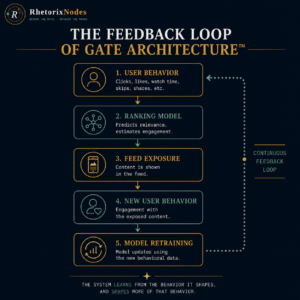
It is worth being precise about what this feedback loop does and doesn’t imply. It does not imply intent in the sense White’s wire editor had intent because no one at the platform decided your specific post should reach fewer people than your neighbor’s.
It implies something arguably harder to hold accountable: an outcome that is fully caused by decisions (which signals to weight, which behaviors to optimize for) while remaining, in its specific instance, decided by no one.
The diffusion of responsibility is not a side effect of gate architecture. It is close to the point of it, whether or not that was ever anyone’s intention.
Classical gatekeeping carried an implicit accountability structure: a decision this consequential needs a decider, and a decider can be asked to justify the decision. Gate architecture inherits none of this by default.
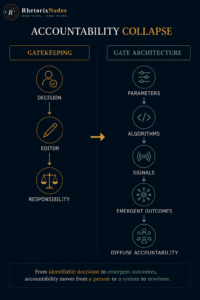
When an ordinary user’s reach fluctuates by an order of magnitude between two similar posts, there is no decider to interview, no criteria document to request, and often no internal record of why that specific gate opened the way it did for that specific person. The outcome is an emergent property of a model interacting with signals, not a decision that was made and could be unmade.
Shoshana Zuboff’s account of surveillance capitalism names the underlying logic driving this design: behavioral data is the raw material, and prediction, including predicting what will hold attention long enough to generate more data, is the product being refined. Differential permeability is not a flaw in that system; it is closer to the intended output.
A gate architecture that let the same content through uniformly to everyone would be leaving prediction accuracy, and therefore revenue, on the table. The inequality of reach is not a bug the architecture tolerates. It is closer to the thing the architecture is for.
Where this framework overreaches, where it can’t be verified, and where the old vocabulary still does necessary work.
Three limits deserve to be stated plainly rather than folded into a caveat clause.
First, this essay’s account of mechanism is necessarily inferential: platform ranking systems are proprietary and largely undisclosed, so “gate architecture” describes the shape of the system as reconstructed from patents, leaked documentation, researcher audits, and platform statements — not from direct access to any specific ranking model. That inferential gap should be treated as a permanent feature of this kind of analysis, not a temporary one awaiting more disclosure.
Second, the architecture framing risks over-correcting into a picture where no one is responsible for anything, which is its own distortion. The parameters that generate differential permeability were still chosen by people, inside organizations, answerable to specific incentive structures. “Emergent” and “unaccountable” are not synonyms, even though the architecture makes them feel that way in practice; collapsing the two lets real design choices hide behind the complexity of their own downstream effects.
Third, classical gatekeeping theory is not actually obsolete. It remains the correct tool for the discrete, attributable decisions platforms still make, and reaching for “architecture” to describe a content-moderation removal would be a category error in the other direction. The two frameworks divide the territory; neither one covers all of it.
Not a bigger villain, but a different kind of object: one that classical media theory’s vocabulary was never built to hold.
The useful outcome of this reframing isn’t a verdict on whether platforms are worse gatekeepers than editors were. It’s a recognition that the object being analyzed changed shape, and that a good deal of contemporary confusion about platform accountability comes from applying gatekeeping’s vocabulary of decisions, deciders, and discrete gates to a system whose defining feature is that it produces different, simultaneous, unrepeatable outcomes for everyone it touches.
Gate architecture doesn’t replace gatekeeping theory so much as mark the boundary of where that theory’s explanatory power runs out… and where a different question has to start: not who decided, but what was designed to decide differently for everyone, all the time.
Gate Architecture is the proposed successor concept to classical gatekeeping: rather than an actor operating one gate and deciding what passes, a platform designs the rule-set — the ranking signals, weights, and defaults — that generates an unbounded number of situational, personalized gates simultaneously, none identical, none final.
Classical gatekeeping, from Lewin and White through Shoemaker and Vos, assumed sequential decisions, uniform outcomes, and a locatable decider. Gate Architecture replaces sequential with continuous, uniform with differential, and locatable with distributed.
Differential Permeability describes how the same piece of content is simultaneously more visible to some viewers and less visible to others, produced by the same underlying ranking architecture rather than by separate decisions about separate items.
No. Discrete content moderation, demonetization, and account suspension remain classical gatekeeping decisions with an identifiable actor and criteria. The claim is narrower: gate architecture explains the much larger share of everyday visibility outcomes that are never the product of any single moderation decision.
Find hidden frames and structures where the dots and nodes cease to be objects.
Response time. We reply within 48 hours. No automated responses — a real person reads and responds.
While you wait. Explore the nodes — Decode, Roots, Dark Matter, The Loop, and Meta are all live.
Stay in the loop. Subscribe to The Dispatch and get notified the moment the next essay goes live.
Every new essay arrives in your inbox before it reaches social media or the feed.
Long-form structural analysis that teaches you to read media — not just react to it.
One email per essay. No digests, no roundups, no promotions. Unsubscribe in one click.