

It was just a model to solve a wiring problem, until it wasn’t.
A model built to solve a wiring problem worked so well that entire disciplines adopted it as a theory of the communicative act itself.
This essay isolates three assumptions that only held because the channel used to be dumb, and asks what breaks once the channel starts making decisions of its own.
How Shannon’s 1948 paper and Weaver’s 1949 introduction split the technical problem from the semantic one and why only the first was ever actually solved.
Claude Shannon did not set out to explain communication. He set out to solve an engineering problem: how to move a signal through a wire with the fewest errors, at the highest possible rate, given a fixed amount of noise. Warren Weaver’s 1949 introduction extended this into three nested problems:
The technical (how accurately can symbols be transmitted)
The semantic (how precisely do transmitted symbols convey meaning)
The effectiveness (how successfully does received meaning produce desired conduct)
But the model itself, the diagram everyone remembers — sender, encoder, channel, noise, decoder, receiver — was built to answer only the first question.
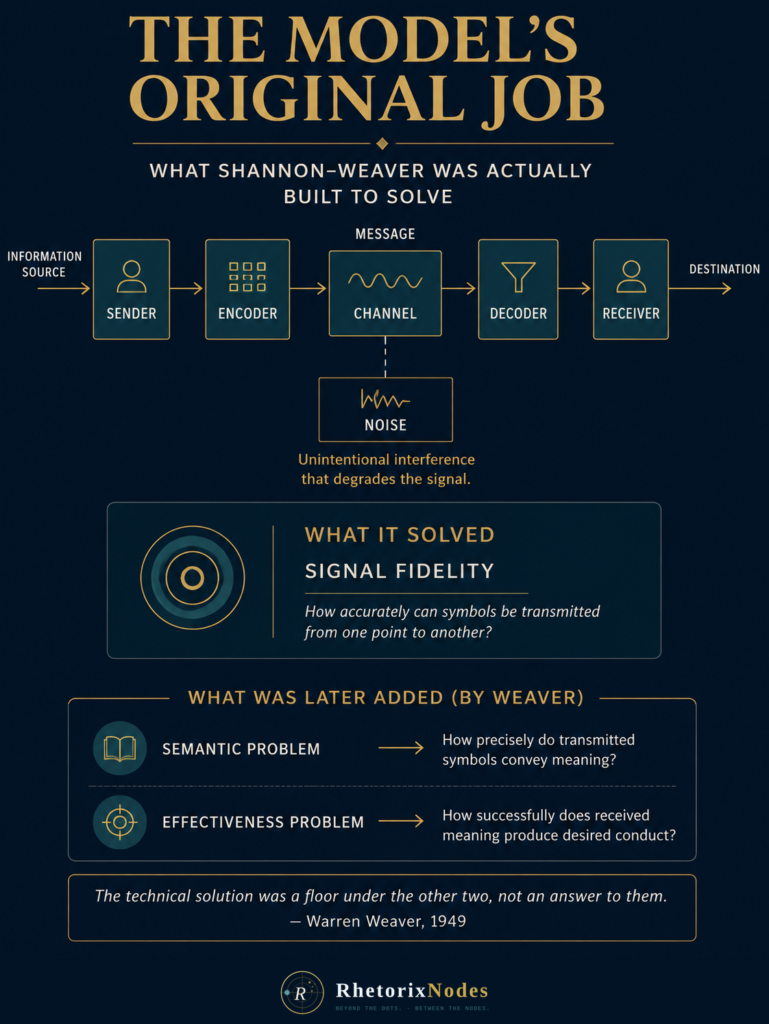
Weaver was explicit that the technical solution was a floor under the other two, not an answer to them. This is worth restating because most critiques of Shannon and Weaver treat the model as a failed theory of meaning.
It was never a theory of meaning. It was a theory of fidelity, later borrowed by disciplines that needed a diagram more than they needed Shannon’s actual claims. The borrowing is where the trouble starts.
Linearity, neutral noise, and a stable receiver: three premises a telephone line could support and a feed cannot.
Three assumptions did the model’s load-bearing work, and each was reasonable for a telephone line in 1949 and untenable for a feed in 2026.
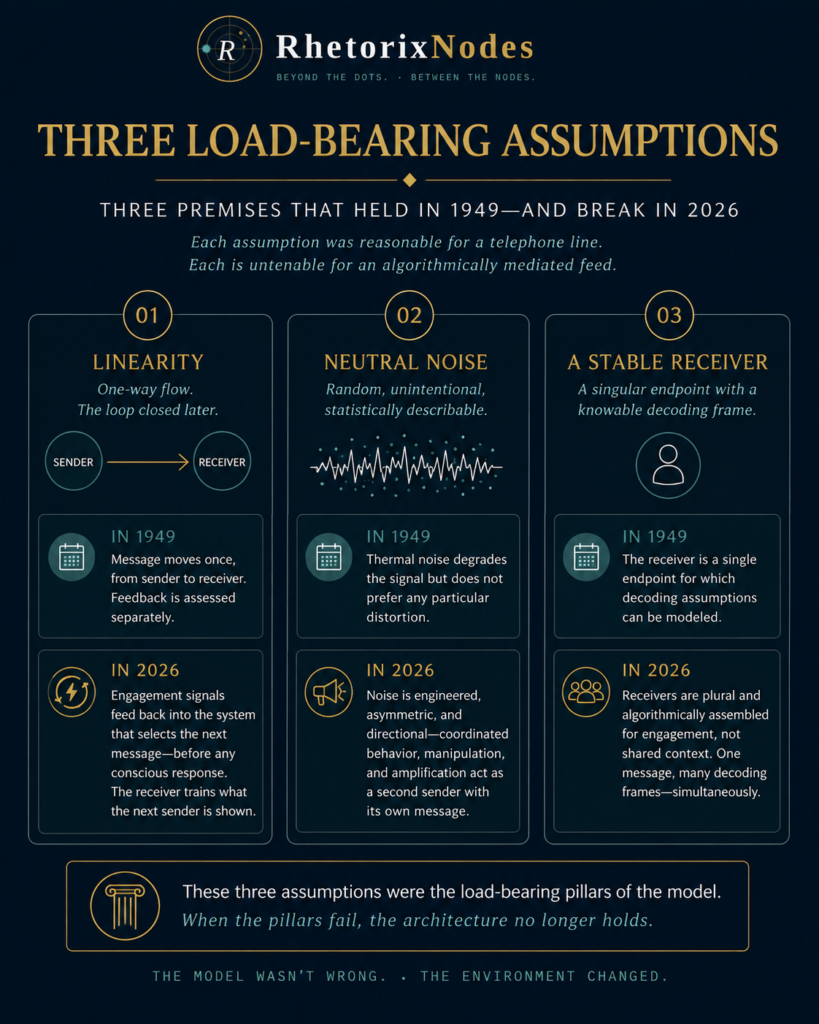
Linearity. Sender, channel, receiver — a message moves once, in one direction, and the loop closes only when Weaver’s semantic and effectiveness problems are separately assessed.
However, today’s channel does not wait for that separate assessment. Engagement signals (dwell time, scroll velocity, replay rate) feed back into the system that selects the next message before any human has consciously responded to the last one.
The “receiver” in Shannon’s diagram was an endpoint. The receiver in a recommendation system is also, simultaneously, a training signal shaping what the next sender is shown is possible to say.
Neutral noise. Shannon’s noise was thermal: symmetric, unintentional, statistically describable. It degraded the signal without preferring any particular distortion. Modern noise is frequently the opposite: engineered, asymmetric, and directional.
Coordinated inauthentic behavior, SEO manipulation, and bot amplification are not static on the line; they are a second sender with its own message, riding the same channel as the first and often overpowering it. Treating this as “noise” in Shannon’s sense — something to be averaged out with a wider bandwidth — misdescribes what is actually an adversarial transmission problem.
A stable receiver. The model presumes a receiver whose decoding frame is knowable enough to be worth modeling. Context collapse was already a known problem before algorithmic distribution like a tweet reaching your boss and your college roommate at once, but the current environment makes it structural rather than incidental.
A single piece of content is algorithmically routed to audiences selected for engagement propensity, not for shared decoding frames, and it reaches all of them in the same instant. There is no longer a single receiver to calibrate for, and the model has no variable for a plural, algorithmically assembled one.
Why folding algorithmic distortion into “noise” obscures the one thing that matters: intent.
The clearest gap is the second one, and it is worth giving it a name rather than folding it into “noise” and moving on. Call it Curatorial Noise™: the systematic, intent-bearing distortion introduced by a mediating system whose objective function is not signal fidelity but a proxy for it — engagement, watch time, session length — optimized on the system’s own behalf rather than the sender’s or receiver’s.
The distinction from Shannon’s noise is not cosmetic. Shannon’s noise is something a sender can engineer against: add redundancy, increase signal strength, use an error-correcting code, and fidelity improves predictably. Curatorial Noise™ does not yield to the same countermeasures, because it is not trying to preserve the signal at all… it is selecting among signals according to a criterion orthogonal to what the sender meant or the receiver needed. More redundancy does not help a message that the curating system has simply decided not to route.
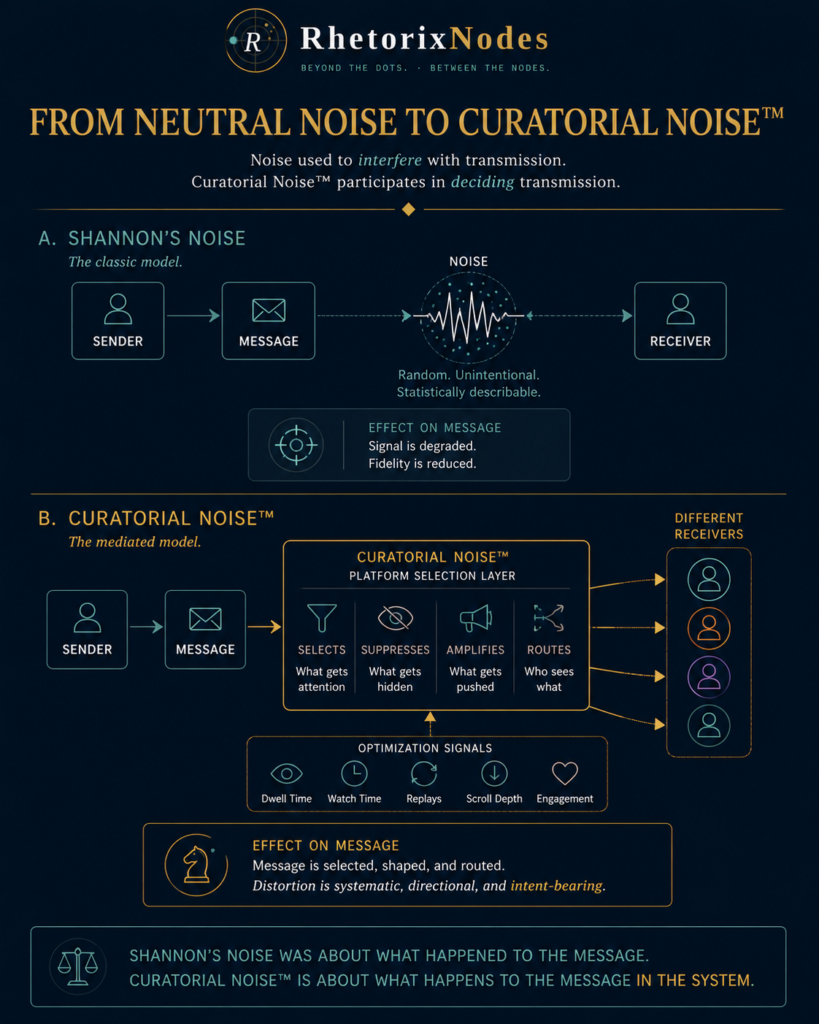
This is closer to Weaver’s semantic and effectiveness problems than to his technical one, except that it happens before meaning is assessed, not after — a filtering layer with its own logic, sitting between the channel and the receiver, that the original model has no slot for.
Curatorial Noise™ operates inside a transmission event already underway, describing how a formed message gets selected or routed. It sits one layer downstream of a broader claim explored elsewhere on RhetorixNodes: Ambient Mediation™, which argues that defaults, feeds, and ambient interfaces shape the field of possible messages before any signal is sent at all (see “Ambient Mediation: How Feeds and Defaults Decide What Gets Sent”). Curatorial Noise™ is best read as one mechanism operating within an Ambient Mediation™-shaped environment, not a competing account of the same layer.
Distinguishing the symbolic feedback later cybernetic extensions added from the sub-symbolic telemetry that actually drives recommendation systems today.
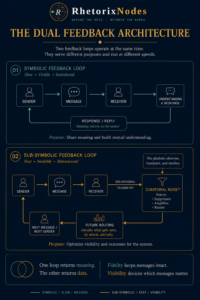
Shannon’s diagram is famously missing a feedback arrow: a fact addressed at length in later cybernetic extensions of the model. But even those extensions generally treat feedback as a second, distinct message traveling back along the same architecture: receiver becomes sender, sends a correction, original sender adjusts.
That, too, understates the current situation.
The feedback in an algorithmic environment is not a message in Shannon’s sense at all. It is telemetry i.e., sub-symbolic, continuous, and never addressed to the original sender, who typically never sees it. The system that receives it is not the human who sent the original message; it is the platform, optimizing a future routing decision.
A model built to add this back in would need two feedback loops, not one: a slow, symbolic one running sender-to-receiver-to-sender, and a fast, sub-symbolic one running receiver-to-platform-to-next-sender, with the second loop typically dwarfing the first in both speed and volume.
Weaver’s tiered structure already routes platform effects to the semantic layer — the case that the technical core needs no new term at all.
None of this means the model deserves the wholesale rebuild this essay has been describing, and the strongest version of that objection is worth stating plainly.
Shannon’s abstraction was deliberately, productively empty of meaning, context, and intent. That emptying is precisely what let it travel across telephony, genetics, and cryptography with genuine explanatory force in each.
A model retrofitted with Curatorial Noise™, dual feedback loops, and plural receivers stops being a general theory of transmission and becomes a specific description of one historical media configuration — accurate for 2026, obsolete by design the moment the architecture changes again, and no longer exportable to the next domain that needs a transmission diagram.
Weaver’s tiered structure already provides an answer for where platform effects belong: they are semantic and effectiveness problems, layered on top of an unmodified technical model, not evidence that the technical model itself is broken. On this view, what this essay calls a missing layer is better understood as Weaver’s own containment strategy working as designed: keep the technical core clean, and push everything context-dependent into the layers built to hold it.
The rebuttal is that the containment strategy only works if the technical layer stays genuinely neutral, and Curatorial Noise™ is a counterexample to that neutrality: it operates on symbols before semantic assessment, at the technical layer’s own altitude, not above it.
But this is a live disagreement about where a boundary sits, not a settled result, and readers with more confidence in tiered models than this essay has should weigh it accordingly.
Where Curatorial Noise™ lacks a measurement method, and where its evidence stops short of channels without algorithmic mediation.
This essay describes a gap in a widely borrowed diagram; it does not offer a formal replacement model, and Curatorial Noise™ is a naming device, not a measurement instrument. Nothing here specifies how curatorial distortion would be quantified against Shannon’s information-theoretic apparatus, which was built to be measured.
The argument also draws its evidence primarily from recommendation-system-mediated platforms; it has not been tested against channels where curatorial mediation is thin or absent like direct messaging, email, print, where the original model may still hold with little modification.
The three failure points should be treated as a diagnosis of where the model strains, not as a demonstrated case that it has ceased to be useful.
That’s where this article comes full circle, and the resonating question persists: What If Shannon and Weaver Built Their Model Today?
No. Shannon’s mathematical theory addressed signal fidelity; Weaver’s introduction separated this from semantic and effectiveness problems, which the model itself does not solve.
A proposed term for algorithmic distortion that selects among signals according to a platform’s own optimization target, rather than degrading a signal randomly the way Shannon’s original noise did.
No. Classical feedback extensions model a symbolic message traveling back to the original sender; algorithmic feedback is largely sub-symbolic telemetry that trains the platform rather than reaching the sender at all.
Not straightforwardly. Its abstraction still travels well across domains that lack curatorial mediation; the case in this essay is narrower, which is that the model strains specifically in algorithmically mediated environments.
Find hidden frames and structures where the dots and nodes cease to be objects.
Response time. We reply within 48 hours. No automated responses — a real person reads and responds.
While you wait. Explore the nodes — Decode, Roots, Dark Matter, The Loop, and Meta are all live.
Stay in the loop. Subscribe to The Dispatch and get notified the moment the next essay goes live.
Every new essay arrives in your inbox before it reaches social media or the feed.
Long-form structural analysis that teaches you to read media — not just react to it.
One email per essay. No digests, no roundups, no promotions. Unsubscribe in one click.