

In 1948, a Bell Labs engineer sketched a diagram to keep static off a telephone line, and communication theory has been reading meaning into it ever since.
Sender, channel, receiver, noise — the drawing was built for signal loss, yet it quietly became the mental architecture an entire discipline reached for whenever it needed to picture one mind trying to reach another.
The trouble is that the built world the diagram now has to explain looks nothing like a telephone wire. It looks like a feed: a standing environment engineered to decide, continuously and invisibly, which signals ever earn the chance to travel at all. Shannon and Weaver never wrote for that world.
This essay asks what changes when environment, rather than signal, becomes the thing communication theory has to explain.
The Shannon-Weaver model explains how signals move cleanly through noisy channels, but it was never built to explain why algorithmic environments like feeds, defaults, ambient interfaces, determine which messages reach which people in the first place. This essay argues the transmission model remains accurate but insufficient, and introduces Ambient Mediation™ as the framework needed to account for communicative power operating at the level of environment rather than signal.
A 1948 engineering paper answers a narrower question than the field that inherited it.
RhetorixNodes has already traced this ground in detail: Shannon’s engineering-only claim, and Weaver’s three-tier extension into the technical, semantic, and effectiveness problems, along with Weaver’s own caveat that the mathematics solved only the first tier (see “What If Shannon and Weaver Built Their Model Today?”).
What matters for this essay is what came after that caveat: it did not survive the model’s popularization, and communication theory kept asking the technical layer a semantic question.
A diagram built for signal loss became, for two generations of communication scholars, a diagram for meaning loss.
Textbook communication theory absorbed the Shannon-Weaver model as a general-purpose account of the communicative act, not an engineering abstraction that happened to be borrowed.
Sender, message, channel, receiver, noise, feedback: the vocabulary migrated into interpersonal, organizational, and mass communication scholarship with barely a caveat. The move was seductive because it was clean. It gave communication a diagram, and diagrams travel well in textbooks and lecture slides.
The cost of that portability was conceptual. Once “noise” stood in for everything from static on a phone line to a listener’s cultural assumptions, the term stopped doing analytical work.
Once “message” implied a stable unit that survives transmission intact, the model quietly assumed what interpretive and critical traditions — Goffman’s frame analysis, Hall’s encoding/decoding, the entire constructivist turn — spent decades arguing against: that meaning is not a payload carried by a channel but something reconstructed, unevenly, by a receiver embedded in a context the model has no room to represent.
This is not a claim that Shannon-Weaver was wrong. It is a claim that the model answers a technical question and was asked, for far too long, to answer a semantic one.
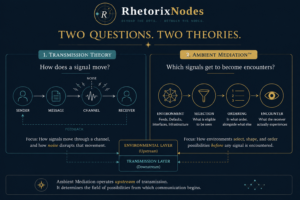
The infrastructure a message moves through no longer sits neutrally beside the message. It now decides which messages exist to be received at all.
Contemporary digital communication does not route around this problem so much as make it impossible to ignore.
A recommender system does not transmit a fixed message from a sender to a receiver across a passive channel; it assembles which messages a given receiver will ever encounter, in what order, alongside what else, and it does this continuously, adaptively, and largely invisibly to both sender and receiver.
Ambient computing extends the same logic past discrete messages entirely: a smart speaker, a location-aware notification, a platform’s default privacy setting are communicative acts with no discrete “message” at all, only a standing environmental condition that shapes what the user can do or notice next.
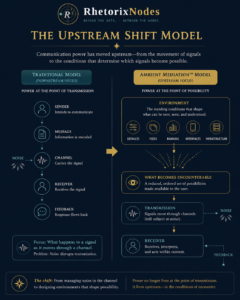
This is the shift I call Ambient Mediation™: communication increasingly operates not through discrete signals passed across a channel, but through environmental conditions (defaults, feeds, ambient interfaces, and standing infrastructural configurations) that shape the field of possible communicative acts before any specific message is ever sent.
Ambient Mediation does not replace the sender-message-receiver structure. It relocates the site of communicative power upstream of it, into the design of the environment in which sending and receiving become possible at all.
Harold Innis’s distinction between space-biased and time-biased media is the closest historical precedent, and it is worth being precise about the continuity.
Innis argued that a medium’s physical properties (durability, portability) bias the kind of social organization built on top of it, quite apart from any specific message that medium carries.
Ambient Mediation is Innis’s insight pushed one layer further: not just that the medium biases communication structurally, but that in networked environments the bias is actively, continuously engineered, tuned by ranking algorithms and interface defaults in something closer to real time than Innis’s centuries-long shifts in stone, papyrus, and paper.
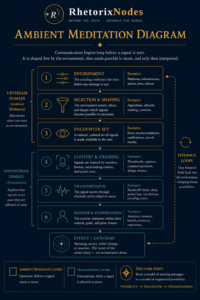
The environmental claim does not retire Shannon-Weaver. It exposes what the model was quietly relying on all along.
The strongest objection to everything above is straightforward: every ambient, environmental, algorithmically-mediated communicative event still, at bottom, consists of bits moving through a channel with measurable noise, bandwidth, and latency.
A recommender system is itself built from transmission i.e., packets, encodings, error correction, all of it Shannon’s problem, solved by Shannon’s mathematics, running underneath the feed.
To say the transmission model has been superseded would be false. Servers still drop packets. Compression still introduces artifacts. The engineering problem Shannon solved has not gone anywhere; it has become so reliable that it disappeared from view, which is a different claim than obsolescence.
The more defensible position, then, is not that Shannon-Weaver has been replaced but that it has been rendered necessary but insufficient. The transmission layer is a precondition for Ambient Mediation, not a competitor to it.
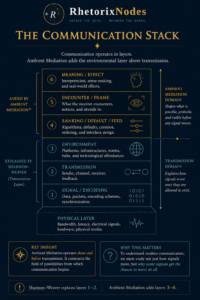
What the environmental frame adds is an account of everything the technical layer cannot see: why this message reached this receiver and not another, why the receiver encountered it inside this frame rather than that one, why the “noise” affecting comprehension might be a design choice rather than a channel defect.
Shannon-Weaver remains the correct model for the question it was built to answer. It was never equipped to answer the question communication scholars kept asking it.
A concept that explains everything about mediated communication risks explaining nothing in particular.
Ambient Mediation, and environmental framings of communication generally, carry their own overextension risk — the same one that afflicted Shannon-Weaver. If every default setting, every algorithmic ranking, every interface choice counts as a communicative environment shaping meaning, the concept loses falsifiability.
Not every technical constraint is meaningfully “environmental” in the sense that matters theoretically; a server timeout is still, most of the time, just a server timeout, not an act of ambient mediation worth theorizing.
The honest version of this framework needs a criterion for when an infrastructural condition rises to the level of a communicative environment and when it remains ordinary technical noise. And that criterion is not yet fully specified here, or arguably anywhere in the environmental-media literature. Without it, “environment” risks becoming communication theory’s new all-purpose noun, doing the same unexamined work “noise” did for the previous fifty years.
A second limit: the environmental frame is easiest to demonstrate in platform-mediated, algorithmically-curated contexts, and harder to demonstrate for communication that still moves through comparatively simple channels — a phone call, a printed letter, a face-to-face conversation. Shannon-Weaver’s model was never wrong for those cases; it may still be closer to sufficient for them than any environmental reframing.
What the transmission model could show and what it could never show turn out to be two different theories wearing one diagram.
Shannon and Weaver gave communication theory a diagram for moving signals cleanly through noise.
What that diagram could never show is the environment deciding, before any signal moves, which signals get to exist. Ambient Mediation names that prior layer — not as a replacement for the transmission model, but as the account of communicative power that transmission was never built to hold.
The task ahead for media theory is not choosing between the two models but specifying, with more precision than the field has managed so far, where the transmission problem ends and the environmental one begins.
Ambient Mediation™ names how environmental conditions: defaults, feeds, ambient interfaces, standing infrastructural configurations, shape the field of possible communicative acts before any specific message is ever sent, rather than distorting a message already in transit.
This essay does not yet specify a firm criterion, and treats that as an open limit rather than a solved problem. Not every technical constraint — a server timeout, for instance — rises to the level of a communicative environment worth theorizing.
No. The transmission layer (packets, encodings, error correction) still runs underneath every ambiently mediated environment. Ambient Mediation adds an account of what decides which messages reach a receiver in the first place; it does not solve, or replace, the technical problem Shannon solved.
Under Ambient Mediation™, yes: a standing environmental condition like a device default or an interface’s ambient posture, shapes what a user can do or notice next, even when no discrete message has been sent.
Find hidden frames and structures where the dots and nodes cease to be objects.
Response time. We reply within 48 hours. No automated responses — a real person reads and responds.
While you wait. Explore the nodes — Decode, Roots, Dark Matter, The Loop, and Meta are all live.
Stay in the loop. Subscribe to The Dispatch and get notified the moment the next essay goes live.
Every new essay arrives in your inbox before it reaches social media or the feed.
Long-form structural analysis that teaches you to read media — not just react to it.
One email per essay. No digests, no roundups, no promotions. Unsubscribe in one click.