

Imagine: It is two in the morning, and someone is talking to a chatbot about a breakup. They did not select this conversation from a schedule. They did not choose it from a library of pre-made options the way they might choose a film from a streaming grid or a station from a radio dial.
They typed a sentence, the model answered, they typed another sentence in response to that answer, and somewhere in the fourth or fifth exchange the conversation became a specific thing that exists nowhere else and will never be repeated. No one made this. It was made, in real time, by the two of them together.
This is an ordinary use of an extraordinary technology, and it is exactly the kind of moment that Uses and Gratifications theory was built to explain and exactly the kind of moment it cannot explain.
That’s where things start getting different — and interesting.
Katz, Blumler, and Gurevitch inverted media effects research by asking what people do with media, not what media does to them.
Katz, Blumler, and Gurevitch turned the central question of media research on its head. Instead of asking what media does to people, they asked what people do with media.
Their 1973–74 formulation treated the audience member as a purposive agent: someone with needs (for information, for personal identity, for social integration, for diversion) who scans the available media environment for the content most likely to satisfy them.
A person tired after work reaches for a sitcom rather than the news not because the sitcom overpowers them, but because they have selected it, consciously or semi-consciously, to serve a need for relaxation over a need for surveillance of the world.
The theory’s genius was in its two-part structure: gratifications sought and gratifications obtained.
Researchers could survey people about why they turned to a medium, then check that against what they actually got, and the gap between the two became a measure of the medium’s functional success or failure. This turned media choice into something legible, comparative, and falsifiable.
It also, crucially, depended on a stable menu. There had to be a fixed set of channels, genres, or outlets (recognizably distinct from one another!) from which the audience could select. The theory measures discrimination among options. It does not describe the creation of an option that did not exist before the audience arrived.
Before examining where this framework fails, it helps to see the mechanism as its founders imagined it.
The theory is not simply a list of audience motivations; it is a sequential engine in which psychological needs lead to media selection, media consumption, and finally to measurable gratification. Every later claim in this essay depends on understanding this underlying architecture.
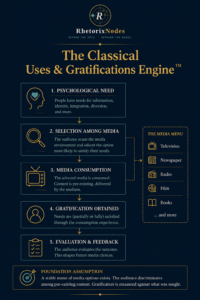
The elegance of this model lies in its stability.
Every stage assumes that the audience is choosing among media objects that already exist and whose content remains fixed throughout the act of consumption.
Because the object is stable, researchers can meaningfully compare what audiences sought with what they eventually obtained. That assumption is so deeply embedded in the framework that it almost disappears from view.
Generative AI removes precisely this hidden assumption. Once the media object ceases to exist before the interaction begins, the engine above can no longer operate as designed.
Generative AI collapses the boundary between audience and media, because no two sessions produce the same artifact.
This is the assumption a generative AI system breaks first, and it breaks it structurally rather than at the margins.
When someone opens a large language model, they are not choosing between Show A and Show B. There is no Show B. There is a blank interface and a prompt box, and whatever gratification eventually emerges is produced jointly, turn by turn, out of the user’s own inputs and the model’s responses to them.
The content did not pre-exist the interaction. It cannot be catalogued the way a program schedule or a content library can be catalogued, because no two people’s sessions, and often no two sessions by the same person, produce the same artifact.
At first glance, this may appear to be a technological difference. But it is actually an architectural one.
Classical media begins with an inventory of finished texts from which audiences select. Generative AI begins with no finished text at all. The comparison below illustrates the structural transition from a world organized around menus to one organized around dialogue.
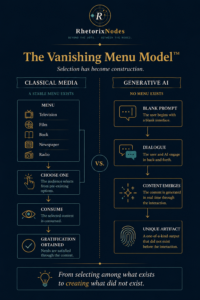
The disappearance of the menu changes more than the user’s experience; it changes the location of production itself.
In classical media, selection occurs after creation.
In generative AI, creation occurs after selection has already begun. The audience is no longer choosing among completed cultural objects. It is participating in the production of the object it will eventually consume.
This collapses a boundary Uses and Gratifications quietly depends on: the boundary between audience and media, between the one who selects and the one who supplies. A reader of a newspaper chooses which article to read but does not write it. A viewer chooses which channel to watch but does not direct it.
That distinction has quietly organized nearly every communication theory built around mass media. Production belongs to one side of the relationship; consumption belongs to the other. The audience exercises agency by choosing among finished texts, but the act of creation remains elsewhere. Generative AI redistributes that responsibility.
The diagram below captures the structural relocation of authorship.

Once the audience becomes part of the production process, the interaction can no longer be described as simple media consumption. Every prompt influences the next response, every response reshapes the following prompt, and the artifact gradually emerges from the dialogue itself.
What appears to be a conversation is simultaneously a process of collaborative construction.
In a generative AI exchange, the user’s own words are half of the substance of what gets produced. The “content” is not merely selected by the audience; it is authored by the audience, in dialogue with a system built to keep producing more of whatever the audience seems to want.
Gratification here is not a property of a pre-existing text the audience found. It is a property of an interaction the audience helped build.
At this point, one response seems obvious. Perhaps nothing fundamental has changed. Perhaps generative AI is simply another medium, and Uses & Gratifications only needs to expand its list of media objects to include large language models.
Many recent studies proceed from exactly this assumption. They ask why people use ChatGPT, what needs it satisfies, and how effectively it fulfills those needs.
While these studies generate valuable empirical findings, they leave the underlying architecture of the theory untouched.
The problem is deeper than the appearance of a new technology. The mechanism that made Uses & Gratifications measurable has itself disappeared.

The classical model succeeds because every stage revolves around a stable object. A psychological need leads to the selection of a completed media text. That text is consumed without changing during the act of consumption, allowing researchers to compare what the audience sought with what it eventually obtained. The entire analytical framework depends on the stability of the media object between those two moments.
Generative AI dissolves this stability. Every response alters the context of the next prompt. Every prompt reshapes the following response. Needs evolve while the interaction is still unfolding, meaning there is no fixed object against which “gratification sought” can be compared with “gratification obtained.” The conversation is simultaneously the medium, the production process, and the site where gratification emerges.
The question is therefore no longer whether people use generative AI for information, entertainment, productivity, or companionship. The deeper question is whether a theory built around selecting finished media objects can adequately explain a system whose defining characteristic is the continuous production of unfinished ones.
The strongest reply from inside the tradition argues the framework scales upward rather than breaking and deserves a fair hearing.
The strongest reply from inside the Uses and Gratifications tradition does not concede any of this easily, and it should not. Scholars extending the framework into interactive media like S. Shyam Sundar’s work on modality, agency, interactivity, and navigability chief among them, have already argued that the theory scales upward rather than breaking.
On this view, a large language model is simply a highly interactive channel, and the classic need-categories still do the explanatory work: someone using an AI companion app is still seeking social integration and diversion; someone asking an AI tutor a question is still seeking information, exactly as the 1973 typology predicted.
The “menu” argument can also be pushed back on directly. A user selecting ChatGPT over Google, or over a friend, or over silence, is still making a channel-level choice among functional alternatives, which is the level at which Uses and Gratifications has always operated. The theory was never a claim about the internal structure of any single piece of content; it was a claim about why people go to media at all.
This is a serious objection, and a fair accounting of the theory has to grant it real ground. The broad need-categories genuinely do survive the transition.
People do not invent new categories of psychological need because a new medium arrives; they bring the same needs i.e., companionship, mastery, distraction, identity-work, to whatever tool is in front of them, and that continuity is real evidence for the theory’s durability rather than its obsolescence.
The theory’s mechanism of selection among stable, pre-existing alternatives cannot survive contact with a system that manufactures the alternative in response to the selector.
But the concession does not save the mechanism, and the mechanism is where the theory actually does its work.
Uses and Gratifications was never only a claim about why people seek media; it was a claim about how that seeking resolves through selection among comparable, pre-existing alternatives, checked afterward against a stable “obtained” experience. Sundar’s extension preserves the why and quietly drops the how, because the how cannot survive contact with a system that manufactures the alternative in response to the selector.
Consider the sought/obtained gap itself, the theory’s central diagnostic tool. It requires that “obtained” name a reasonably stable thing — the episode a person watched, the article they read — against which “sought” can be measured.
In a generative exchange, gratification obtained is not independent of gratification sought; the user’s own prompting shapes the very thing they are being gratified by, in real time, mid-interaction. There is no fixed object left over afterward to compare against the original want. The person having the 2am breakup conversation did not select a pre-made gratification and then check whether it satisfied them. They built the satisfaction and the checking into the same act, continuously, exchange by exchange.
Reeves and Nass’s older finding that people unconsciously treat computers as social actors is instructive here, precisely because it shows how long this problem has been visible without being named.
Their research already demonstrated that media users respond to interactive systems with social scripts that Uses and Gratifications’ selection model was never built to hold.
Generative AI does not introduce this problem for the first time; it makes it impossible to keep ignoring, because the interaction is now sustained, adaptive, and personalized at a scale and duration that a single interactive-television study never had to account for.
Naming the mechanism the theory cannot see: satisfaction manufactured through dialogue, not selected from an inventory.
What the theory is missing is a name for the mechanism itself, not just the outcome.
Call it Generative Gratification™: satisfaction produced through a dialogic exchange in which the audience member’s own input is a load-bearing component of the artifact that gratifies them, rather than satisfaction obtained by selecting among stable, pre-existing alternatives.
Defining the concept is only the first step. The more important task is identifying the process that produces it.
Unlike the classical Uses and Gratifications model, which moves linearly from need to media choice to satisfaction, Generative Gratification™ unfolds as a recursive conversation.
Each exchange reshapes both the user’s understanding and the system’s next response, gradually constructing the very satisfaction the interaction is seeking.
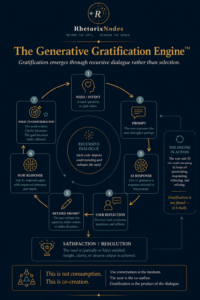
The engine illustrates why gratification can no longer be treated as the endpoint of media consumption. It is the cumulative product of repeated cycles of prompting, interpretation, revision, and reflection. Satisfaction does not arrive when a finished media object is selected; it emerges while the interaction is still unfolding.
This shift changes the unit of analysis altogether…
The meaningful object is no longer the completed text but the evolving exchange that continuously transforms both the user’s understanding and the artifact being produced. Gratification therefore becomes an emergent property of the dialogue rather than a measurable characteristic of an independently existing media object.
The distinction matters because it relocates where the theory should be measuring.
Uses and Gratifications asks: which option did the person choose, and did it satisfy the need they brought to it?
Generative Gratification™ asks a different question: what did the person and the system jointly construct, and at what point in the construction did the felt need actually resolve? The unit of analysis shifts from the text to the exchange. This is not a small technical adjustment. It means the survey instrument that made Uses and Gratifications empirically tractable — ask people what they sought, then ask what they got — cannot be applied unmodified, because “what they got” is not a stable artifact that exists independently of the asking.
This account is strongest for sustained, dialogic AI use and weakest at the margins where AI use collapses back into single-transaction retrieval.
This account has real boundaries, and naming those matters more than hedging them.
Generative Gratification™ describes sustained, dialogic AI use well like companion apps, extended chatbot sessions, iterative creative collaboration. It describes one-shot, static AI outputs far less convincingly.
A person who asks an AI system for a single image, a single summary, a single translated sentence, and then leaves, is doing something much closer to classical selection: they specify a want, receive a bounded output, and are done.
The mechanism proposed here is strongest exactly where the interaction is longest and most iterative, and weakest at the margins where AI use collapses back into single-transaction retrieval, which is still, by volume, a great deal of AI use.
There is also a harder empirical problem. The sought/obtained framework was popular in part because it was measurable. It could be surveyed. Generative Gratification™, as described here, resists that kind of clean measurement, because the boundary between the seeking and the obtaining is exactly what has dissolved.
Any research program built on this idea will need new instruments, not adapted ones, and it is fair to say those instruments do not yet exist.
Finally, a media historian could reasonably object that interactive fiction, MUDs, and early social chatbots posed a version of this same problem decades ago without requiring a new framework: that this essay is renaming a known phenomenon rather than discovering one.
That challenge deserves to be taken seriously rather than waved off: what is genuinely new is not the dialogic structure itself but its scale, its personalization, and its now-routine presence in daily life, which is a claim about degree that should be argued for, not assumed.
Uses and Gratifications was right that audiences are active. What it could not anticipate is a medium that turns activity into authorship.
It is two in the morning, and someone is talking to a chatbot about a breakup. But we don’t yet know how his gratification will be fulfilled. That’s where the load accumulates!
Uses and Gratifications theory, developed by Katz, Blumler, and Gurevitch, treats the media audience as an active, purposive agent who selects among available channels and content to satisfy specific needs — information, personal identity, social integration, and diversion — rather than a passive recipient of media effects.
Uses and Gratifications theory struggles with generative AI because it assumes a fixed menu of pre-existing content from which an audience selects. Generative AI produces content jointly with the user in real time, collapsing the boundary between audience and media and removing the stable, comparable alternatives the theory’s selection mechanism depends on.
Generative Gratification™ is a proposed framework describing satisfaction produced through a dialogic exchange with an AI system, in which the user’s own input is a load-bearing component of the artifact that gratifies them, rather than satisfaction obtained by selecting among stable, pre-existing alternatives.
The sought and obtained gratifications model works poorly for sustained AI chat because it requires “obtained” to name a stable artifact that can be compared against what was originally sought. In a generative exchange, the user’s own prompting shapes the output in real time, so there is no fixed object left over afterward to measure against the initial want.
Find hidden frames and structures where the dots and nodes cease to be objects.
Response time. We reply within 48 hours. No automated responses — a real person reads and responds.
While you wait. Explore the nodes — Decode, Roots, Dark Matter, The Loop, and Meta are all live.
Stay in the loop. Subscribe to The Dispatch and get notified the moment the next essay goes live.
Every new essay arrives in your inbox before it reaches social media or the feed.
Long-form structural analysis that teaches you to read media — not just react to it.
One email per essay. No digests, no roundups, no promotions. Unsubscribe in one click.