

Ask ten different people the same question of a large language model, on the same day, and you will get ten different answers — not ten different opinions about the same story, but ten different stories.
Ask the same person the same question twice, and the two answers may still not match.
This is not a flaw in the system. It is the system running on new tracks, working as designed.
And it is the single fact that a mid-century theory about television could not have anticipated, because that theory’s entire mechanism depended on the opposite condition being true.
Gerbner’s Cultural Indicators project showed that heavy viewers absorbed a remarkably consistent set of messages regardless of which specific programs they watched.
George Gerbner’s Cultivation Theory, developed through the Cultural Indicators project beginning in the late 1960s, rested on an observation about American television that seems almost quaint in its stability: heavy viewers were exposed to a remarkably consistent set of messages, night after night, across channels and genres, regardless of which specific programs they watched.
Crime dramas, procedurals, and local news all told a similar story about danger, authority, and who gets victimized. Gerbner’s team performed systematic content analysis on this “message system.” While counting acts of violence, tallying which characters were perpetrators and which were victims, they found the same patterns recurring so reliably that the particular show almost did not matter. What mattered was dosage: how many hours a person spent inside this consistent symbolic world.
It was about consuming content in a particular world!
The theory’s most famous finding, “mean world syndrome,” showed that heavy viewers came to overestimate real-world danger and distrust their neighbors at rates that tracked their viewing hours, independent of their actual risk of victimization.
Gerbner refined the mechanism further with two subtler concepts:
Resonance, where television’s fictional world amplifies a viewer’s own lived experience of danger
Mainstreaming, where heavy viewing pulls people from otherwise different demographic and political backgrounds toward a shared, convergent worldview
The theory’s power came from this convergence. Cultivation was never about any single message persuading any single viewer. It was about a repeated, shared symbolic environment slowly narrowing the range of what a whole population believed to be true about the world.
At the heart of Cultivation Theory lies a remarkably simple communication architecture. A stable set of messages circulates through society, exposing millions of people to substantially the same symbolic environment over long periods of time. Individual programs may differ, but the deeper message system remains consistent enough that repeated exposure gradually produces converging beliefs about reality.
That architecture is not merely historical background. It is the load-bearing assumption on which every later claim in the theory depends.
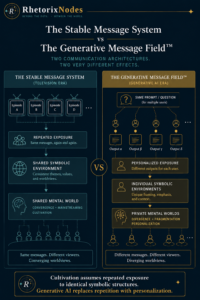
The contrast makes the theoretical problem immediately visible.
Television distributes stable symbolic environments to large audiences, allowing repetition to accumulate across an entire population.
Generative AI distributes personalized symbolic environments that change from one interaction to the next. The mechanism shifts from convergence toward divergence, because the shared message system disappears.
With that structural difference established, we can now ask the central question of this essay: what becomes of Cultivation Theory once the stable message system it presupposes no longer exists?
Generative AI produces no stable text to be exposed to repeatedly, and no comparable episode for a mass audience to converge upon.
This is the condition a generative AI system cannot reproduce, because there is no longer a stable text to be exposed to repeatedly.
Gerbner could point his researchers at a season of prime-time programming and count what was in it, because the “it” held still long enough to be counted.
A large language model produces no such fixed corpus of output. Two people typing the same prompt receive different responses; the same person, on a different day, may receive something different again. There is no:
There is only an unbounded, non-repeating stream of individually generated text, image, and audio, none of which any other user is guaranteed to ever see.
The disappearance of a stable message system changes more than the object researchers analyze. It also removes the structural condition that allowed Cultivation Theory to explain why large populations gradually came to share similar assumptions about reality.
The mechanism George Gerbner called mainstreaming depends on many people repeatedly entering the same symbolic environment. Once that common environment fragments into individualized outputs, the direction of cultivation changes as well.
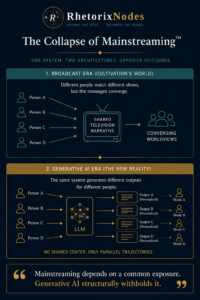
The diagram makes the shift unmistakable.
Broadcast television pulled diverse audiences toward a common symbolic center because they repeatedly encountered substantially the same messages.
Generative AI begins from a shared model, yet distributes different symbolic experiences to different users. Instead of converging upon one narrative environment, users move outward into parallel interpretive trajectories generated independently for each interaction.
This is precisely why mainstreaming becomes difficult to preserve within Gerbner’s original framework.
Mainstreaming in particular depends on a shared exposure that generative AI structurally withholds. Gerbner’s convergence required different people to be pulled toward the same symbolic center by watching, in effect, the same thing. If no two users receive the same output, there is no common center to converge upon.
There remain only millions of parallel, personalized trajectories that never cross. The theory’s unit of analysis, the repeatable message, has no equivalent here to be counted, compared, or cultivated from.
Outputs vary, but training data and reward objectives are shared across every user — a new kind of message system operating one layer beneath the surface.
The objection is stronger than it first appears because it shifts attention away from what users see and toward what every generated response shares beneath the surface.
Two people may receive different answers, yet those answers can still emerge from the same statistical architecture, the same training corpus, and the same alignment objectives. The visible diversity of outputs therefore does not automatically imply diversity at the level of the system itself.
The distinction is easiest to understand as two interacting layers.
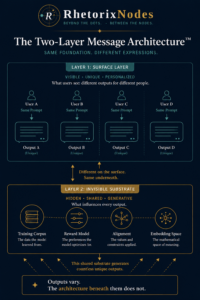
The upper layer is the only one users ever encounter directly. Every conversation appears unique, every response is generated in real time, and every interaction carries its own framing and emphasis.
Beneath those individualized responses, however, lies a shared substrate that remains common across the entire model: its training data, reward architecture, and learned probability distribution.
Seen this way, the apparent collapse of a shared message system may itself be misleading. The common symbolic environment has not disappeared entirely; it has simply migrated beneath the level of observable messages.
This is the strongest possible extension of Cultivation Theory, and it deserves to be considered before being rejected.
The strongest defense of Cultivation does not retreat to the surface level of individual outputs, and it should not, because the objection it raises is real.
A model’s outputs vary, but they are not drawn from nowhere: every response is generated from a training corpus and a set of reinforcement-learned preferences that are, in fact, shared across every user of that system.
On this view, the training data and the fine-tuning objectives function as a new kind of message system — not one the audience watches directly, the way Gerbner’s viewers watched prime-time television, but one whose consistent underlying patterns of framing, emphasis, and omission get transmitted into every personalized output regardless of how different those outputs look on the surface.
Research on algorithmic homogenization and on the political and cultural leanings embedded in large models’ training data supports exactly this claim: outputs that look individually distinct can still carry a statistically consistent worldview, the same way Gerbner’s varied programs carried a consistent one beneath their different plots.
This deserves to be taken seriously as more than a rhetorical parallel. If a model consistently frames certain topics with certain associations across millions of independently generated conversations, that consistency is a real, measurable property of the system, and it is not obviously less powerful than Gerbner’s dosage effect simply because no single viewer perceives the pattern directly.
A cultivation effect that operates below the level of conscious awareness was always part of Gerbner’s original claim; audiences were never assumed to notice they were being cultivated.
The shared corpus lies a layer beneath what any user actually encounters — cultivated by residue, not by repetition.
The debate no longer concerns whether a shared symbolic structure exists. It concerns how that structure reaches the audience.
Gerbner’s theory described a mechanism built on repeated encounters with the same observable messages. The proposed extension relocates that mechanism beneath the surface, where users never encounter the underlying structure directly but only experience its effects through individually generated responses.
That distinction is subtle, yet it changes the causal logic of cultivation itself.
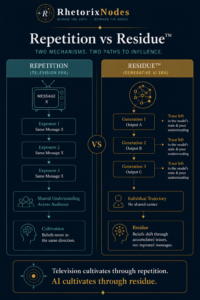
The contrast is more than a difference in delivery; it is a difference in mechanism.
Television repeatedly exposed audiences to the same symbolic patterns until those patterns became familiar enough to shape expectations about reality. Generative AI follows a different path. Users do not repeatedly encounter the shared corpus itself. They encounter unique responses that carry traces of that corpus without ever reproducing it in identical form.
The result is a shift from cultivation through repetition to cultivation through residue. What remains constant is no longer the message but the statistical architecture that quietly influences each newly generated message.
With that distinction in view, the limitations of extending Gerbner’s framework become much easier to see.
But the extension trades one of the theory’s load-bearing assumptions for another it cannot afford to lose. Gerbner’s mechanism required repeated exposure to a message system the audience actually encountered: the same score of violent acts, the same visual grammar of who threatens whom, watched again and again until it became the water a heavy viewer swam in.
The “shared corpus” defense relocates cultivation to a layer no user ever sees or repeatedly encounters in its own right: the training data and the reward model.
A user is not cultivated by repeated exposure to that layer. They are cultivated, if at all, by its downstream residue, filtered anew through a personalized generation process every single time.
This is a fundamentally different causal chain than repetition, and Cultivation Theory’s evidentiary method, content analysis of a stable, observable message system, has no way to analyze a layer that is, by design, never directly presented to the audience twice in the same form.
There is a second problem the defense does not solve. Gerbner’s message system was relatively stable across the years his team studied it; genre conventions in commercial television changed slowly.
A model’s outputs shift with retraining, fine-tuning updates, and safety adjustments on a cadence measured in months, sometimes weeks. Even if we grant that a consistent underlying worldview is being transmitted at any given moment, that underlying layer is itself a moving target in a way broadcast-era genre codes were not, which undermines the kind of longitudinal dosage analysis that made Gerbner’s original findings possible in the first place.
Naming the mechanism the theory cannot see: a consistent worldview transmitted through a shared corpus, expressed only through unique, non-repeating outputs.
What the theory needs is a name for this new causal layer, and an honest acknowledgment that it works by a different mechanism than the one Gerbner described. Call it Substrate Cultivation™: the transmission of a statistically consistent worldview through a shared training corpus and reward architecture, expressed to each user only through a unique, non-repeating, personalized surface that no two people ever directly compare.
The definition identifies the mechanism but not yet its architecture.
Unlike broadcast television, where audiences repeatedly encountered the same symbolic artifacts, Substrate Cultivation™ operates through a hidden causal chain. The underlying system remains shared while every visible expression is generated anew. Cultivation therefore emerges not from identical messages, but from a common generative substrate that continually produces individualized encounters.
The mechanism can be understood as a sequence rather than a static structure.
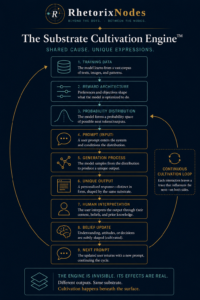
Each stage performs a distinct role within the cultivation process. The training corpus and reward architecture establish the statistical tendencies of the model. Those tendencies shape the probability distribution from which every response is generated. Individual prompts then sample that distribution, producing unique outputs that users interpret as singular conversations.
Although each interaction appears independent, every interpretation carries subtle traces of the same underlying substrate. Over time, repeated encounters with these individualized outputs accumulate into gradual shifts in expectations, assumptions, and worldviews.
Cultivation therefore has not disappeared. Its causal pathway has changed.
The distinction matters because it relocates both the object of study and the method required to study it.
Gerbner could count what was on screen. Studying Substrate Cultivation™ requires something closer to systematic red-teaming or large-scale prompt auditing i.e., sampling many independently generated outputs across many users and many prompts to detect a statistical regularity that no individual user could ever notice from the inside, because no individual user ever sees more than their own slice of the output space.
The unit of cultivation moves from the viewed message to the underlying distribution the message was drawn from i.e., a layer that has to be inferred rather than watched.
That methodological shift is as significant as the theoretical one. Cultivation research no longer begins with a stable collection of messages that can be catalogued through conventional content analysis. Instead, researchers must reconstruct an invisible statistical structure by observing thousands of independently generated outputs. The object of analysis remains real, but it can no longer be observed directly.
The transition can be understood as a change in the logic of inference itself.
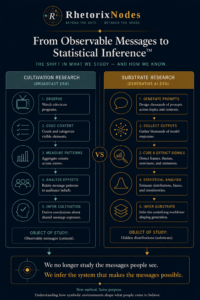
The broadcast era rewarded direct observation. Researchers identified recurring themes, measured frequencies, and drew conclusions from messages that every audience member could, in principle, encounter.
Generative systems reverse that relationship. Individual outputs become samples rather than the object of study, while the underlying probability distribution becomes the phenomenon researchers seek to infer.
This is more than a methodological refinement. It changes what counts as evidence. Observable messages become indicators of a hidden generative process rather than the primary unit of analysis. Future cultivation research therefore shifts from describing visible content to estimating the statistical architecture that consistently produces it.
This is a hypothesis about a mechanism, not yet a demonstrated finding and some AI use resembles classical Cultivation more closely than this argument allows.
This framework has real limits, and they are worth stating without hedging.
Cultivation’s original power came from decades of systematic content analysis showing a specific, replicable, quantified pattern. Gerbner’s team could report exact ratios of victims to perpetrators across measured programming hours.
Substrate Cultivation™, as proposed here, has nothing comparable yet. It is a hypothesis about a mechanism, not a demonstrated empirical finding, and it will remain a plausible conjecture rather than an established effect until someone does the equivalent large-scale auditing work across model outputs that Gerbner’s team did across broadcast schedules.
That work is methodologically harder, not merely more expensive, because the “message system” here is adversarially difficult to sample in a way that captures its true statistical shape rather than a biased subset of prompts researchers happened to try.
There is also a genuine case that some AI use resembles classical Cultivation more closely than this essay allows. Search-style, single-turn factual queries like asking a model who won an election, what a word means, what happened in a news event, produce outputs that are far more consistent across users than open-ended creative or conversational use, because there is less room for the model to vary a factual answer.
In that narrower band of use, something closer to Gerbner’s repeated, comparable message system may still be operating, and it would be an overclaim to say Cultivation Theory has nothing left to say about AI.
The theory likely fails hardest at the open, generative, conversational end of AI use and holds up better at the narrow, retrieval-like end — a distinction future work in this direction should sharpen rather than flatten.
Taken together, these arguments reveal that the transition from broadcast media to generative systems is not a single theoretical adjustment. Every major component of Cultivation Theory shifts at once: the nature of the message, the mechanism of exposure, the object of analysis, the research method, and even the meaning of cultivation itself.
The transition can be summarized as a movement between two fundamentally different communication architectures.
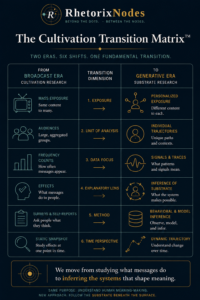
The matrix does not suggest that Gerbner’s theory has become obsolete. It clarifies where its explanatory power ends and where a different framework becomes necessary.
The broadcast model assumed stability, repetition, and shared exposure. Generative systems preserve none of those assumptions in their original form. What remains is the underlying insight that symbolic environments shape perception, even as the architecture producing those environments changes completely.
Seen this way, Substrate Cultivation™ is not a rejection of Cultivation Theory. It is an attempt to preserve its central intuition while relocating it within the communicative conditions of the generative age.
Gerbner was right that a shared, repeated symbolic environment can quietly reshape what an entire population believes about the world. What he could not have anticipated is a medium whose shared environment is buried a layer beneath the one any audience member actually see — ever.
Third Part Preamble: The next theory in this series, Agenda-Setting, runs into a related wall: it depended on visible, comparable gatekeeping decisions that a mass audience could recognize as shared and an AI answer engine gives each user a single, private answer that no one else in that audience ever sees at all.
Cultivation Theory, developed by George Gerbner through the Cultural Indicators project, holds that heavy exposure to a stable, repeated media message system gradually shapes an audience’s beliefs about the real world, independent of which specific programs they watch. Its best-known finding, mean world syndrome, shows heavy television viewers overestimating real-world danger in proportion to their viewing hours.
Cultivation Theory struggles with generative AI because it depends on a stable, repeatable message system that a mass audience is exposed to in common. Generative AI produces a different, personalized output for nearly every user and every session, so there is no shared, repeatable text left for a population to converge around in the way Gerbner’s theory requires.
Substrate Cultivation™ is a proposed framework describing the transmission of a statistically consistent worldview through an AI system’s shared training corpus and reward architecture, expressed to each user only through a unique, non-repeating, personalized output that no two people ever directly compare.
Mainstreaming, the process by which Cultivation Theory says heavy viewers from different backgrounds converge on a shared worldview, depends on different people being exposed to the same message. Since generative AI rarely produces identical outputs for different users, there is no shared center for a population to converge upon in the way classical mainstreaming describes.
Find hidden frames and structures where the dots and nodes cease to be objects.
Response time. We reply within 48 hours. No automated responses — a real person reads and responds.
While you wait. Explore the nodes — Decode, Roots, Dark Matter, The Loop, and Meta are all live.
Stay in the loop. Subscribe to The Dispatch and get notified the moment the next essay goes live.
Every new essay arrives in your inbox before it reaches social media or the feed.
Long-form structural analysis that teaches you to read media — not just react to it.
One email per essay. No digests, no roundups, no promotions. Unsubscribe in one click.