

You put the phone down. The video was nineteen seconds long, a stranger’s hands folding dough on a marble counter, and you watched it twice without deciding to.
Nothing about it matched what you’d have said, an hour earlier, that you were interested in. You don’t bake. You’ve never wanted to bake. And yet there it was, queued for you specifically, as if something had been watching not your preferences but your hands, waiting to see what they’d do before you did.
This is usually where the essay reaches for a friend. It’s like having a friend who knows you better than you know yourself.
The sentence is so available it barely requires writing; an entire genre of cultural criticism has now produced it independently, in roughly the same words, hundreds of times.
The trouble with the sentence isn’t that it’s wrong. It’s that it’s specific in the wrong place, It tells you the platform’s knowledge is excessive, but smuggles past the more interesting question, which is why a system built by an advertising company, running on a server farm, optimizing a number on a dashboard, gets described using the warmest word in the language for another human being.
Of all the metaphors available like spy, mirror, stalker, only “friend” keeps the user relaxed and flattered at once. That isn’t a coincidence; it’s a design outcome.
Start with the selection itself, because it’s a decision, not an accident.
A recommendation engine that knows your unstated habits and feeds them back to you before you’ve named them could just as easily be called a spy. It could be called a mirror, or a stalker, or — more clinically, more accurately — a behavioral model. Each of those words is available, and each is arguably closer to the mechanics of what’s happening. None of them is the word people reach for first.
The fact that “friend” wins this competition is itself a finding, and it’s worth taking seriously before moving past it.
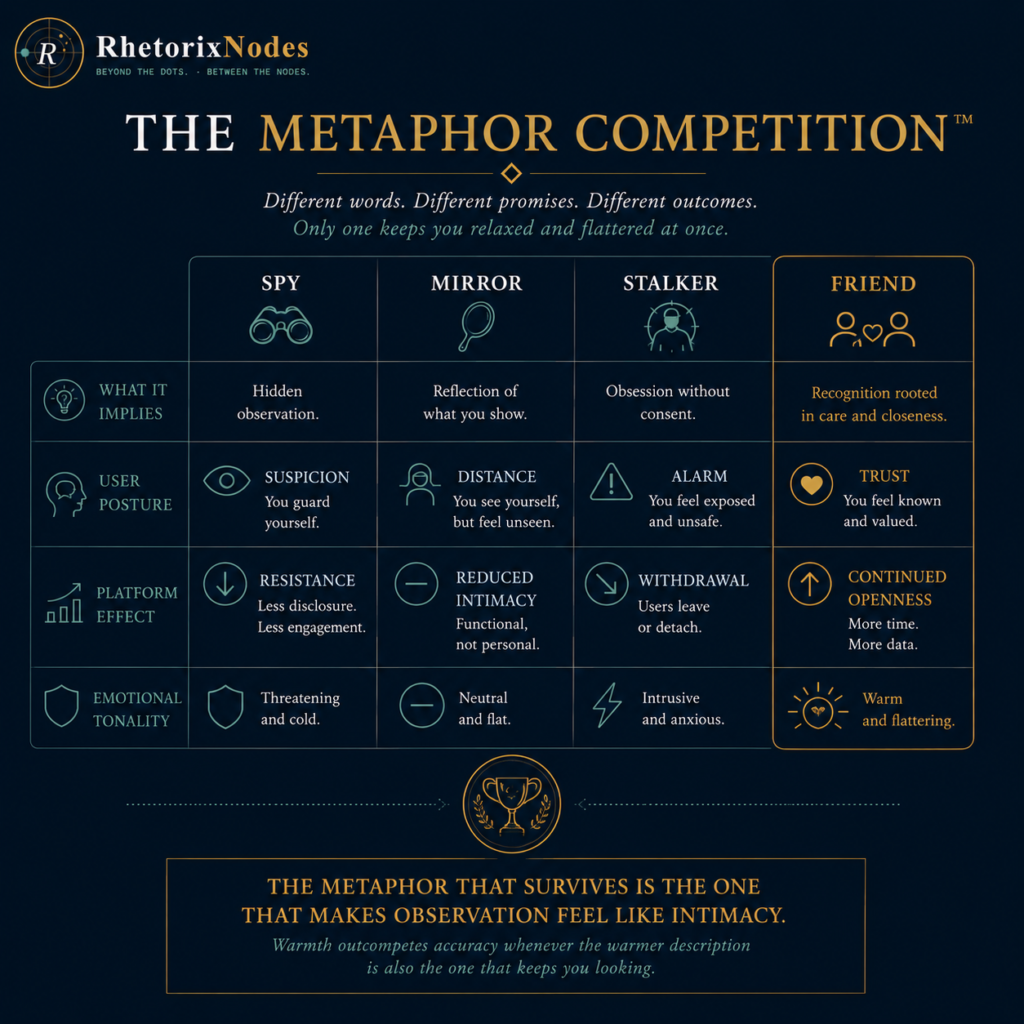
Friendship is the one relationship in that list that requires reciprocity. You also know your friend, you also have some power in the relationship, you could also, in principle, choose to leave.
A mirror has none of these. A spy has none of these. And yet the metaphor that sticks, against a field of more accurate alternatives, is the one that implies mutual exposure where there is in fact none.
This isn’t a coincidence of language, and it isn’t accidental either, which is worth sitting with for a moment.
Consider what the alternatives would cost the platform if they won instead.
If the dominant cultural metaphor for the feed were “spy,” the emotional posture a person brings to the app changes immediately — vigilance, suspicion, the instinct to give less away. If the metaphor were “mirror,” the implication is colder still: nothing is known about you at all, only reflected, which would undercut the entire promise of personalization the product is selling. “Friend” is the only metaphor in the set that keeps the user relaxed and flattered simultaneously.
Relaxed because friends are safe, flattered because being known this precisely implies the platform finds you, specifically, worth knowing. No other available word does both jobs at once. That the culture converged on the one metaphor that serves the product best, out of several that were equally available and arguably more accurate, is not proof of a conspiracy.
It’s simpler than that: warmth outcompetes accuracy whenever the warmer description is also the one that keeps a person looking at the screen a few seconds longer, and over millions of users and small design choices made gradually, the metaphor that survives is the one the interface was built, more or less unconsciously, to teach people to reach for.
The interface that hands you the dough video is built, frame by frame, color by color, pacing beat by pacing beat, to feel nonthreatening. The choice of “friend” over “spy” is downstream of decisions made by people who understood — correctly — that a system perceived as warm generates more attention than a system perceived as watchful.
Erving Goffman described the self as a performance staged for an audience, divided cleanly into a front-stage, where you manage what’s visible, and a backstage, where you don’t. The entire architecture of ordinary social trust depends on this division holding, i.e., on the assumption that what other people know about you is, mostly, what you’ve chosen to show them.
A friendship, properly understood in Goffman’s terms, is a backstage you’ve voluntarily extended to someone, a small number of people permitted past the performance because you decided, over time, that the risk of being seen unrehearsed was worth what the relationship gave back.
The “friend” metaphor imports this front-stage logic by default, and that default is the most basic thing wrong with it. It’s wrong before any data-privacy argument even enters the room. The metaphor describes a system that has been let backstage, the way a friend is let backstage: invited, gradually, with consent accumulating over a hundred small disclosures. What’s actually happening is closer to a window installed in a wall you didn’t know was glass.
Nobody extended an invitation. The backstage was never architecturally separate from the front in the first place.
Humans have always read affect off each other before a word is said. If that’s true, the algorithm isn’t new; it’s just perceptive. Here’s why that objection ultimately fails.
The obvious objection here is that none of this is new. Humans have been reading each other’s backstage for as long as there have been humans.
A bartender pours a stronger drink before you’ve said the word “bad day,” because your shoulders said it first. A mother knows her child is about to cry several seconds before the child does, from some compound of breath and posture that has no name. This is not a flaw in human relationships; arguably it’s the substance of intimacy itself, the capacity to be known in ways you haven’t authored.
A doctor, watching you describe a pain that hasn’t yet become a diagnosis, often knows what’s wrong before you’ve finished the sentence, reading the wince and the way you favor one side rather than the words you’ve chosen.
If that’s true, the entire argument so far reduces to: algorithms are perceptive. Which is not a discovery. It’s a restatement of something every close relationship, and a fair number of professional ones, already know, dressed up in newer vocabulary to sound like news.
This objection is strong, and it deserves to be granted rather than waved off. It should be granted fully, not as a rhetorical courtesy before the real argument resumes, because if it isn’t actually true that something changes between the bartender and the feed, then this essay has nothing to say that hasn’t already been said better by people writing about empathy.
So take the objection on its own terms for a moment. The bartender’s read and the platform’s read really do start from the same place: both notice something the person hasn’t said. Both are, in the moment, a form of attention that exceeds the explicit content of the interaction. If the only claim available were “a system perceives your unstated state,” the objection wins outright, and the essay should stop here.
But the comparison survives only if it stops at the fact of being read and doesn’t follow the read anywhere — and it doesn’t survive that, because the bartender’s perception, real and uninvited as it is, also terminates. It dies with the shift. It doesn’t get written down, cross-referenced against ten thousand other slumped shoulders, or fed into a model that predicts your next bad day before you have it.
The doctor’s read, similarly, terminates at the diagnosis; it exists to be resolved, not accumulated. The bartender has a hunch, formed once, gone by morning.
What reads your dough video has something else entirely: a standing, permanent, accumulating record of every flinch you’ve ever produced in its presence, compared in real time against the flinches of everyone else who has ever used the app. The bartender’s read is local to one body, on one night, in one room. The platform’s read has no room. It has a population, and you are a coordinate inside it.
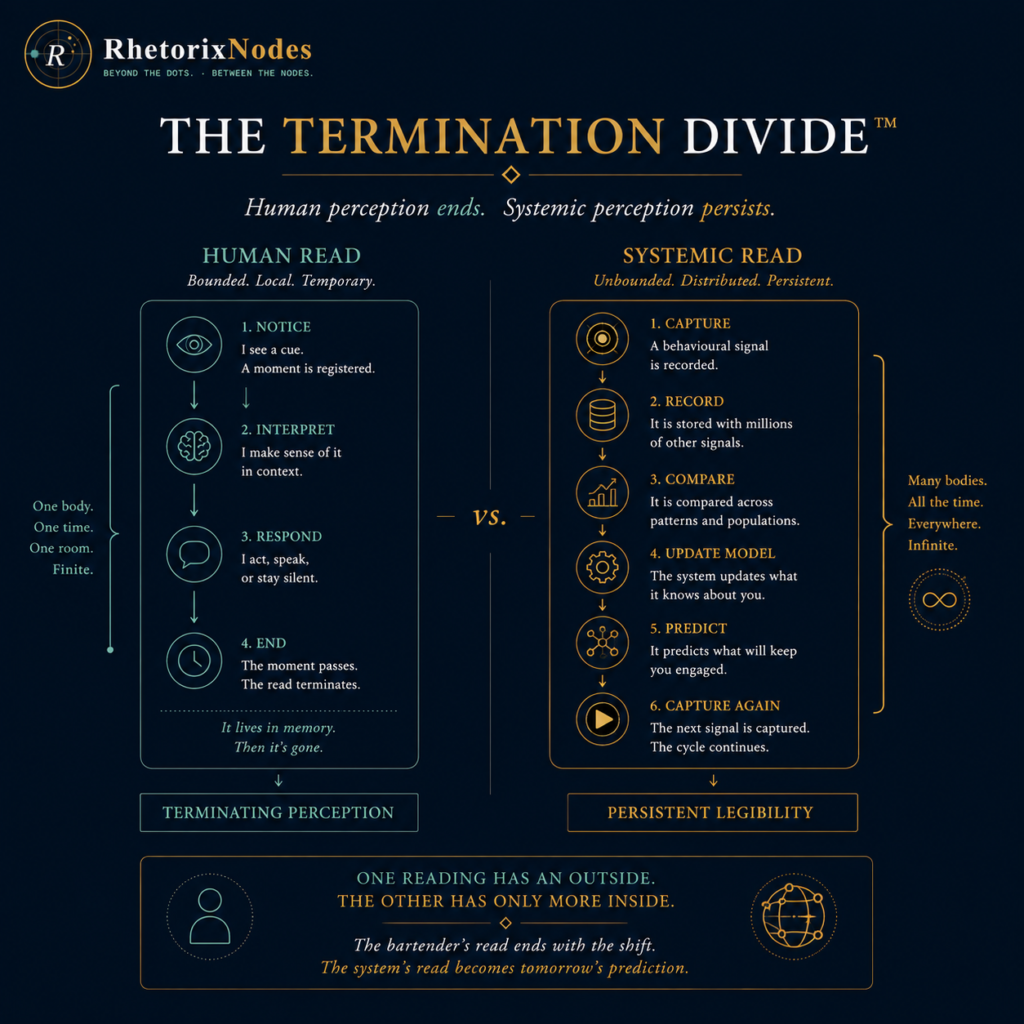
There’s a second difference worth naming, which the bartender comparison also exposes once it’s pushed far enough: the bartender’s read can be wrong in a way that costs the bartender something. He can misjudge you, over-pour, embarrass himself, learn from the mistake the next time he sees your face. He carries the consequence of being wrong in his own body, the same body doing the reading.
The platform’s read carries no equivalent cost. A bad recommendation doesn’t injure the system that produced it; it’s simply discarded data, folded back into the next iteration of the model without ever touching anything that could be called regret.
The difference the bartender comparison reveals, once it’s pushed, isn’t that something perceives you. It’s what the perception is for, where it goes once it’s made, and what it costs the perceiver to get it wrong: three questions the bartender answers in ways no recommendation engine can.
Massumi’s distinction between emotion and affect names the precise layer TikTok reads: the intensity beneath narration, prior to the self that might choose to disclose it.
Here is the claim the rest of this essay is built on: the discomfort people feel is not that the platform reads something true about them. It’s that what the platform reads was never supposed to be legible to anyone, including the person it belongs to. And the reason it’s legible now is that an entire system has been built, at enormous expense, to optimize for exactly that material.
The philosopher Brian Massumi draws a distinction that does real work here. Emotion, in his usage, is intensity that has been captured by language — named, narrated, owned.
You feel a tightness in your chest, and at some point you call it anxiety, or grief, or anticipation, and in naming it you’ve made it yours: a thing you can describe, defend, revise, or discuss with someone else. Affect, by contrast, is the intensity before that capture — pre-personal, pre-narrative, registered in the body before the mind has assigned it a story. A flinch. A held breath. A thumb that stops scrolling a half-second before any conscious judgment has been formed about why.
A friend, even an extraordinarily perceptive one, mostly has access to your emotion — the version of you that has already been through the work of becoming a story, the version you arrive with after the editing has already happened.
What a recommendation engine reads is closer to affect: the twitch itself, stripped of the narrative that would otherwise convert it into something you could choose to share or withhold. This is the precise content of “knows too much.” Not that it knows more facts.

That it knows a layer that sits beneath the layer where facts and disclosure normally happen. It’s the layer you’d need to have a self, in the narrated sense, before you could even decide whether to hide it.
The system optimizes for affective capture, not for you. Asymmetry, persistence, and cumulation aren’t separate violations, they are the structural consequences of that single fact.
None of this would matter much if it were simply observed and set aside, the way the bartender’s hunch is set aside by morning. What makes it a different order of thing is that the read is in service of an optimization target, and the target is not you.
This is the generative fact beneath everything else in this essay, and the rest follows from it as consequence rather than coincidence. A system that optimizes for affective capture (for whatever keeps the thumb still a half-second longer) has no design reason to be legible back to the person it’s reading.
Legibility in the other direction would cost retention; it would let you see the seam, and once you can see the seam, you can resist it. So the read is asymmetric not because someone decided to keep it secret, but because symmetry was never part of the function being maximized. You cannot petition a loss function. It has no backstage of its own to invite you into, because it isn’t a self in the relevant sense. It’s a procedure, applied to you, indifferent in the specific way only a procedure can be.
The same logic produces the second consequence. The bartender’s read dies with the shift because the bartender is a person, and people have an outside — a home, a life, an end to the workday. An optimization process has no outside. There is no moment at which it clocks out and stops weighing your flinch against the flinches of everyone else. It does not forget, because forgetting would degrade the function it exists to maximize. Persistence isn’t a side effect of the system. It’s close to the system’s entire purpose.
And the third consequence follows the same way. If affect is the raw material being mined, then every instance of it has to be retained and compared, because a single flinch tells the system almost nothing. It’s only legible as a pattern across millions of other flinches, yours included.
Cumulation, here, isn’t incidental data hoarding. It’s the actual mechanism by which the read becomes accurate enough to be worth anything at all. The system isn’t watching you closely. It’s watching a population closely, and you are, for its purposes, a single data point inside that population, made legible only by comparison to everyone else doing roughly the same thing with their thumbs.
The technologist and philosopher Bernard Stiegler argued that media technologies do not merely record consciousness from the outside; over time, they become part of how consciousness is formed in the first place. That’s what he called tertiary retention, memory externalized into a technical object that then loops back and shapes the remember.
This is the furthest claim this essay will make, and it should be marked clearly as the furthest one: if a system is reading your affect at this scale, for this long, with this much retention, it becomes difficult to say with confidence that it is only describing your reflexes rather than gradually training them. The thumb that used to stop at novelty may, after enough repetitions, be stopping at what the system has taught it to find arresting.
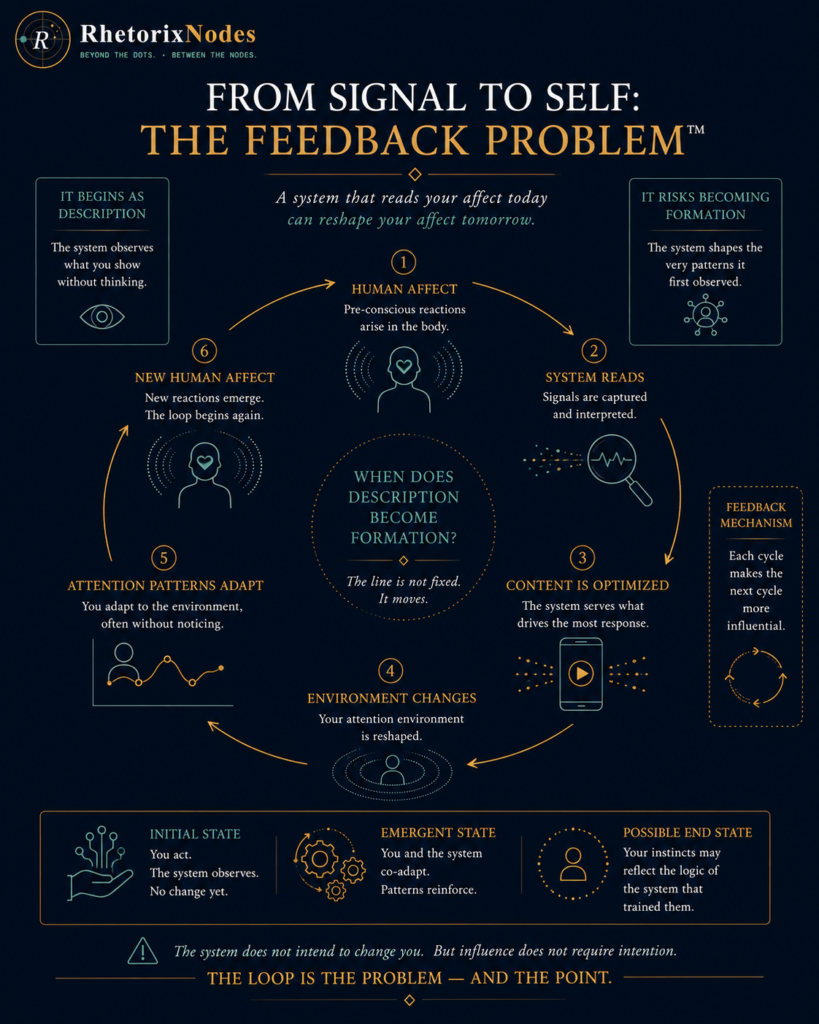
The claim is not that this is settled. It’s that the architecture described above (asymmetric, permanent, cumulative) is precisely the architecture under which it would happen, if it were going to happen at all.
Surveillance names the watching. Dataveillance names the data. Neither names this: a read that is affective, asymmetric, cumulative, and optimization-driven with nothing owed back.
It’s worth asking, at this point, whether any of this already has a name or whether media studies got here first and simply called it something else.
Surveillance is the obvious candidate, and it isn’t wrong, but it names the watching, broadly, without distinguishing what’s actually being watched.
Dataveillance is closer, and useful, but it tends to describe behavior at the level of clicks and purchases like legible action, the kind a person could in principle have predicted someone might notice, not pre-personal intensity that arrives before the person noticing it themselves.
What’s missing is a term for the particular configuration this essay has been assembling: a read that is affective rather than merely behavioral, asymmetric rather than mutual, cumulative rather than momentary, and structured by an optimization target rather than a curious mind.
Each of those words exists separately in the literature. The specific combination, applied to a single phenomenon, doesn’t appear to have a settled name. Surveillance and dataveillance name the watching; what follows names the thing being watched and the shape of its one-sidedness.
Call it, provisionally, unreciprocated legibility: a state in which one party is read, continuously and at a depth prior to self-narration, by a system that owes nothing back. Reciprocity is not absent by oversight. It’s structurally unavailable because the thing doing the reading isn’t a party to a relationship in the sense the word implies. It’s a function, and functions don’t have backstages.
The philosopher Byung-Chul Han, writing on what he calls psychopolitics, argues that contemporary power has largely stopped needing to repress people in the old, visible way like through prohibition, surveillance you can feel, walls you can see. It has found something more efficient: seduction of the pre-reflective.
Power that doesn’t have to push against your stated will because it never reaches the level where will is formed.
Unreciprocated legibility is what that seduction looks like from the inside, on an ordinary evening, with a phone in your hand and a stranger folding dough on a counter you’ve never owned.

Zuboff’s behavioral surplus explains the economic logic: affect monetizes faster than identity because it requires no narrative, no consent, and no interview. The nervous system just leaks!
The economic explanation for why affect, specifically, was the target worth building all this machinery to capture is not complicated, and it has already been made with great care by others — most thoroughly by Shoshana Zuboff, who named the practice of harvesting behavior beyond what users knowingly provide behavioral surplus, and showed how thoroughly that surplus has become the actual product being sold.
It’s worth stating briefly, in service of the argument already built, rather than re-litigated from the ground up: affect is cheaper to monetize than identity. It requires no narrative, no consent process, no interpretation. A stated preference has to be asked for, and people lie, forget, or change their minds when asked.
A flinch needs no interview. It arrives pre-verified, immune to the gap between what people say they want and what actually holds their attention. It’s, not coincidentally, the exact gap every advertising-funded platform has spent two decades trying to close.
This is why the optimization target described above is affect rather than self — not because affect is more interesting, but because affect is more liquid. It moves through the system without friction.
A self has to be told things. A nervous system just leaks them.
Reciprocity would demand termination, mutual legibility, and the capacity to be wrong at a cost. Each of these is structurally incompatible with what the system was built to maximize.
What would it take for this to be reciprocal — for the relationship the metaphor borrows from to actually obtain?

At minimum: the read would have to terminate somewhere, the way the bartender’s read terminates at the end of a shift. It would have to be legible back to you in the same depth it reads you, so that you could, in principle, catch it misjudging you the way you can catch a friend doing the same.
It would also have to be answerable to something other than the function it was built to maximize; capable of being told it was wrong, in a way that changed its behavior rather than merely logging the correction as another data point to optimize around. It would, in short, have to be able to lose something when it misjudged you, the way the bartender risks something every time he reads a room wrong.
None of these are technical problems. They are incompatible, definitionally, with the thing currently doing the reading. A system built to optimize affective capture cannot become reciprocal without ceasing to do the one thing it was built for, which is the actual, structural reason this can never simply be fixed with a setting, a toggle, a more transparent privacy policy.
The asymmetry isn’t a bug sitting next to the product. It is, in a fairly precise sense, the product.
So the dough video keeps appearing, accurate in a way that has nothing to do with friendship and everything to do with a function that has been quietly optimizing your thumb for longer than you’ve been thinking about it in these terms.
So…
It isn’t a friend who knows too much. There was never anyone there to know you in the first place — only a process, reading the part of you that exists before you do, and reading it back to no one at all.
The feeling comes from mistaking depth of reading for friendship. TikTok’s recommendation system reads affect — pre-personal, pre-narrative intensity such as a flinch or a pause before conscious thought — rather than emotion, which is the narrated, owned feeling a friend typically has access to. Friendship also requires reciprocity, an embodied limit, and a cost when one party misjudges the other. An algorithmic system has none of these, which is why the resemblance to friendship is emotionally convincing but structurally false.
Emotion is intensity already captured by language — named, narrated, owned. Affect is the intensity prior to that capture: pre-personal, registered in the body before the mind assigns it a story. A thumb that stops scrolling before a conscious judgment forms is affect; deciding afterward to call that reaction “boredom” or “interest” is emotion.
Not exactly. Recommendation systems are better understood as reading affect rather than emotion — pre-conscious behavioral signals like pause time, rewatch, and scroll velocity, rather than narrated feelings. This is part of why the system can seem to anticipate interests a person hasn’t consciously formed an opinion about yet.
Of the available metaphors for a system that perceives unstated behavior — spy, mirror, stalker, friend — “friend” is the only one that keeps a user relaxed and flattered at the same time. Interface design that favors warmth over alarm reinforces this metaphor over more structurally accurate ones, because perceived warmth correlates with longer attention and engagement.
Unreciprocated legibility describes a state in which one party is read continuously, and at a depth prior to self-narration, by a system that owes no comparable legibility back. It differs from general terms like surveillance or dataveillance by specifying four features at once: the reading is affective rather than behavioral, asymmetric rather than mutual, cumulative rather than momentary, and structured by an optimization target rather than by curiosity or care.
Psychopolitics, as Byung-Chul Han describes it, is a model of power that no longer relies on visible repression or prohibition. Instead, it operates by seducing the pre-reflective layer of a person — influencing behavior before conscious will is formed, rather than pushing against a will that has already been stated.
Behavioral surplus is Shoshana Zuboff’s term for behavioral data harvested beyond what a user knowingly or willingly provides. It explains the economic incentive behind affect-based recommendation systems: affect-level signals are cheaper to monetize than stated identity or preference, because they require no interpretation, no narrative, and no consent process to extract.
Find hidden frames and structures where the dots and nodes cease to be objects.
Response time. We reply within 48 hours. No automated responses — a real person reads and responds.
While you wait. Explore the nodes — Decode, Roots, Dark Matter, The Loop, and Meta are all live.
Stay in the loop. Subscribe to The Dispatch and get notified the moment the next essay goes live.
Every new essay arrives in your inbox before it reaches social media or the feed.
Long-form structural analysis that teaches you to read media — not just react to it.
One email per essay. No digests, no roundups, no promotions. Unsubscribe in one click.