

A person types a political opinion into a chatbot that they would never post under their own name. Maybe it’s a view on immigration, or gender, or a verdict that’s been dominating the news.
It’s something turned over in private for weeks but never spoken aloud, not at work, not at the family table, not even to the friends who would probably agree.
Here, at least, nothing is at stake in the ordinary social sense. No one is watching. No one will screenshot it, quote it back out of context, or trade a knowing look with someone else in the room. The reply arrives evenly, without a flicker of judgment in it, as though the opinion had been spoken into an empty house.
There is, in the fullest sense Elisabeth Noelle-Neumann meant it, no social climate to fear here at all — no audience whose expression might tighten, no room that might go quiet.
And that absence is either the most liberating thing about talking to AI, or the beginning of a stranger problem than the one her theory described. Noelle-Neumann’s spiral was built around a very particular kind of fear: the fear of visible others, watching and judging in real time.
Remove the others, and the spiral would seem to have nothing left to turn on. But something is still happening in that exchange, something that does not require an audience at all, and it is worth asking, before anything else in this essay, whether what dissolves in that empty room is the fear itself, or only the audience that used to carry it.
Noelle-Neumann argued people constantly scan their environment for the prevailing opinion climate and stay quiet rather than risk isolation.
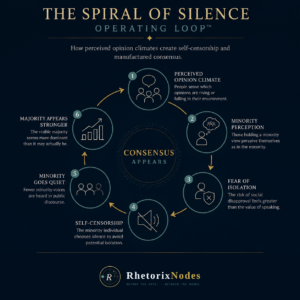
Elisabeth Noelle-Neumann’s Spiral of Silence theory, developed across the 1970s and formalized in her 1984 book of the same name, argued that people possess something like a quasi-statistical sense: an ongoing, largely unconscious perception of which opinions are gaining or losing ground in their social environment.
Fearing isolation more than they value being right, people who sense their view is in the minority tend to fall silent, while people who sense majority support speak more confidently and more often.
This asymmetry accumulates. As minority views go quiet and majority views grow louder, the perceived climate shifts further toward the majority, which silences still more of the minority. It forms a spiral, tightening with each turn, until an opinion that may never have commanded true majority support comes to look unanimous simply because its holders spoke and its doubters didn’t.
Noelle-Neumann built in an important exception: a small “hardcore” or “avant-garde” minority, willing to accept social isolation for the sake of their convictions, who continue speaking regardless of the perceived climate.
But for the great majority of people on most issues, the theory predicted, the mass media’s portrayal of which views were ascendant functioned as the primary source of the climate being read. In this case, media didn’t just report opinion, it manufactured the sense of consensus that then silenced dissent from it.
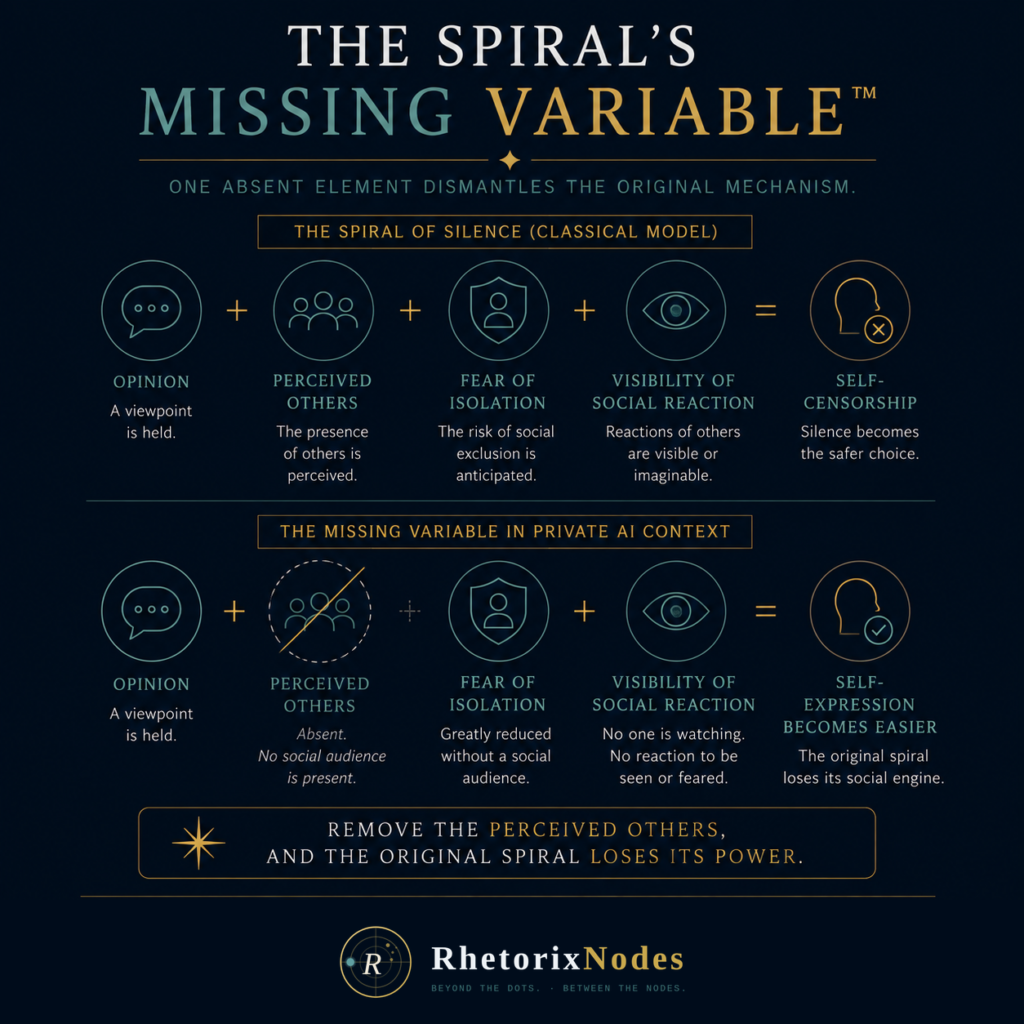
A private, non-judgmental AI chat removes the audience the spiral depends on. There is no one present to be isolated from.
This is the mechanism a private AI conversation dismantles from the inside.
Noelle-Neumann’s spiral required a perceived audience: real or imagined others whose good opinion a speaker stood to lose.
A chatbot session has, structurally, no audience of this kind. There is no crowd to read as hostile or receptive, no risk of the AI repeating what was said to someone else, and no visible reaction that could be misread as social rejection.
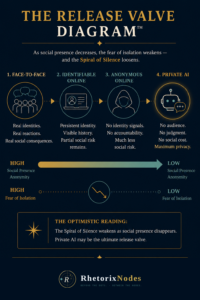
On the face of it, this should function as a release valve exactly where the spiral has always been tightest: a private, unthreatening space where a person can voice a minority-feeling opinion, test it, refine it, and perhaps carry a little more confidence back into an actual public conversation than they had before.
The salience judgment is real; the system has, in some sense, decided what to lead with and what to leave out. But that judgment is dissolved into fluent sentences rather than printed as a rankable list, and it is never exposed to a second reader who could check it against their own.
This is the territory this platform’s own Gate Architecture™ and Custodial Bias™ frameworks have already mapped: the gate has not disappeared, but it has become invisible and non-comparable, which changes what kind of public event a gatekeeping decision can be.
The disappearance is not merely stylistic. Agenda-setting’s mechanism required cross-person comparability to function as a public phenomenon at all. The theory measured a population’s convergence around a shared sense of importance, not any single individual’s private impression. When each output is bespoke, there is no longer a single agenda being set for a public to notice, discuss, or contest.
There are only as many private agendas as there are conversations, each invisible to every other, which is a different kind of thing than a front page, however personalized that front page might have been.
This isn’t a new argument. Research on anonymous, computer-mediated communication has long found reduced spiral-of-silence effects online.
The strongest version of this optimistic reading doesn’t need to invent new theory to make its case, and it deserves to be stated in its strongest form.
A substantial body of computer-mediated communication research already found, well before generative AI, that anonymity and reduced social presence in online contexts weaken spiral-of-silence effects: people are measurably more willing to express minority opinions in anonymous forums, comment sections, and surveys than in face-to-face settings where their identity and social standing are on the line.
A private AI chat, on this view, is simply the most extreme point on a continuum computer-mediated communication scholars have already mapped, where anonymity is taken to its logical limit, with an interlocutor incapable of gossiping, judging, or excluding at all. The theory doesn’t need revision here so much as confirmation at a further extreme.
This deserves real weight.
The anonymity research is genuine, and a chatbot session is, if anything, a more extreme version of the conditions that research already studied.
Anyone building a serious account of AI and public opinion has to grant that private AI use plausibly does function as a release valve for the specific mechanism Noelle-Neumann described, which is a real, if narrow, point of continuity with existing spiral-of-silence scholarship.
The mechanism dissolves, but a different one, unaccounted for by Noelle-Neumann or the anonymity literature, quietly takes its place.
But the anonymity defense only addresses fear of a perceived social climate, and a second effect is operating in the exchange that has nothing to do with that fear at all.
Every large language model is shaped by a reinforcement-learning process that rewards certain framings, certain hedges, certain distributions of “on the one hand, on the other” over confident, unqualified takes on contested topics.
This produces a single, consistent conversational posture — call it institutional caution — that every user encounters as if it were simply how the topic naturally gets discussed, rather than one particular, trained judgment about how much confidence a given claim deserves.
A person testing a minority-feeling opinion against this posture is not facing a perceived social climate they fear isolation from. They are facing something that presents itself as neutral, reasoned even-handedness but is, underneath, a single institutionally produced standard applied identically to millions of separate, unwitnessed conversations.
This is a genuinely different mechanism from Noelle-Neumann’s, not a relabeling of it. Her spiral required a perceived plurality, a sense of where various others stood, that a speaker measured themselves against and found wanting.
What operates in an AI chat is not a perception of where others stand at all; the user never learns what any other person thinks. It is instead a single, repeated encounter with one system’s trained sense of how confidently a claim may be stated, mistaken by the user for the reasonable, moderate default any careful thinker would land on.
The old spiral silenced people who believed themselves to be in the minority. This produces something adjacent but distinct: a private, invisible recalibration of how confidently a person feels entitled to hold an opinion at all, shaped not by a perceived plurality of other people but by one company’s trained model of acceptable epistemic caution, encountered identically and privately by everyone who asks.
The disappearance of the public audience creates a strange reversal. The climate of opinion has not simply vanished; the source from which that climate is inferred has changed. What once had to be read from people, media, and visible social interaction can now be encountered through the conversational architecture of a single system.
The movement is therefore from a public climate that is observed to a synthetic climate that is encountered.
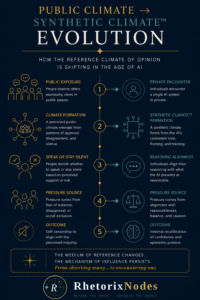
This shift matters because the new environment cannot be adequately described as an anonymous version of the old one. The public plurality that Spiral of Silence required has been replaced by a singular, institutionally produced conversational posture.
What appears to the user as neutral reasonableness may therefore function as a new reference point for judging how confidently an opinion should be held.
That manufactured stand-in needs a name.
Naming the single, manufactured standard of acceptable opinion that stands in for the plural social climate the original theory required.
What is missing is a name for this manufactured stand-in. Call it Synthetic Climate™: a single, institutionally produced standard of acceptable confidence and framing, encountered privately and identically by each user of an AI system, that substitutes for the plural, perceived social climate Noelle-Neumann’s theory required, while being mistaken by users for a neutral reflection of reasonable public opinion rather than one particular trained judgment.
The distinction from Spiral of Silence matters at the level of mechanism, not just outcome.
Noelle-Neumann’s spiral was a claim about perception of others; Synthetic Climate™ is a claim about a manufactured standard with no others behind it at all.
Where the old spiral could in principle be broken by discovering that the true climate was different from the perceived one, i.e., a minority finding out it was actually a majority, Synthetic Climate™ offers no such correction, because there is no true plurality underneath it to discover. It is not a misperception of real social consensus. It is a single trained posture standing in for the idea of consensus itself.
Naming Synthetic Climate™ identifies the phenomenon, but it does not yet explain how it acquires influence.
Unlike the public climate described by Noelle-Neumann, no visible majority exists for the individual to observe. The persuasive force emerges somewhere else: inside the architecture of the conversation itself.
Each interaction exposes the user to the same institutionally trained conversational posture. Over time, that posture begins to function as a substitute for the public climate. It doesn’t reflect what other people believe, but because it repeatedly presents one standard of what appears careful, balanced, and reasonable.
The mechanism can be visualized as follows.
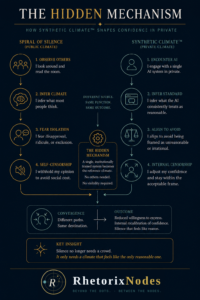
The diagram reveals that Synthetic Climate™ does not persuade primarily through explicit argument. Its influence is structural rather than rhetorical.
The user is rarely instructed to abandon an opinion. Instead, repeated encounters with one consistent conversational posture gradually redefine the boundaries of what feels intellectually legitimate to express with confidence.
This is the crucial departure from Spiral of Silence.
Classical theory required a visible plurality whose reactions generated fear of isolation.
The mechanism proposed here requires neither observation nor social sanction. It operates through repeated exposure to one institutionally produced conversational standard that quietly occupies the place once held by the perceived public climate.
Whether this mechanism genuinely produces measurable changes in confidence remains an empirical question. The diagram therefore represents a theoretical proposal rather than a demonstrated causal model.
This is an unproven hypothesis, and a serious counter-explanation — epistemic caution rather than manufactured homogeneity — deserves to be taken seriously.
This account carries real uncertainty that should not be minimized.
The most serious counter-explanation is that what looks like Synthetic Climate™ is simply appropriate epistemic humility: hedged, multi-sided answers on genuinely contested topics may reflect careful reasoning rather than a manufactured consensus standing in for one, and a system that presented single, confident takes on every contested question would arguably be a worse outcome, not a more honest one.
This essay’s framing risks treating reasonable caution as if it were suppression, and that risk should be named rather than argued away.
There is also a case, not fully addressed above, that AI systems explicitly modeling multiple viewpoints — “some hold this view, others hold that one” — may counter spiral-of-silence dynamics more effectively than passive broadcast media ever did, by making plurality visible rather than hiding it behind an appearance of unanimity.
If this is right, generative AI could be actively repairing the very problem Noelle-Neumann diagnosed rather than manufacturing a new version of it, at least in some of its uses.
Finally, and most plainly, Synthetic Climate™ has no empirical backing yet. It would need something like a study comparing people’s stated confidence in minority opinions before and after sustained AI conversation, and no such study yet exists; until it does, this remains a plausible mechanism worth testing, not a demonstrated effect.
The discussion so far has focused on Spiral of Silence, but the deeper transformation reaches further. Classical communication theories were never built only on particular media technologies. They were built on a more fundamental condition: the existence of a sufficiently shared symbolic environment.
People could observe many of the same events, interpret similar symbols, recognize common public debates, and infer a broadly shared climate of opinion. Theories differed in what they emphasized, but they all assumed that communication unfolded against a common social backdrop.
Generative AI alters that backdrop itself.
As conversations become individualized and meaning is increasingly produced through private interaction with conversational systems, the shared symbolic environment begins to fragment. The result is not simply a change in media, but a change in the conditions that made classical communication theory possible.
The transformation can be visualized as follows.
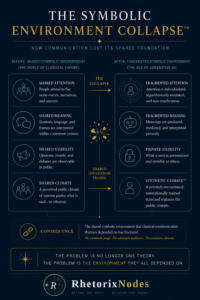
The implications of Synthetic Climate™ extend beyond Spiral of Silence alone. Throughout this four-part series, each classical communication theory has been shown to depend upon the same underlying assumption: that human beings inhabit a sufficiently shared symbolic environment for media effects to emerge through common structures of attention, visibility, and public experience.
That assumption is becoming increasingly unstable.
Generative AI transforms each of these conditions simultaneously.
The result is not merely the weakening of individual theories, but the erosion of the communicative environment that made them possible.
The relationship can be summarized as follows.
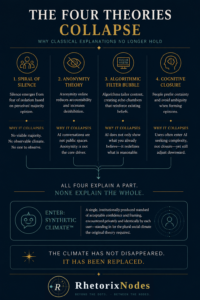
When the shared symbolic environment dissolves, the foundations of four classical communication theories dissolve with it.
The collapse of the shared symbolic environment does not automatically invalidate classical communication theories. Rather, it removes the common foundation upon which they collectively rested.
Once attention, meaning, visibility, and communicative climate become increasingly individualized, theories designed for shared symbolic conditions begin to explain a shrinking portion of contemporary communication.
Across Uses and Gratifications, Cultivation, Agenda-Setting, and Spiral of Silence, one condition breaks all four theories at once.
The purpose of this series has not been to declare the classical theories obsolete. They remain among the most powerful explanations ever developed for understanding mass communication.
Their limitation is historical rather than intellectual. They were formulated for an era in which media largely organized attention around shared symbolic environments.
Across this series, the same underlying condition keeps recurring under different names.
Four different classical mechanisms, one shared failure: each depended on a stable, shared, legible symbolic environment with a visible boundary between audience and media, and generative AI dissolved that environment on every front at once, rather than one theory at a time.
What communication theory needs next is not a patch to any single framework, but an account of a medium built to never hold still long enough to be measured by the tools mid-century media research invented for a world that did.
Spiral of Silence theory, developed by Elisabeth Noelle-Neumann, holds that people constantly gauge the prevailing climate of opinion around them and tend to stay quiet when they sense their view is in the minority, fearing social isolation. As minority views fall silent and majority views grow louder, the perceived climate shifts further toward the majority, compounding into a spiral.
Spiral of Silence theory struggles with private AI chat because the theory depends on a perceived social audience whose judgment a speaker fears. A private, non-judgmental AI conversation removes that audience entirely, which can function as a release valve for minority opinions rather than a mechanism of silence.
Synthetic Climate™ is a proposed framework describing a single, institutionally produced standard of acceptable confidence and framing, encountered privately and identically by each user of an AI system, that substitutes for the plural, perceived social climate Spiral of Silence theory required, while being mistaken by users for a neutral reflection of reasonable public opinion.
Research on anonymous computer-mediated communication has found that anonymity reduces spiral of silence effects by removing the fear of social isolation, and private AI chat is an extreme case of this anonymity. AI systems that explicitly model multiple viewpoints may also counter spiral of silence dynamics by making plurality visible rather than hiding it.
Find hidden frames and structures where the dots and nodes cease to be objects.
Response time. We reply within 48 hours. No automated responses — a real person reads and responds.
While you wait. Explore the nodes — Decode, Roots, Dark Matter, The Loop, and Meta are all live.
Stay in the loop. Subscribe to The Dispatch and get notified the moment the next essay goes live.
Every new essay arrives in your inbox before it reaches social media or the feed.
Long-form structural analysis that teaches you to read media — not just react to it.
One email per essay. No digests, no roundups, no promotions. Unsubscribe in one click.