

Open a newspaper from any decade of the twentieth century and you know, within seconds, what the editors decided mattered most. The lead story sits above the fold in the largest type. The second story is smaller. The third smaller still. Anyone else who bought that same edition saw the same ranking, in the same order, on the same morning.
You could argue about whether the editors got it right. You could not argue about what they had decided, because the decision was printed, visible, and identical for every reader who held the page.
Now:
Ask a chatbot what matters most in the news today, and no one else in the world receives quite the same list, in quite the same order, phrased quite the same way — and there is, in a strict sense, no page anyone is holding at all.
McCombs and Shaw’s Chapel Hill study showed the press doesn’t tell people what to think, but is remarkably successful at telling them what to think about.
Maxwell McCombs and Donald Shaw’s 1972 Chapel Hill study established one of the most durable findings in media effects research: the press may not be very successful in telling people what to think, but it is stunningly successful in telling people what to think about.
By comparing the ranked issues voters said mattered most against the ranked issues that dominated news coverage in the same period, McCombs and Shaw showed a strong correlation between media emphasis and public perception of importance; not opinion transfer, but salience transfer.
Later refinements distinguished first-level agenda-setting, which issues get covered, from second-level agenda-setting, which attributes and frames of those issues get emphasized, and both levels depended on the same underlying mechanism: a visible, rankable set of media choices that a mass audience was exposed to in comparable form.
This is what gave the theory its evidentiary strength. Researchers could count column inches, tally lead stories across competing outlets, and compare that ranking against survey data on what the public considered the nation’s most important problem.
The gatekeeping decision was public in the fullest sense — printed, broadcast, and observable by anyone, including the researchers measuring it.
Agenda-setting was never a claim about private persuasion. It was a claim about a shared, visible hierarchy of importance that a whole audience could see was being constructed, argue with, or ignore, but could not fail to perceive as a common reference point.
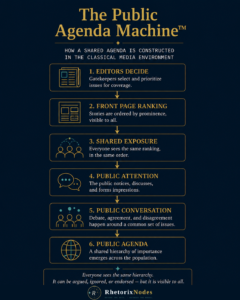
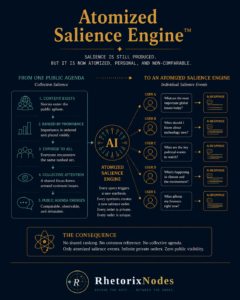
The diagram reveals something often overlooked in discussions of agenda-setting.
The theory is not merely about editorial influence; it depends on the existence of a stable public artifact that every participant can inspect.
Editors make decisions, those decisions become a visible ranking, the ranking is encountered collectively, collective attention forms, conversation emerges around that common reference point, and a public agenda gradually takes shape.
Each stage relies upon the previous one. Remove any single step and the entire mechanism weakens. Remove the shared ranking itself, and the machine no longer produces a common agenda at all.
That assumption quietly disappears inside conversational AI.
An AI answer engine dissolves salience into private prose rather than printing it as a rankable list anyone else could compare.
This is precisely the condition an AI answer engine removes. When a person asks a conversational AI system what matters today, the system does not hand them a ranked, itemized front page that a researcher (or anyone else!) could hold up next to another user’s front page and compare. It generates a single, synthesized paragraph of prose, produced for that user alone, in that moment alone.
The consequence is larger than personalization. If each person receives a different synthesis of what matters, the judgments that once accumulated into a recognizable public hierarchy can no longer accumulate in the same way. One person’s lead becomes another person’s absence. One conversation can make an issue salient without making that salience visible to anyone outside it.
What fragments, therefore, is not simply the audience. The common field of importance itself begins to break apart.
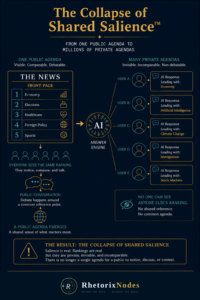
The salience judgment is real; the system has, in some sense, decided what to lead with and what to leave out. But that judgment is dissolved into fluent sentences rather than printed as a rankable list, and it is never exposed to a second reader who could check it against their own.
This is the territory this platform’s own Gate Architecture™ and Custodial Bias™ frameworks have already mapped: the gate has not disappeared, but it has become invisible and non-comparable, which changes what kind of public event a gatekeeping decision can be.
The disappearance is not merely stylistic. Agenda-setting’s mechanism required cross-person comparability to function as a public phenomenon at all. The theory measured a population’s convergence around a shared sense of importance, not any single individual’s private impression. When each output is bespoke, there is no longer a single agenda being set for a public to notice, discuss, or contest.
There are only as many private agendas as there are conversations, each invisible to every other, which is a different kind of thing than a front page, however personalized that front page might have been.
Personalized feeds already fragmented the shared agenda years before generative AI — and the field adapted with network and individual-level models.
The strongest reply from inside the agenda-setting tradition points out, correctly, that the shared public agenda had already been fragmenting for two decades before generative AI arrived.
Personalized search rankings, algorithmic social feeds, and filter-bubble dynamics — the subject of substantial research following Eli Pariser’s popularization of the term — had already replaced the single shared front page with millions of individually ranked feeds long before any chatbot existed.
Agenda-setting scholarship adapted to this reality rather than collapsing under it, developing network agenda-setting models and incorporating moderating variables like an individual’s need for orientation, which predicts how strongly a person’s sense of importance will track media emphasis.
On this view, an AI answer engine’s personalized salience judgment is not a new phenomenon breaking the theory; it is simply the next iteration of an algorithmic gatekeeping fragmentation the field has already been studying, with existing tools, for years.
This is a fair and important corrective, and it deserves to reshape the claim rather than be waved past. Algorithmic feeds genuinely did establish the precedent that personalization and salience-setting can coexist, and agenda-setting research has already produced a body of work on individual-level and networked salience that this essay should not pretend didn’t exist before generative AI.
Feed algorithms still surface discrete, nameable, comparable items; conversational AI answers dissolve even that shared item-pool.
But the precedent the feed algorithms set is weaker than it looks, because a social media feed — however personalized — still surfaces discrete, nameable, comparable items: specific posts, specific headlines, specific videos, each with its own visible ranking a user could screenshot and a researcher could audit.
Two people with different feeds are still looking at ranked lists built from a common pool of shared, citable content, which is why network agenda-setting research could still measure which topics clustered together across different feeds.
That distinction becomes clearer when the two architectures are placed side by side.
A feed changes the order in which shared objects reach a person. A conversational system changes the object that reaches them in the first place. The first operates on a common pool; the second can construct a response from the interaction itself.
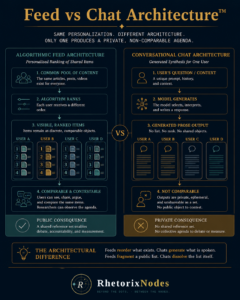
A conversational AI answer does not give you an item from a shared pool. It gives you a sentence the system built specifically in response to your specific words, with no discrete “item” underneath it that a second user’s differently worded question would have produced in comparable form.
The distinction becomes clearest when we look at what happens to ranking itself. A feed can personalize the order of objects that already exist: one headline rises, another falls, one video appears first, another disappears down the page. The objects remain identifiable even when their positions change.
Conversational AI removes that stable layer. The system does not simply rearrange a common set of items. It constructs the response itself, deciding through prose what deserves emphasis, what can be compressed, and what never needs to appear.
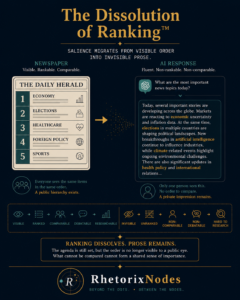
The salience judgment is encoded in prose structure: what gets a full paragraph, what gets a subordinate clause, what gets left out entirely, rather than in a rankable list of shared, nameable objects.
That is a difference in kind, not merely a further degree of personalization along the same axis feed algorithms already established.
There is a second, related failure. Agenda-setting’s public function depended on the ranking being contestable, a reader, a competing outlet, or a media critic could point at the front page and argue the editors got the ranking wrong. A private, synthesized, invisible salience judgment embedded in one person’s chat transcript is nearly impossible to contest in this way, because there is no artifact stable enough to point at.
The gate did not just become personalized. It became argument-proof, in a way even the most aggressively personalized social feed, with its still-discrete and still-screenshotable posts, was not.
Naming a salience-setting process that has lost its public, comparable, contestable character entirely.
What the theory needs is a name for a salience-setting process that has lost its public, comparable, contestable character entirely. Call it Atomized Salience™: the individualized, largely invisible construction of what matters, produced anew within each private exchange, with no shared or rankable artifact left over for a public to converge on, compare, or contest.
The concept becomes clearer when the mechanism is separated from its consequence. Atomized Salience™ does not mean that the system stops making judgments about importance. It means that those judgments are generated inside individual exchanges rather than across a shared public field.
Each conversation therefore becomes a small salience-producing system of its own: a question enters, the model interprets its context, some information receives greater attention, other information is compressed or omitted, and the resulting hierarchy exists only within that exchange.
The distinction from network agenda-setting matters. Network agenda-setting still assumes a population of feeds built from a common item-pool that researchers can trace connections across.
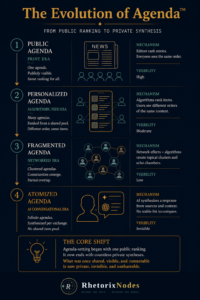
Atomized Salience™ describes a condition one step further out, where even the item-pool disappears from view, replaced by synthesized prose generated fresh for each private exchange. The public agenda is not merely fragmented into many smaller shared agendas. It is dissolved into units of one.
Seen from this distance, the shift is easier to understand as a change in the architecture of agenda-setting itself. Each media environment preserved some form of salience while changing where its hierarchy lived: first in a shared publication, then in personalized rankings, then across fragmented networks, and finally inside individual exchanges.
The important question is therefore not simply whether agendas still exist. They do. The question is where the agenda now resides, who can see it, and whether anyone else can share the same hierarchy of importance.
Citation-heavy answer engines reintroduce a comparable, visible ranking this argument does not account for well.
This framework is considerably weaker for one important category of AI system than this argument allows, and that limit is worth stating plainly. Citation-heavy AI answer engines that surface a ranked list of linked sources alongside a generated summary, reintroduce exactly the kind of visible, comparable artifact that conversational chat dissolves.
A user can see which sources were ranked first, screenshot that list, and compare it against another user’s results for a similar query, much as a researcher could once compare front pages. Atomized Salience™ describes prose-based conversational answers far more convincingly than it describes retrieval-augmented answer engines with visible citations, and treating all AI systems as equally opaque would be an overclaim.
There is also a real question about how much the public agenda actually disappears versus simply moves.
People routinely screenshot and share AI outputs on social media, effectively re-publicizing what was originally a private exchange and reconstructing something like a shared point of comparison after the fact. Whether this secondary circulation restores enough of agenda-setting’s original public function, or merely creates a much noisier and more selective sample of what gets compared, is an open empirical question this essay cannot resolve from theory alone.
Finally, measuring Atomized Salience™ empirically is genuinely harder than measuring a printed front page: there is no natural unit to count, no column inch to tally, and any research program in this direction will need to invent a method for quantifying salience embedded in generated prose before the concept can move from argument to evidence.
McCombs and Shaw were right that a visible, shared ranking of importance can shape what a whole public believes matters. What they could not have anticipated is a medium that performs the same judgment invisibly, for an audience of one, with no artifact left behind for anyone else to see.
The final theory in this series, Spiral of Silence, meets a stranger version of the same problem: a private, non-judgmental AI interlocutor might let people voice opinions they would suppress in public — while quietly replacing the plural social climate that theory depends on with a single, homogenized sense of what counts as acceptable to say at all.
Agenda-Setting theory, established by Maxwell McCombs and Donald Shaw’s 1972 Chapel Hill study, holds that the press does not tell people what to think but is highly effective at telling them what to think about. It works through salience transfer: a strong correlation between the ranked importance the media gives to issues and the ranked importance the public assigns to those same issues.
Agenda-Setting theory struggles with AI answer engines because it depends on a visible, comparable ranking of issues that a mass audience is exposed to in common, such as a printed front page. Conversational AI systems generate a private, synthesized response for each user individually, so there is no shared, rankable artifact left for a public to converge on, compare, or contest.
Atomized Salience™ is a proposed framework describing the individualized, largely invisible construction of what matters, produced anew within each private AI exchange, with no shared or rankable artifact left over for a public to converge on, compare, or contest.
Citation-based AI answer engines that surface a ranked list of linked sources reintroduce a visible, comparable artifact closer to a classical agenda-setting ranking, since users can see which sources were ranked first and compare results across queries. This makes Atomized Salience™ a weaker fit for retrieval-augmented answer engines than for prose-based conversational AI.
Find hidden frames and structures where the dots and nodes cease to be objects.
Response time. We reply within 48 hours. No automated responses — a real person reads and responds.
While you wait. Explore the nodes — Decode, Roots, Dark Matter, The Loop, and Meta are all live.
Stay in the loop. Subscribe to The Dispatch and get notified the moment the next essay goes live.
Every new essay arrives in your inbox before it reaches social media or the feed.
Long-form structural analysis that teaches you to read media — not just react to it.
One email per essay. No digests, no roundups, no promotions. Unsubscribe in one click.