
Nostalgia cycles are usually treated as a cultural fact rather than a mechanical one: styles return, generations rediscover their childhoods, and critics measure the interval the way you’d measure the gap between a wave and its echo — a fixed distance, dictated by how sound travels, not by anything the echo wants.
That assumption has held for a century of criticism because it was reasonable for a century of media environments.
It stops being reasonable the moment the thing doing the “remembering” is no longer a person with a childhood, but a ranking system with a memory that never fades and a reason, every second, to reach into it.
What follows takes the interval itself as the object of study rather than the styles passing through it. It is not another account of why 2016 feels retrievable. Jameson, Fisher, and Reynolds have already done that work well, and this essay leans on it rather than repeating it.
It is an account of why the retrieval now takes half as long, and it locates the answer not in taste, generational memory, or the usual vocabulary of cultural criticism, but in the machinery doing the choosing.
The claim being tested is specific and has a name — Recursive Legibility™ — and it is built here the way an argument worth trusting has to be built: stated plainly, set against its strongest counterargument, and left with the conditions that would prove it wrong still attached, rather than quietly filed away as settled.
Indie sleaze filters, mid-2010s meme cadences, and Vine-era comic timing are back on For You pages that didn’t exist when the originals were current.
Anyone who spent 2016 online can recognize 2026’s aesthetic without trying.
The flash photography and party-grain of “indie sleaze” is back in fashion editorials. Short-form video has rediscovered the deadpan, jump-cut comic timing that Vine invented and Vine alone owned for four years before it died in 2016.
Meme formats that depended on a specific mid-2010s irony register — the kind that assumed shared exhaustion with corporate social media rather than genuine affection for it — are being remixed by creators who were in elementary school when the originals circulated.
None of this is unusual on its face. Cultural nostalgia running on a roughly twenty-year delay is one of the best-documented patterns in pop culture criticism: the 1970s revived the 1950s, the 1990s revived the 1970s, and the 2010s revived the 1990s.
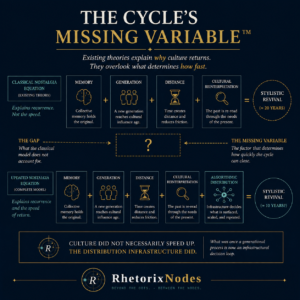
What’s unusual is the math. 2016 to 2026 is ten years, not twenty. The cycle that once took two decades to complete a lap is now completing it in one, and it is worth asking why, rather than filing it under “nostalgia accelerating” and moving on, because “accelerating” is a description, not an explanation.
Existing nostalgia theory explains why culture loops back on itself; it does not explain why the loop has started closing twice as fast.
The best existing accounts of nostalgia cycles converge on a shared claim: nostalgia is not really about the past. It is about the present’s difficulty representing itself.
Fredric Jameson’s account of pastiche in postmodern culture treats the recycling of old styles as a symptom of a culture that has lost the ability to produce genuinely new forms, so it wears the old ones instead — pastiche without parody, imitation without a joke.
Mark Fisher extended this into hauntology: culture haunted by lost futures, endlessly re-consuming the aesthetics of moments when the future still felt open, because the present cannot generate that feeling on its own.
Simon Reynolds, writing specifically about the mechanics of the cycle in Retromania, located it in generational turnover; each cohort reaches cultural authorship age and reaches first for the aesthetics of its own childhood, filtered through nostalgia rather than the aesthetics of its parents’ youth, which still carries the parents’ authority.
Taken together, these accounts explain recurrence. They explain why a culture would return to 2016 rather than inventing something unprecedented.
What none of them explain (because none of them were built to!) is why the gap between original and revival would compress.
Reynolds’ twenty-year figure was itself empirical, drawn from observed cycles across the twentieth century, not derived from a first-principles claim about how long cultural memory must season before it becomes usable again. If the gap is now roughly half that, the existing theory has no internal reason to expect it. Something changed the machinery, not just the content moving through it.
A twenty-year lag assumed a slow, generational transmission mechanism; the mechanism moving culture today is neither slow nor generational.
The classical account assumes a specific delivery system for nostalgia: it has to pass through people.
A stylistic revival needed someone who remembered the original, a media environment slow enough that revivals happened in waves rather than continuously, and enough distance for the original to lose its embarrassment and gain its charm. Reynolds calls this the difference between something being merely dated and becoming “cool again.”
That process took time because human memory, generational succession, and broadcast media all moved at human and institutional speed.
None of the three constraints holds the same way now.
Content doesn’t wait for a person to remember it and choose to revive it; it is retrieved, re-served, and re-contextualized by systems that have no embarrassment threshold to wait out, because they were never embarrassed in the first place. A recommendation system does not know that 2016 aesthetics are “dated” in the way a person raised through that period does. It knows only what performed well, and performance is available to it immediately and continuously, not after a decade’s wait.
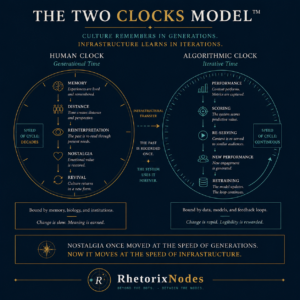
If the delivery mechanism no longer requires human memory and generational patience to function, there is no obvious reason it should still run on human memory’s timescale.
The theory that explained the twenty-year cycle was, without saying so, a theory of a particular infrastructure. Change the infrastructure and the cycle should be expected to change too — the surprising thing would be if it didn’t.
Content that has already proven legible to an engagement model gets re-served preferentially over content that hasn’t yet been scored, and each re-serving re-teaches the model that legibility, closing the loop faster with every pass.
Here is the mechanism I want to name. Call it Recursive Legibility™: a recommendation system’s structural preference for content whose performance is already known over content whose performance is still uncertain, and the compounding effect this preference has on what gets re-circulated and how quickly.
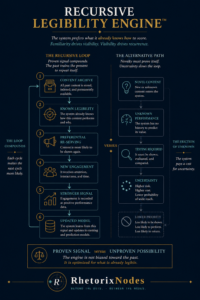
Novel content is a wager for a recommendation system. It has no engagement history, so surfacing it is a bet that must be tested against an audience before its value is known, and testing is expensive in a system optimized to minimize wasted impressions.
Content that already performed well once — anywhere, at any point in the platform’s memory — is not a wager. Its legibility has already been established. Re-serving it, or re-serving something adjacent to it in style, is close to a sure thing.
This is not a claim that platforms deliberately curate nostalgia; it is a claim about what a system optimizing purely for engagement will do when given the choice between a proven signal and an unproven one, repeated at the scale of billions of ranking decisions per day. It will lean toward the proven signal, every time the choice is close, and the choice is close constantly.
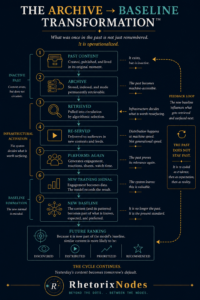
The recursive part is what makes this a media-ecological claim rather than just a business observation.
Each time already-legible content is re-served and performs again, it doesn’t just get re-served, it becomes a stronger training signal for the next round of ranking. What was retrieved from the archive becomes the new baseline the model tunes toward.
The loop does not run once per cultural generation, the way Reynolds’ mechanism did. It runs continuously, on a cadence set by training and retraining cycles rather than by the turnover of human cohorts.
A twenty-year cultural mechanism, run through an infrastructure that closes its own loop in weeks rather than decades, should be expected to produce a compressed cycle. It isn’t because taste changed, but because the thing doing the choosing changed its clock speed.
This is the natural extension of what I’ve elsewhere called Custodial Bias™ which is the claim that infrastructure doesn’t just preserve or transmit content neutrally but actively favors what it already knows how to handle. Recursive Legibility™ is Custodial Bias™ specifically applied to the temporal dimension: not just what gets custodial preference, but how fast that preference re-feeds itself.
The ten-year cycle could simply be evidence that nostalgia was already compressing before algorithmic feeds existed to accelerate it, and this essay does not have the data to rule that out.
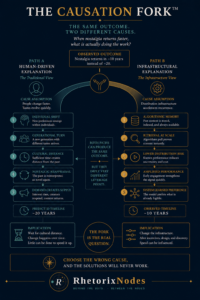
The load-bearing objection to this argument is not a minor one, and it deserves to be stated at full strength rather than gestured at.
Reynolds was documenting an accelerating cycle before algorithmic recommendation was a factor in mainstream media consumption at all. His own account of Retromania, written in the early 2010s, already noted the gap between original and revival shrinking across the twentieth century, well before TikTok’s For You page or YouTube’s recommendation engine existed in anything like their current form.
If the cycle was already compressing on its own trajectory, then what this essay is calling Recursive Legibility™ may be an accelerant layered onto a pre-existing trend, not its cause. It’s the same relationship a faster processor has to a program that was already going to run, just more slowly.
Distinguishing “algorithmic recursion caused the compression” from “algorithmic recursion is riding a compression that had its own momentum” requires something this essay does not have: actual engagement-rate data showing that revival content’s time-to-re-surface has shortened specifically in proportion to how algorithmically-mediated a platform’s distribution is, compared to platforms or eras with less algorithmic mediation.
Without that comparison, the argument here is a plausible mechanism, not a demonstrated cause.
It’s entirely possible that generational cultural transmission was already going to compress the cycle on its own (smartphones alone changed how continuously each generation is exposed to the media of the one before it!) and that recommendation systems are simply the most visible surface of a change whose deeper cause is elsewhere.
This argument would be falsified by evidence that nostalgia cycles are compressing at the same rate on low-algorithmic and high-algorithmic platforms alike.
What would count against Recursive Legibility™ as a meaningful explanation, rather than a redundant description?
If nostalgia cycles compressed by a comparable margin on platforms with minimal algorithmic curation (a curated-by-humans magazine, a subscription newsletter, a strictly chronological feed) as on platforms built around continuous ranking, that would suggest the compression is happening upstream of any recommendation system, and this essay’s mechanism is decoration rather than explanation.
Equally, if the compression turns out to track a single confounding variable better than it tracks algorithmic mediation — the sheer increase in total content volume, say, which would shorten any cycle for reasons that have nothing to do with recursive scoring — the more parsimonious account should win.
This essay treats Recursive Legibility™ as a strong candidate mechanism worth testing, not as a settled cause. The honest version of this argument is falsifiable, and it should stay that way.
The ten-year nostalgia cycle is either a system re-feeding its own output or an old pattern accelerating on its own terms, and telling those apart is an empirical project, not a rhetorical one.
2026 looking like 2016 is not proof that culture has run out of ideas, and it is not proof that an algorithm invented nostalgia.
It is evidence that a very old cultural mechanism is now running through infrastructure built to close its own loops quickly, and that the resulting compression deserves a name and a testable claim rather than a shrug at “everything is cyclical now.”
Recursive Legibility™ names what a system does when it prefers what it already knows how to score over what it doesn’t. Whether that preference is the actual engine of the shorter cycle, or just the most visible passenger riding a cycle that would have shortened anyway, is the question the next round of data should answer — not this essay.
Recursive Legibility is a proposed media-theory framework describing a recommendation system’s structural preference for content whose performance is already known over content whose performance is still uncertain, and the compounding effect this preference has on how quickly old content is re-circulated.
2026 looking like 2016 reflects a nostalgia cycle that has compressed from the classical twenty-year lag to roughly ten years, likely because recommendation systems re-serve already-proven content continuously rather than waiting for generational cultural transmission.
Recursive Legibility extends Custodial Bias by applying its core claim that infrastructure favors what it already knows how to handle, specifically to the temporal dimension, explaining not just what gets preferential treatment but how fast that preference re-feeds itself.
This is not yet demonstrated. Simon Reynolds documented nostalgia cycles compressing before algorithmic recommendation existed in its current form, so algorithmic recursion may be an accelerant of a pre-existing trend rather than its cause. Testing this requires engagement-rate data comparing platforms with differing levels of algorithmic mediation.
Find hidden frames and structures where the dots and nodes cease to be objects.
Response time. We reply within 48 hours. No automated responses — a real person reads and responds.
While you wait. Explore the nodes — Decode, Roots, Dark Matter, The Loop, and Meta are all live.
Stay in the loop. Subscribe to The Dispatch and get notified the moment the next essay goes live.
Every new essay arrives in your inbox before it reaches social media or the feed.
Long-form structural analysis that teaches you to read media — not just react to it.
One email per essay. No digests, no roundups, no promotions. Unsubscribe in one click.