

A tweet is a small thing. But it can create a huge impact.
A thing fewer than three hundred characters, gone from most feeds within the hour, written by someone who almost certainly did not intend to start anything. And yet watch what happens to it: a stranger crops it into a screenshot, framing out everything that made it make sense. The screenshot grows a caption, sharp and knowing. The caption grows replies.
Somewhere a meme is born from the wreckage, fluent in a visual dialect the original poster has never spoken. By evening, a headline announces that “the internet is reacting,” and the tweet, the actual, original, three-hundred-character thing, has become a rumor about itself, cited by almost no one, read by almost no one, yet somehow still the official cause of everything downstream.
The claim is narrow: reactions to communication are increasingly treated, functionally, as communication in their own right, and the object everyone is actually responding to keeps sliding one step further from the source.
This is the anatomy this essay wants to open up: not the tweet, and not even the outrage, but the machinery in between — the quiet handoff by which a reaction stops commenting on communication and starts being communication, indistinguishable in status from the thing it responded to.
Call it a magic trick with the misdirection built into the platform rather than the performer. The hand moves, everyone watches the hand, and the coin, the original utterance, has already left the stage.
A short primary utterance is rarely what audiences end up responding to. Networked media quietly multiplies that text into five or six before anyone finishes reading the first one.
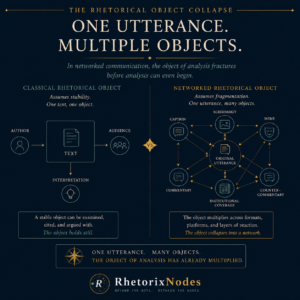
Classical rhetorical analysis assumes a stable object: a speech, a text, an utterance that can be examined, cited, and argued with.
Networked communication breaks that assumption quietly, without announcing itself. A tweet is posted. Within an hour, the tweet has been screenshotted, captioned, and reposted with commentary. The caption gets its own replies.
Someone makes a meme out of the screenshot. The meme circulates on a platform where the original poster does not have an account and never will.
By the time a critic sits down to analyze “what happened,” the object of analysis has already multiplied.
The original tweet, the screenshot, the caption, the meme, and the discourse about the meme are five different texts, each with its own audience, its own metrics, and its own life span. Most of the people engaged with the fifth text have never seen the first.
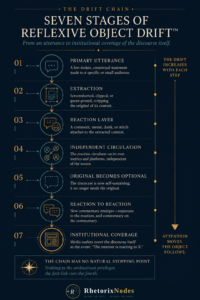
From a single low-stakes post to a headline about “the discourse” itself — tracing the seven-stage chain by which attention detaches from its source and never looks back.
The pattern is consistent enough to describe as a sequence rather than a series of accidents. A primary utterance occurs — low-stakes, contextual, often addressed to a small or specific audience. It gets extracted: screenshotted, clipped, or quote-posted, a move that strips the surrounding context that made it legible in the first place. A reaction layer attaches, a comment, a meme, a dunk, or a stitch, and that reaction begins circulating on its own engagement metrics, independent of the source.
At this point the original becomes optional.
The discourse is self-sustaining; it no longer needs the thing that started it.
A further layer appears: reactions to the reaction, commentary on the commentary, and eventually institutional media covers the discourse itself as the event, publishing some version of “the internet is reacting to X,” where X was already three steps removed from whatever was originally said.
Each stage is a legitimate rhetorical act. The instability isn’t in any single stage. It’s in the fact that the chain has no natural stopping point, and nothing in the architecture privileges the first link over the fourth.
Giving the mechanism a name and a unit of analysis — the moment a reaction stops referring to its source and starts competing with it for rhetorical primacy.
Reflexive Object Drift™ names the process by which the object of collective attention migrates away from a primary communicative act and settles on a reaction to it.
It’s a migration that can repeat recursively, with each new layer becoming a fresh object for the next round of reaction. The term is deliberately mechanical rather than moralizing: drift is not decay.
It describes a structural tendency of reflexive media environments, not a failure of individual judgment.
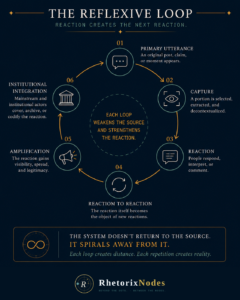
The useful unit of analysis under this framework is not the original text but the drift chain, i.e., the full sequence of extraction, reaction, and re-reaction, tracked as a single rhetorical event with multiple authors and no single author in control of its final shape.
Asking “what did the original poster mean” becomes a much smaller question than asking “where did this chain stabilize, and why there.”
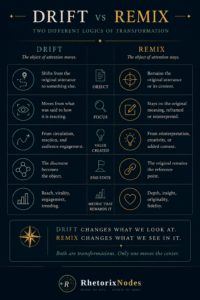
Remix keeps the source as raw material for something new; drift discards the source and keeps only the gravitational pull it left behind — a distinction worth drawing carefully.
It’s tempting to fold this into existing accounts of remix and participatory media. The audiences have always recombined source material into new texts.
But remix keeps the source material as raw ingredient; the new text is built from pieces of the old one.
Reflexive Object Drift™ describes something structurally different: the reaction doesn’t incorporate the original so much as replace it as the thing people are actually oriented toward. The original can vanish, get deleted, or turn out to be satire, and the discourse chain often continues undisturbed, because it was never really about the original text. It was about the reaction economy that formed around it.
This is a shift in referent, not just a shift in form. Remix culture changes what gets made. Drift changes what gets treated as the primary object of attention in the first place.
The quote-post, the stitch, the screenshot-with-caption: reaction has hardened into repeatable form with its own grammar, and form this stable functions as infrastructure, not commentary.
What makes this newly visible as a rhetorical phenomenon, rather than an old one under a new name, is that reaction now has fixed generic form.
Because these forms are stable and repeatable, they function less like commentary and more like infrastructure — durable channels that any piece of primary communication will very likely pass through on its way to becoming discourse. The reaction genres now exist prior to any specific reaction, waiting to receive the next input.
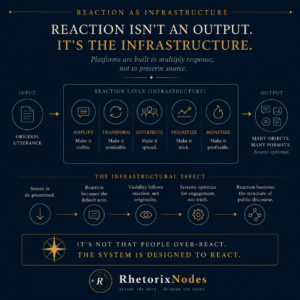
Before treating drift as a problem worth naming, the strongest possible case that it’s simply democratized discourse working exactly as intended deserves a full hearing.
The strongest objection to treating drift as a phenomenon worth flagging comes from participatory-culture scholarship: audiences becoming producers, talking back to media rather than passively consuming it, has generally been read as democratizing.
On this view, Reflexive Object Drift™ is simply what healthy public discourse looks like when the tools of production are widely distributed. Treating it as a rhetorical problem, i.e., implying something has gone wrong when reactions outcompete sources, risks smuggling in a preference for top-down, author-controlled communication and dressing that preference up as neutral description.
This objection has real force. Nothing in the drift mechanism is inherently corrosive; a society where audiences can redirect attention away from an original speaker toward a collective response is arguably doing exactly what public discourse is supposed to do.
The framework is most useful not as a verdict on whether drift is good or bad, but as a description of where explanatory and evidentiary weight actually sits in a given controversy — which is a separate question from whether that distribution of weight is desirable.
Letters to the editor and call-in radio ran this same play decades ago; the mechanism isn’t new, and claiming otherwise would overstate what platforms actually invented.
Reaction becoming its own communicative object is not new.
Letters-to-the-editor sections, call-in radio, and op-ed rebuttals all made commentary into a public text with its own audience, sometimes larger than the audience for the original piece.
Framing Reflexive Object Drift™ as a novel condition of networked media would overstate the case.
What is genuinely different is velocity and formal institutionalization. A letter to the editor took days to write, was filtered by an editor, and appeared once. A quote-post takes seconds, has no gatekeeper, and can itself be quote-posted within the same minute, collapsing a process that used to take a news cycle into one that can complete and move past its own origin before most people encounter the source.
The mechanism is old. The compression is new, and the compression is what makes the drift chain outrun any single actor’s ability to track or correct it.
Somewhere between a tweet and the news cycle it eventually generates, something happens to the tweet. It stops being the point!
Reflexive Object Drift™ is the process by which the object of collective attention migrates away from a primary communicative act like a post, a statement, a clip, and settles instead on a reaction to it, sometimes repeating across several recursive layers of reaction to reaction.
Remix culture recombines source material into new content while keeping the source as raw ingredient. Drift relocates the center of attention away from the source itself, often leaving it behind entirely. The discourse can continue even if the original is deleted or was satire.
No. Reaction becoming its own communicative object predates networked platforms as letters to the editor and call-in radio did this too. What’s new is velocity and formal institutionalization: the drift chain now completes in minutes through fixed genres like quote-posts and stitches, rather than over a news cycle mediated by an editor.
Not necessarily. The framework describes where attention settles in a controversy; it doesn’t pass judgment on whether that settlement is desirable. A strong counter-view holds that drift is simply what participatory, democratized discourse looks like when production tools are widely distributed.
The drift chain is the full sequence of extraction, reaction, and re-reaction, rather than the original text alone. Analyzing only the source text misses where the discourse actually stabilized.
Treating drift chains as the unit of rhetorical analysis, rather than isolated texts, doesn’t resolve the participatory-culture objection above — it just relocates the question. The more tractable question is where, in a given chain, attention actually settled, and what got built on top of that settlement. That’s a description, not a diagnosis, and the two shouldn’t be confused for each other.
Find hidden frames and structures where the dots and nodes cease to be objects.
Response time. We reply within 48 hours. No automated responses — a real person reads and responds.
While you wait. Explore the nodes — Decode, Roots, Dark Matter, The Loop, and Meta are all live.
Stay in the loop. Subscribe to The Dispatch and get notified the moment the next essay goes live.
Every new essay arrives in your inbox before it reaches social media or the feed.
Long-form structural analysis that teaches you to read media — not just react to it.
One email per essay. No digests, no roundups, no promotions. Unsubscribe in one click.