

Two claims are born on the same Tuesday morning. One says a city councilman was caught pocketing bribes from a construction firm. The other says the same councilman quietly reversed his position on a zoning ordinance.
By dinner, the bribery claim has crossed a hundred thousand timelines, arrived in three group chats, and acquired its own hashtag.
The zoning claim is still sitting in a handful of policy newsletters, true, sourced, and almost entirely unread.
A week later, a fact-checking desk rules the bribery story false. Nobody ever rules on the zoning story, because nothing about it was ever contested enough to need a ruling. It was simply slower, and quieter, and true.
This is the shape of the puzzle usually filed under “why does fake news spread faster than true news” — and it is worth noticing, before reaching for arousal or novelty or algorithms as the mechanism, that the puzzle has already made a decision on our behalf.
It has decided that the councilman’s two claims are comparable data points, differing only in truth-value and speed. It has decided that “spread” means the same thing for both. It has decided that the interesting question is why the false one won, rather than who gets to say, and when, that it lost.
A Meta-node reading does not dispute that false claims often travel further and faster than true ones — the councilman’s bribery story really did outrun his zoning vote. It asks what the framing quietly assumed in order to make that outcome legible as a finding at all.
The question is pre-loaded in three further ways.
What follows takes each of these presumptions apart in turn, before returning, deliberately, to what the deconstruction cannot be allowed to excuse.
The 2018 Twitter study behind this claim is real and widely cited, but its “false” label was assigned by six fact-checking organizations working on their own schedule, not discovered as a property inherent to the claim itself.
The most-cited empirical anchor for this topic is Soroush Vosoughi, Deb Roy, and Sinan Aral’s 2018 Science study, which tracked roughly 126,000 cascades of contested news stories on Twitter between 2006 and 2017 and found that false stories reached more people, spread faster, and traveled deeper into networks than true ones — an effect the authors attributed to human sharing behavior rather than automated bots.
The finding is real and widely replicated in spirit across subsequent platform studies. What deserves separate scrutiny is the machinery that produced the labels “false” and “true” in the first place, since the study’s classification depended on rulings from six independent fact-checking organizations.
Those organizations operate on their own institutional timeline, with their own selection criteria for which claims are worth checking at all, and their own thresholds for what counts as sufficiently adjudicable to rule on.
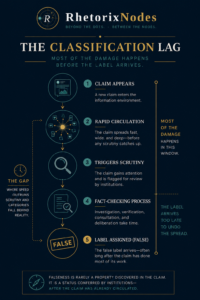
A claim’s “falseness,” in this data-set, is not a property discovered in the claim — it is a status conferred by an external institution, at a moment that may arrive well after the claim has already done most of its circulating.
Two coined frameworks, Infogenomics and Unreciprocated Legibility, explain why the claims most likely to be ruled false later are also the claims most primed to spread quickly now. The overlap, not falseness alone, may be driving the result.
This is where the framework of Infogenomics, which means treating information artifacts as bearing an encoded history of the institutional processes that produced, labeled, and routed them, becomes useful.
A claim’s “spreadability” and its “falseness” are not independent variables measured at the same moment; the falseness label is typically retrofitted after a claim has already achieved whatever circulation it was going to achieve. This produces a structural asymmetry worth naming directly:
…are exactly the claims fact-checkers take longest to rule on, and exactly the claims most likely to eventually receive a “false” label precisely because ambiguity is what invites fact-checking scrutiny in the first place.
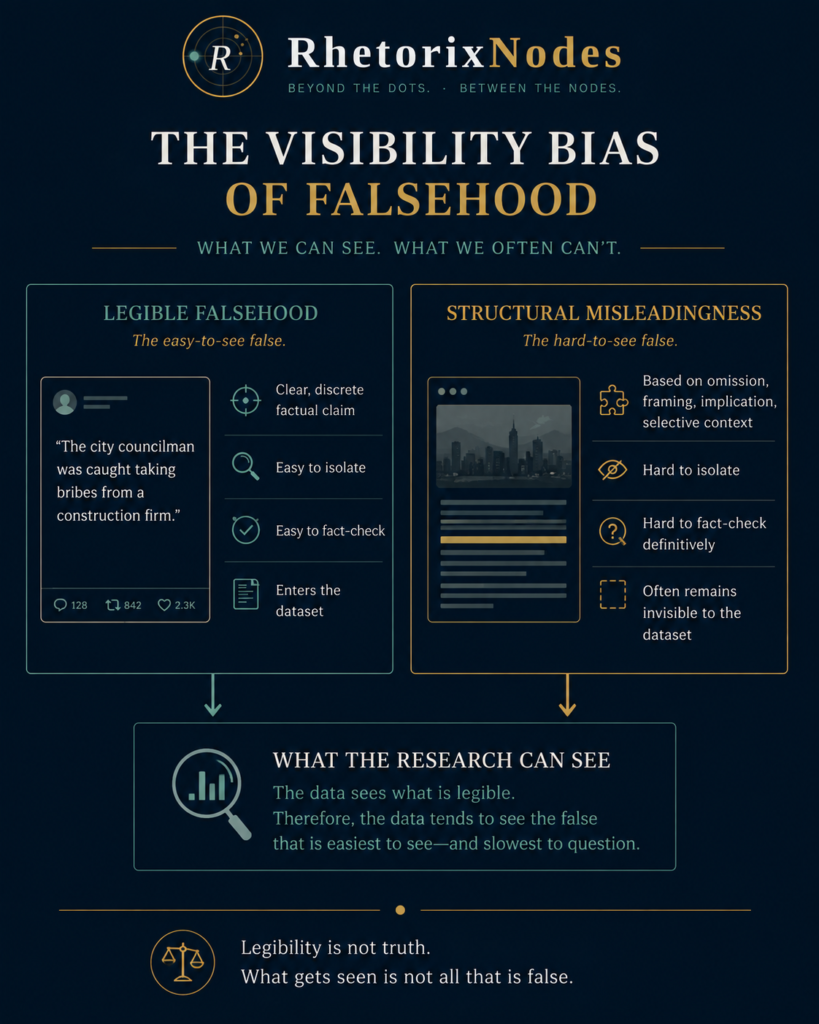
The related concept of Unreciprocated Legibility captures the other side of this: some claims are more legible to the classifying apparatus than others, independent of their truth-value, because they arrive in a form institutions are equipped to process — a discrete, checkable factual assertion rather than a diffuse mood, framing, or omission.
Claims that are false in a legible way get flagged and counted. Claims that are misleading in a structural or connotative way, i.e., true statements arranged to produce a false impression, often escape the classification system entirely, which means they escape the data-set, which means they escape the finding.
None of this overturns the original result. It relocates part of the explanatory burden from “falseness causes faster spread” to “the properties that make a claim classifiable as false and the properties that make a claim spread quickly overlap substantially, and the overlap itself needs accounting for.”
Retweets, shares, and reach are metrics platforms engineered to be gamed, not neutral instruments for studying truth, and using them to measure virality risks confirming the platform’s own priorities rather than any fact about falsehood.
A second layer of instrument-scrutiny concerns “spread” itself.
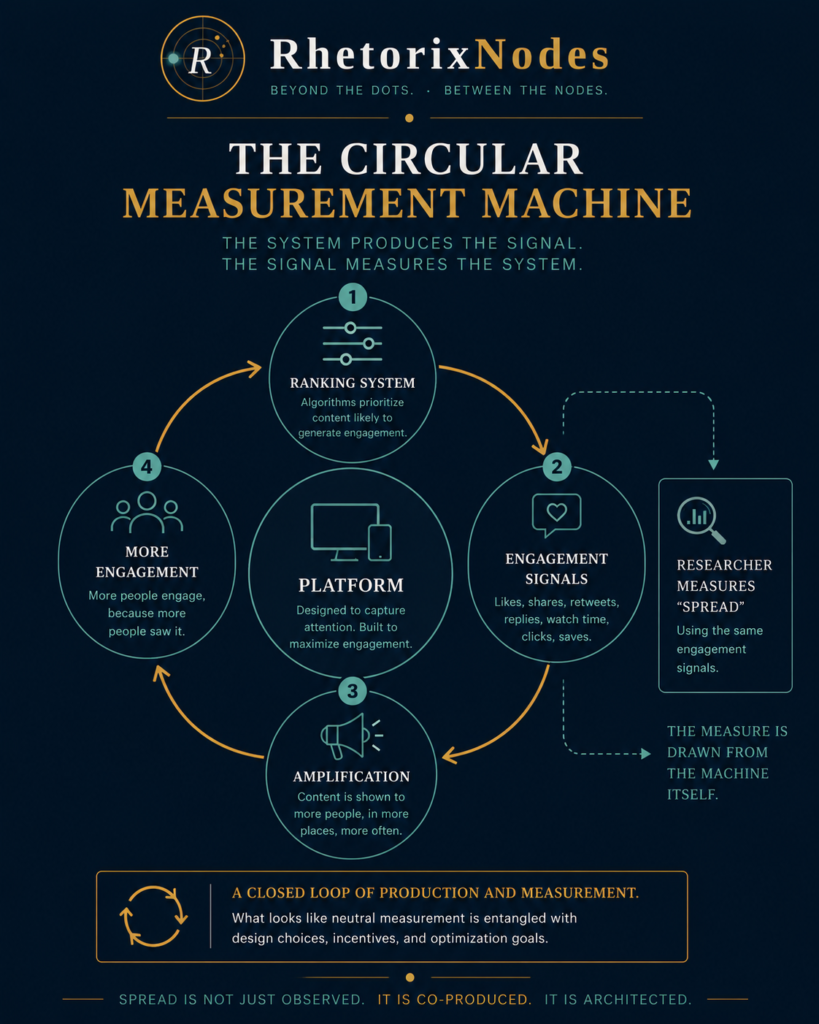
Retweets, shares, and reach are not neutral units of measurement borrowed from a disinterested science of information transmission. They are metrics platforms built and continually tune specifically because they are optimizable, and platforms optimize their ranking systems against exactly these signals.
Tarleton Gillespie’s work on platforms as governed, engineered environments — distinct from earlier, more diffuse media-ecology accounts of how information environments shape cognition (the McLuhan–Postman–Innis lineage concerned with medium-level effects rather than platform-level engineering) — is the more precise framework here, because it locates agency in specific, adjustable architecture rather than in the general properties of a communication medium.
When a study measures “spread” using retweet cascades, it is measuring the output of a system that was deliberately built to reward the affective signature like arousal, moral outrage, novelty, that happens to correlate with the kinds of claims later ruled false.
This is not an accusation that the finding is fabricated. It is an observation that studying virality with platform-native virality metrics risks a kind of circularity: whatever the ranking algorithm is tuned to amplify will show up as “spreading faster,” and if the algorithm’s amplification criteria correlate with the affective profile of false claims, the study will reliably find that false claims spread faster regardless of whether falseness itself is doing any causal work.
An essay that opens with a striking, quantified claim about what makes claims spread is already using the exact rhetorical mechanics it sets out to diagnose — a loop named here as Rhetorical Overproduction.
The more uncomfortable move, and the one that most justifies a Meta-node treatment rather than a Decode or Dark Matter one, is turning the instrument on the essay itself.
An essay that opens with “false news spreads six times faster than true news” is deploying a striking, quantified, emotionally resonant claim — the exact rhetorical shape that the essay is diagnosing as the mechanism of viral falsehood.
Citing the number, repeating it, building a hook around it: these moves are rhetorically indistinguishable from the sharing behavior under examination.
This is not a reason to avoid discussing the finding.
It is a reason to notice that “writing compellingly about what makes claims compelling” is not a neutral vantage point outside the system. It is a further iteration of the system, produced by someone (in this case, the writer) who has audience-attention incentives of their own.
The category of Rhetorical Overproduction, which means describing the tendency of discourse about a phenomenon to reproduce that phenomenon’s own persuasive machinery in the act of describing it, names this loop precisely.
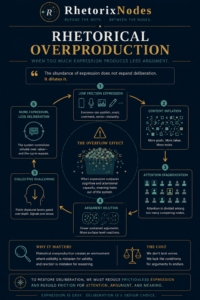
A Meta-node essay’s obligation is not to pretend to stand outside this loop, which is not achievable, but to say so plainly enough that the reader can factor it into how much weight the essay’s own rhetorical choices deserve.
The strongest objection to everything above is that deconstructing a category can quietly excuse inaction on real harm — a challenge this essay meets by separating the unstable edges of “fake news” from its verifiably false and damaging center.
The strongest challenge to everything above is a version of what philosophers of science call underdetermination skepticism applied loosely to a political question: if every category is constructed, every metric is an artifact, and every essay about virality participates in virality, then nothing can be said with confidence, and the whole exercise risks becoming a way of never having to conclude anything.
This challenge has real force and needs to be met directly rather than gestured past. Deconstructing the instability of “fake news” as a category does not make the underlying phenomenon disappear, and treating classification problems as grounds for suspending judgment can function, in practice, as a way of laundering away real stakes.
A false claim about vaccine ingredients circulating among parents of unvaccinated infants is not primarily an epistemological puzzle about labeling apparatus; it is a claim that is false, that causes measurable harm, and that a parent needs accurate information about regardless of how contestable the boundary of “fake news” is at the margins.
The instability documented in this essay lives mostly at the edges of the category — in cases of contested framing, omission, and slow-forming institutional judgment — not in the clear center, where verifiably false and materially harmful claims sit and where classification lag or metric circularity does very little to change the moral picture.
An honest version of this argument treats the edges and the center as requiring different standards of evidence and different obligations to act, rather than letting uncertainty at the edges bleed backward to excuse inaction at the center.
This meta-level critique sharpens how misinformation research gets read, but it cannot tell a platform team whether to label a claim today, and its evidence base is Twitter-specific data that may not hold on closed networks like WhatsApp.
This meta-level treatment is better suited to examining the discourse surrounding misinformation than to equipping anyone who has to act on a live case in the next hour.
A public health communicator responding to an active outbreak of false claims about a vaccine, or a platform trust-and-safety team deciding whether to label a claim during a fast-moving news event, does not have the luxury of waiting for category stability to resolve itself — the operational question (“should this specific claim be labeled, downranked, or left alone, today”) cannot be answered by an argument about the constructedness of the fake-news category, and treating this essay’s framework as a substitute for that operational judgment would be a misapplication of it.
Separately, the empirical anchor discussed here draws on Twitter data from 2006 to 2017, a period and platform architecture that differ substantially from closed, forward-only networks like WhatsApp or Telegram, where a meaningful share of contemporary misinformation now circulates and where cascade-tracking methods of the kind Vosoughi, Roy, and Aral used are largely inapplicable.
Whether the classification-lag and metrics-circularity arguments made here hold up on those platforms is, at this point, an open question rather than a settled extension.

The most-cited study, by Vosoughi, Roy, and Aral (2018), found false stories on Twitter spread further and faster than true ones, an effect attributed to human sharing rather than bots. A Meta-node reading adds that the “false” label in this dataset was assigned after the fact by fact-checking organizations, so classification lag and platform-metric design may share responsibility for the effect alongside falseness itself.
At the edges, no — contested framing, omission, and slow institutional judgment make the boundary genuinely unstable. At the center, claims that are verifiably false and cause measurable harm remain clearly classifiable, and that instability at the edges should not be used to excuse inaction toward claims at the center.
There is a risk of circularity. Retweets, shares, and reach are metrics platforms built and tune to be optimizable. If a platform’s ranking system rewards the same affective signature — arousal, novelty, outrage — that correlates with claims later ruled false, studies using those metrics will reliably find false claims spreading faster regardless of how much causal weight falseness itself carries.
It is better suited to examining the discourse around misinformation than to guiding a live operational decision, such as a platform team deciding whether to label a claim today. It also draws on Twitter-specific data from 2006–2017, which may not generalize to closed networks like WhatsApp or Telegram.
Find hidden frames and structures where the dots and nodes cease to be objects.
Response time. We reply within 48 hours. No automated responses — a real person reads and responds.
While you wait. Explore the nodes — Decode, Roots, Dark Matter, The Loop, and Meta are all live.
Stay in the loop. Subscribe to The Dispatch and get notified the moment the next essay goes live.
Every new essay arrives in your inbox before it reaches social media or the feed.
Long-form structural analysis that teaches you to read media — not just react to it.
One email per essay. No digests, no roundups, no promotions. Unsubscribe in one click.