

You have been told the half-baked story this whole time — the one where the announced hero turned out to be a decoy.
The story Henry Jenkins began in 2001, in “Convergence? I Diverge,” where he called media convergence a force “on the verge of transforming our culture as profoundly as the Renaissance did” — that story was taken on the wrong route.
Media convergence, properly understood, is not just a story about the merging of television, telephony, and the internet into a single pleasurable screen. That’s just the visible tip. The Renaissance-level transformation lies somewhere else — at the point where separate media entities (devices, networks, content, markets) don’t just become more alike, but all become facilitators in the making of a new sovereign.
Media convergence, properly excavated, is a story about the restructuring of power across the entire chain of symbolic production. It is a story about who gets to own the conditions under which culture is made and delivered.
There is a phrase that circulates in media industry discourse with the confidence of settled fact: content is king. The phrase is wrong, not because content is unimportant, but because it misidentifies the sovereign. In the contemporary media landscape, infrastructure is king. Distribution is king. The capacity to determine where meaning travels, how fast, and through whose pipes is the site of real power.
And that’s where media convergence stops being a technological shift and starts building new arenas of power. The exact point where the story starts becoming interesting… and accurate.
To tell that story correctly requires beginning before the digital, in the analog architectures that convergence would eventually dissolve.
Channel specificity was not a technological accident. It was a secret political architecture and what it kept separate was not just signals, but power.
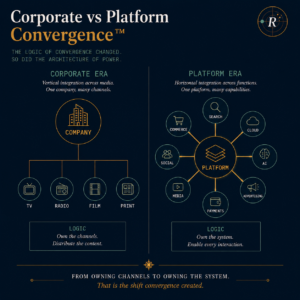
For most of the twentieth century, media systems were organized around what might be called the principle of channel specificity. Each medium had its material substrate, its regulatory regime, its professional culture, and its audience address.
Everything had its place. Each technology operated in its own orbit, never colliding with another medium. But the architecture was doing more than keeping signals apart. It was also, deliberately, keeping something else from colliding: power.
This separation was never merely technological. It was political-economic. The regulatory frameworks governing each medium were designed in part to prevent monopolistic control across all channels simultaneously.
The Federal Communications Commission in the United States, the BBC model in Britain, state broadcasting authorities across Europe — all operated from a premise that the management of a channel was a public trust, not simply a property right. The separation of press from broadcasting, of common carrier telephony from editorial media, was a structural guarantee that no single entity could simultaneously control the message and the medium.
That guarantee began to collapse in the 1980s, under the pressure of deregulation, digitization, and a political philosophy that reframed concentration as efficiency.
Negroponte predicted liberation. Instead, concentration arrived. The bit was universal but the platform that carried it wasn’t.
The first meaningful sense in which media converged was technical. Digitization, i.e., the translation of all signals into binary code, dissolved the material specificity that had kept media separate. Text, sound, image, and video, which had previously required distinct physical substrates and transmission technologies, became, at the level of the bit, identical.
This was not merely a convenience. It was a structural transformation with profound consequences.
Nicholas Negroponte captured the intuition in Being Digital (1995) with his distinction between atoms and bits: the old media economy moved atoms (newspapers, cassettes, reels of film), while the new one would move bits (weightless, infinitely reproducible, globally transmissible at near-zero marginal cost).
Negroponte was largely correct about the technical fact and largely wrong about the political consequence. He imagined digitization as liberation, i.e., the democratization of content creation and distribution, the end of the broadcast era’s artificial scarcity.
What followed was something more ambivalent: the liberation of content creation alongside the intensified concentration of distribution infrastructure.
The mechanism was the network effect. Because digital networks become more valuable as more people use them, early movers in any digital platform market face winner-take-all dynamics. The platform that reaches critical mass first can leverage that mass to attract more users, more content, and more advertisers in a self-reinforcing loop.
Henry Jenkins, writing in Convergence Culture (2006), offered a more nuanced account. For Jenkins, convergence was not a technological endpoint but a cultural process — ongoing, contested, and participatory. He distinguished between corporate convergence (the concentration of media ownership) and grassroots convergence (the creative recombination of media content by audiences).
In Jenkins’s framework, convergence created new spaces for participatory culture: fan communities, remix practices, transmedia storytelling. The audience was not merely receiving; it was producing, transforming, and distributing.
Jenkins’s analysis was generative and importantly corrective to purely top-down accounts. But in retrospect, it underestimated the speed and completeness with which platforms would capture the value of participatory culture and internalize it within corporate structures.
The fan wiki, the remix video, and the user review were indeed forms of cultural labor, but they were also, increasingly, forms of unpaid data generation feeding algorithmic systems owned by the same corporations whose content was being remixed.
Deregulation was not the inevitable consequence of digitization. It was a political choice and it determined who would own the converged landscape that followed.
Between the technical possibility of convergence and its political-economic realization, there was a crucial moment of regulatory decision. The Telecommunications Act of 1996 in the United States, and similar deregulatory initiatives across Europe and the Global South, dismantled the legal architecture that had kept media, telephony, and broadcasting separate.
The Act’s premise was that convergence was technologically inevitable, and that regulatory barriers to cross-media ownership were therefore artificial distortions of market efficiency.
The consequences were immediate and significant.
A wave of mergers followed: Time Warner and CNN, Viacom and CBS, AOL and Time Warner (the spectacular failure that became a case study in convergence hubris).
These mergers were premised on the theory of synergy that content libraries plus distribution networks plus audience data would compound into dominant market positions. Some succeeded; many did not. But the structural shift was irreversible.
The principle of channel separation, already weakened, was effectively abandoned as a regulatory commitment.
What the deregulatory moment created was not a competitive market but an oligopoly of vertically integrated media conglomerates… entities that owned content, distribution, and in some cases the physical infrastructure of cable and satellite.
The promise was consumer choice and abundance; the result was concentration and the increasing subordination of editorial and creative decisions to financial logic.
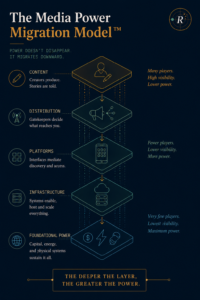
This is not a nostalgic argument for the old regulatory regime, which carried its own distortions, exclusions, and power asymmetries. It is an argument that the manner in which convergence was institutionalized — through deregulation rather than re-regulation, through property rights rather than public interest obligations — determined a great deal about the shape of the media landscape that followed.
The old conglomerates converged production. The platforms converged consumption, and with it, human attention and behavioral data into a unified prediction market.
The first wave of corporate convergence, the mega-mergers of the 1990s and early 2000s, was largely a story about traditional media industries attempting to consolidate before the digital tide overwhelmed them.
The second wave was different in kind. It was driven not by legacy media companies but by technology platforms whose core competency was not content production but infrastructure management: Google, Facebook, Amazon, Apple, and later Netflix, Spotify, and their successors.
These platforms achieved convergence through a different mechanism. Rather than acquiring existing content libraries and distribution networks, they built new infrastructure that made existing industry boundaries irrelevant.
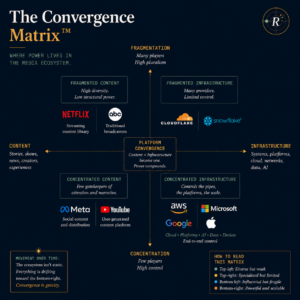
The platform’s distinctive contribution to media convergence was the aggregation of attention across media types. Where the old conglomerates converged content production, the platforms converged content consumption — the site where the audience actually spent its time and, crucially, generated its data.
Shoshana Zuboff’s framework of surveillance capitalism captures this precisely. The extraction of behavioral data from media consumption is not an incidental feature of platform business models but their constitutive logic.
What the platform converges is not merely media channels but human attention and behavior into a unified data stream that can be fed into prediction markets. The convergence, from this perspective, is less about the merging of television and the internet than about the merging of media consumption and behavioral surveillance into a single operation.
When Amazon Web Services hosts its own competitors’ streaming content, the question of media is no longer separable from the question of logistics, energy, and computation.
The most recent phase of media convergence involves a shift that even critical platform studies sometimes underestimates: the convergence of cultural infrastructure with physical infrastructure. This is the moment at which the question of media is no longer separable from questions of logistics, energy, computation, and the built environment.
Amazon Web Services hosts a significant proportion of the global internet’s content, including the streaming services of media companies that compete with Amazon’s own Prime Video.
The cloud infrastructure that enables media convergence is itself owned by the same platform conglomerates that are converging at the content layer.
The data centers that process media consumption are physical installations with enormous energy requirements, geographic concentrations, and labor relations of their own.
The undersea cables that carry global media traffic are partly owned by Google, Facebook, and Microsoft.
This convergence of cultural and physical infrastructure produces what might be called infrastructural symbolic interactionism: the conditions under which meaning is made are increasingly indistinguishable from the conditions under which logistics, computation, and energy are managed.
The culture and the material have converged not in the utopian sense of media liberation but in the sense that cultural production is now entirely dependent on, and in key respects subordinate to, the infrastructural choices of a small number of technology corporations.
Convergence has not produced a single global media system. It has produced a dialectic, ongoing and unresolved, between centralizing infrastructure and fragmenting culture.
Against this narrative of convergence as concentration, it is necessary to acknowledge the genuine counterforces.
Media convergence has not produced a single global media system, rather it has produced a dialectic between convergence pressures and fragmentation tendencies that is ongoing and unresolved.

The first counterforce is platform nationalism: the assertion of digital sovereignty by states unwilling to accept American (or increasingly Chinese) platform dominance.
The Great Firewall of China is the most complete example, but versions of platform nationalism appear across the Global South, in the European Union’s regulatory interventions (GDPR, the Digital Markets Act), and in the growing number of countries that have demanded data localization and content regulation from global platforms.
The second counterforce is audience fragmentation. The proliferation of streaming services, podcasts, newsletters, and social platforms has in one sense deepened convergence (all through the internet) while in another sense produced unprecedented fragmentation of the audience.
The shared cultural text, the broadcast moment when a majority of a nation watched the same program simultaneously, has largely dissolved. In its place is a landscape of niches, each with its own algorithmic feed, its own community norms, its own canon of reference.
This fragmentation creates new possibilities for minority voices and alternative framings, but it also produces the epistemological balkanization that Eli Pariser presciently identified with the concept of the filter bubble.
The third counterforce is technological refusal: the growing practices of platform exit, encryption use, and analog media revival among users who experience the costs of platform convergence as outweighing its benefits.
The Attention Depletion Economy, i.e., the systematic exhaustion of human cognitive and affective capacity through perpetual stimulation, may be approaching the limits of what audiences will bear.
Technology has converged. Ownership has concentrated. Power has converged most completely across media, data, logistics, and finance simultaneously, in ways no single prior theory can fully describe.
It is worth, at this stage of the argument, asking what exactly has converged in the evolution of media convergence. The answer is more complicated than either the techno-optimist or the political economy critic typically acknowledges.
Technology has genuinely converged: the digital bit is the universal substrate, and the smartphone is the universal interface.
Ownership has concentrated: a handful of platform conglomerates now control the distribution infrastructure of most of the world’s media.
Audiences have both converged (onto platform interfaces) and fragmented (across countless content niches).
The convergence is infrastructural; the fragmentation is cultural. Regulatory philosophy has shifted, unevenly, from acceptance of platform self-governance toward renewed public interest intervention — but without yet producing a coherent alternative framework.
Power, finally, has converged in ways that exceed the analysis of any single discipline.
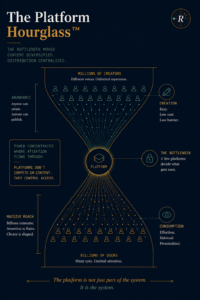
Media power, data power, logistical power, and financial power have become mutually reinforcing in the platform form, producing concentrations of structural influence that earlier theories of media power, based on ownership of content, control of editorial agenda, or even surveillance, are individually insufficient to describe.
The task is not theoretical synthesis at the expense of rigor. It is a media theory willing to follow convergence to where it has actually gone and to name the political choices that put it there.
The story that started in 2001 has outgrown the frameworks used to understand and conceptualize its core idea. Consequently, the question of what kind of theoretical framework is adequate to this history arises in uncertainty.
The tools developed in the mid-twentieth century like Frankfurt School critical theory, structuralist semiology, and political economy of communication, each illuminate aspects of convergence but were not designed for the specific configuration it has produced.
What convergence theory needs is a framework that can operate simultaneously across three registers: the infrastructural (who owns the pipes and at what cost), the algorithmic (how systems of automated decision-making distribute visibility, attention, and value), and the symbolic (how meaning is made, contested, and naturalized within these infrastructural and algorithmic conditions).
These registers are mutually conditioning: the symbolic cannot be read without the algorithmic; the algorithmic cannot be assessed without the infrastructural; the infrastructural is organized in the service of symbolic and economic goals.
This is not a call for theoretical synthesis at the expense of rigor.
It is a call to fully bake a half-baked story, a call for a media theory willing to follow convergence to where it has actually gone: into the cloud, into the data center, into the behavioral profile, into the logistics network — without losing sight of the fact that all of this infrastructure ultimately serves, and is legitimated by, the circulation of meaning among human beings who remain, despite everything, the irreducible subject of media inquiry.
Every account of media convergence eventually arrives at the same question, posed differently across different theoretical traditions: who decides? Who decides what content is amplified and what is suppressed? Who decides what infrastructure is built and where? Who decides what data is collected, for how long, and for whose purposes? Who decides what counts as a platform and therefore as infrastructure, subject to common carrier obligations, rather than a media company with editorial discretion? These are political questions dressed in technical language. The achievement of media convergence — the seamless integration of communication, computation, and culture into a single experiential flow — has been to make its own political conditions invisible. The interface is smooth; the infrastructure is buried; the decision architectures are proprietary; the power is distributed across so many technical layers that accountability becomes difficult to locate. The task of media theory, and of the critical media literacy that theory should enable, is to keep these questions visible, to refuse the naturalization of convergent infrastructure as technological destiny rather than political choice, and to insist that the conditions under which meaning circulates remain, always, a matter of public concern and democratic contestation. Beyond the interface. Between the nodes. That is where the real convergence has happened and where the real argument must begin.
Media convergence refers to the merging of previously distinct media systems like print, broadcasting, telephony, and computing, into a unified digital infrastructure. It is both a technical process, driven by digitization, and a political-economic one, driven by deregulation and platform concentration. Properly understood, media convergence describes the restructuring of power across the entire chain of symbolic production: who owns the conditions under which culture is made and distributed.
Three interacting forces produced media convergence: technological (digitization dissolving the material specificity of different media), regulatory (the Telecommunications Act of 1996 dismantling legal barriers between press, broadcasting, and telephony), and economic (network effects and winner-take-all platform dynamics concentrating ownership across previously separate media sectors).
The distinction was developed by Henry Jenkins in Convergence Culture (2006). Corporate convergence refers to the concentration of media ownership i.e., the horizontal and vertical integration of content, distribution, and infrastructure under a small number of conglomerates. Grassroots convergence refers to the participatory recombination of media content by audiences: fan wikis, remix videos, transmedia storytelling. Platforms subsequently captured the value of grassroots convergence, internalizing participatory labor as unpaid data generation within corporate structures.
Platform convergence describes the second major wave of media convergence, driven by technology platforms like Google, Facebook, Amazon, Apple that built infrastructure making existing industry boundaries irrelevant by owning the interface through which audiences consumed all media simultaneously. Rather than acquiring content libraries, these platforms aggregated attention and behavioral data across media types, converging human behavior into a unified prediction market — the defining feature of surveillance capitalism as a media system.
Shoshana Zuboff’s concept of surveillance capitalism illuminates how platform convergence transformed media consumption into behavioral data extraction. As media channels converged onto platform interfaces, the behavioral traces of that consumption became raw material for algorithmic prediction systems. The convergence of media was simultaneously a convergence of audience behavior into a unified data stream. It means the real object of platform convergence is not content or attention but the behavioral profile feeding advertising prediction markets.
The Telecommunications Act of 1996 was the landmark U.S. deregulatory legislation that dismantled the legal architecture separating media, telephony, and broadcasting. It triggered mega-mergers, including AOL–Time Warner, Viacom–CBS, and effectively abandoned the principle that channel separation served public interest. It represents the political-economic hinge on which technical convergence became institutional reality, determining that convergence would be institutionalized through property rights rather than public interest obligations.
Infrastructural convergence is the deepest phase of media convergence, in which cultural and physical infrastructure become inseparable. Amazon Web Services hosts competitors’ streaming content. Undersea cables are partly owned by Google, Facebook, and Microsoft. Data centers processing media consumption require enormous energy and occupy specific geographies. At this level, media convergence is no longer simply about content or distribution. It concerns the material conditions of computation, logistics, and energy that make all cultural exchange possible.
Key theorists include: Harold Innis (media bias and channel specificity), Nicholas Negroponte (atoms vs. bits; Being Digital, 1995), Henry Jenkins (corporate vs. grassroots convergence; Convergence Culture, 2006), Shoshana Zuboff (surveillance capitalism and behavioral data extraction), Eli Pariser (filter bubble and audience fragmentation), and Dallas Smythe, Vincent Mosco, and Dwayne Winseck in the political economy tradition (media infrastructure ownership and power).
Find hidden frames and structures where the dots and nodes cease to be objects.
Response time. We reply within 48 hours. No automated responses — a real person reads and responds.
While you wait. Explore the nodes — Decode, Roots, Dark Matter, The Loop, and Meta are all live.
Stay in the loop. Subscribe to The Dispatch and get notified the moment the next essay goes live.
Every new essay arrives in your inbox before it reaches social media or the feed.
Long-form structural analysis that teaches you to read media — not just react to it.
One email per essay. No digests, no roundups, no promotions. Unsubscribe in one click.